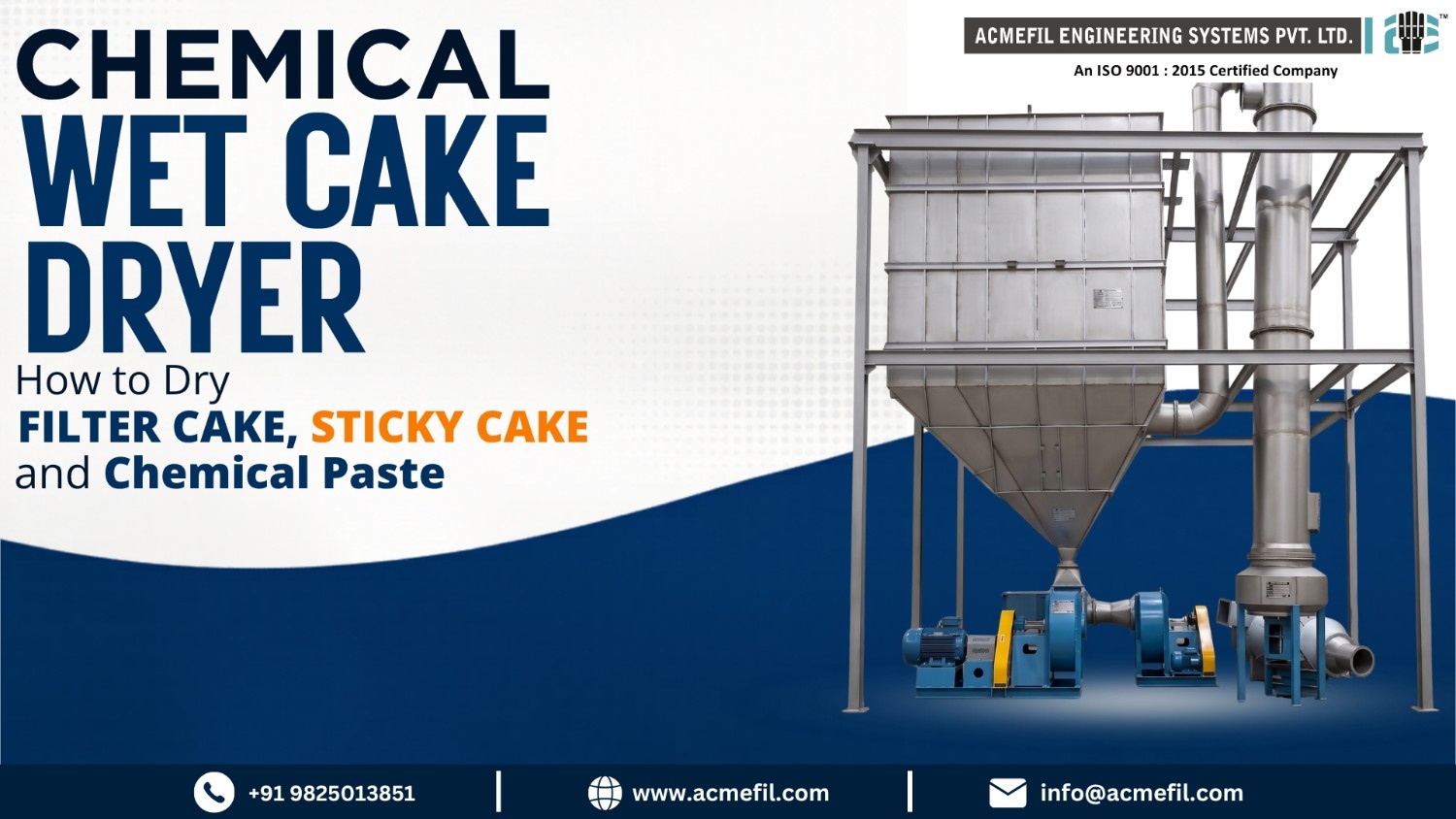
A chemical wet cake dryer is used to convert filter press cake, centrifuge cake, sticky chemical paste, or high-moisture sludge into dry powder or low-moisture solid. For many chemical wet cakes, a spin flash dryer is one of the most practical choices because it breaks lumps at the feed point and dries the fragments in a hot air stream with short residence time.
This matters in dyes, pigments, agrochemicals, inorganic chemicals and chemical intermediates where the feed is not free-flowing. If the dryer cannot disperse the wet cake properly, it will choke, dry unevenly, or produce inconsistent final moisture.
What Is a Chemical Wet Cake Dryer?
A chemical wet cake dryer is industrial drying equipment designed for wet solids discharged from a filter press, centrifuge, nutsche filter, or similar solid-liquid separation system.
The feed usually looks like a cake, paste, lump, sludge, or damp solid mass. It may contain surface moisture, bound moisture, solvent, salts, pigments, dyes, intermediates, or fine chemical particles.
In practical plant language, chemical wet cake drying means:
- Breaking the cake into smaller particles
- Exposing those particles to controlled hot air or heated surfaces
- Removing moisture without burning, degrading, or contaminating the product
- Separating the dried powder from the air stream
- Collecting the final material in a usable form for packing or further processing
For chemical plants, the dryer is not selected only by capacity. It must be selected by feed behavior.
A wet cake with 35% moisture but good friability behaves very differently from a 35% moisture cake that is sticky, gelatinous, thixotropic, or adhesive.
Why Chemical Wet Cake Is Difficult to Dry
Chemical wet cake is rarely uniform. On paper, the material may look simple because the process sheet only says “filter cake moisture 30 to 45%.” In actual operation, the cake may change every batch.
I usually look at these practical problems before recommending any dryer:
| Wet Cake Problem | What Happens in the Dryer | Why It Matters |
|---|---|---|
| Sticky or pasty feed | Cake sticks to screw, chamber wall, or duct | Causes choking and shutdowns |
| Large lumps | Moisture stays trapped inside the lump | Final powder moisture becomes uneven |
| Fine particles | Dust load increases in cyclone and bag filter | Needs proper separation and filtration |
| Heat-sensitive product | Product can degrade if exposure is too long | Dryer residence time becomes critical |
| Abrasive chemical solids | Wear increases on disintegrator and ducts | MOC and wear protection must be checked |
| Corrosive material | Contact parts may corrode | MOC selection becomes important |
| Variable moisture | Outlet moisture fluctuates | Feed control and trial data become important |
This is why a standard dryer selection based only on kilograms per hour is risky.
A chemical wet cake dryer must match the physical behavior of the cake, not only the chemistry of the product.
Why a Standard Flash Dryer Often Fails on Sticky Wet Cake
A standard flash dryer works well when the material is already powdery, granular, friable, or easy to disperse. It uses high-velocity hot air to dry and pneumatically convey the product to a cyclone or bag filter.
But sticky chemical wet cake is different.
If the cake enters the flash dryer as a lump or paste, hot air cannot contact enough surface area. The outside may dry, but the inside remains wet. In some cases, the material sticks near the feed zone and builds up until the system chokes.
This is where spin flash dryer working principle becomes important.
A spin flash dryer adds mechanical disintegration at the feed point. The wet cake is not expected to behave like free-flowing powder. It is broken, dispersed, and dried in the same process zone.
How a Spin Flash Chemical Wet Cake Dryer Works
In a spin flash dryer, the wet cake is normally fed through a screw feeder into the drying chamber. At the feed point, a disintegrator breaks the material into smaller fragments. Hot air enters the chamber and immediately contacts the broken wet cake.
The process can be understood in six stages:
- Wet cake enters from the filter press, centrifuge, or collection hopper.
- A variable speed feed screw controls the feed rate.
- A lump breaker or disintegrator breaks sticky lumps.
- Hot air contacts the dispersed wet solids.
- Moisture evaporates rapidly because the exposed surface area increases.
- Dried powder travels with air to the cyclone and bag filter for separation.
This is why spin flash drying is useful for filter cakes, dye intermediates, pigment cakes, agrochemical wet cakes and high-viscosity chemical sludge.
The dryer is doing two jobs at the same time. It is size-reducing the wet material and drying it.
Chemical Wet Cake Dryer Selection by Feed Type
Not every wet cake should go to a spin flash dryer. The right answer depends on feed consistency, stickiness, target product form, heat sensitivity and drying load.
| Feed Type | Likely Dryer Option | Practical Selection Note |
|---|---|---|
| Sticky filter cake | Spin flash dryer | Good option when cake needs disintegration before drying |
| Gelatinous chemical paste | Spin flash dryer, trial required | Feed screw and disintegrator design are critical |
| Free-flowing centrifuge cake | Flash dryer or fluid bed dryer | Depends on particle size and final moisture |
| Fine pigment wet cake | Spin flash dryer | Dust collection and product recovery must be designed carefully |
| High-viscosity sludge | Spin flash dryer or sludge dryer | Depends on stickiness, ash, organics and final use |
| Heat-sensitive chemical intermediate | Spin flash dryer with controlled residence time | Trial drying is strongly recommended |
| Solvent-containing wet cake | Needs special evaluation | Safety, vapor handling and MOC must be checked before selection |
For detailed selection logic, refer to this guide on how to choose a spin flash dryer.
Where Chemical Wet Cake Dryers Are Commonly Used
Chemical wet cake drying is common in industries where filtration or centrifugation happens before final drying.
Typical applications include:
- Reactive dyes
- Disperse dyes
- Acid dyes
- Direct dyes
- Vat dyes
- Dye intermediates
- Pigments
- Agrochemical products
- Inorganic chemicals
- Chemical sludge
- Filter press discharge from chemical processing
- High-viscosity chemical paste
- Heat-sensitive chemical intermediates
In dye and pigment plants, the wet cake is often sticky and fine. That combination needs careful drying. If the dryer disperses the product poorly, final moisture and powder quality will not remain stable.
You can also review wider applications of spin flash dryers to understand where this technology fits across industries.
Key Components in a Chemical Wet Cake Spin Flash Dryer
A chemical wet cake dryer is not only a drying chamber. The complete system must be designed as one process line.
| Component | Function |
|---|---|
| Feed hopper | Receives wet cake from filter press or upstream equipment |
| Variable speed feed screw | Controls feed rate into the dryer |
| Lump breaker | Reduces large wet lumps before main drying |
| Disintegrator | Breaks and disperses sticky wet cake in the hot air stream |
| Hot air generator | Supplies controlled hot air for evaporation |
| Drying chamber | Provides contact between wet particles and hot air |
| Cyclone separator | Separates dried product from conveying air |
| Bag filter | Recovers fine powder and controls dust emission |
| Rotary airlock valve | Discharges product while controlling air leakage |
| Control panel | Controls temperatures, feed rate and operating sequence |
For chemical wet cake, the feed zone is the heart of the system. A weak feed arrangement can make even a correctly sized dryer perform badly.
Cage Mill vs Pin Mill Disintegrator
Spin flash dryers commonly use cage mill or pin mill type disintegrators depending on product behavior.
| Disintegrator Type | Where It Helps | Selection Caution |
|---|---|---|
| Cage mill type | Wet cake, pasty feed, larger lumps | Useful when aggressive breaking is needed |
| Pin mill type | Finer material, softer cakes, dispersion-focused drying | Must be checked for wear and product sensitivity |
The disintegrator should not be selected by name alone. It must be selected after checking lump size, stickiness, hardness, abrasiveness and target powder condition.
In my experience, many dryer problems start because the buyer focuses on the drying chamber but ignores the feed and disintegration zone.
Process Flow for Chemical Wet Cake Drying
A typical chemical wet cake drying line can follow this sequence:
Filter press or centrifuge discharge → wet cake collection → feed hopper → screw feeder → lump breaker or disintegrator → spin flash drying chamber → cyclone separator → bag filter → rotary airlock → dried powder collection.
This arrangement keeps the process continuous and reduces manual tray handling.
For wet cake coming directly from a filter press, the biggest advantage is reduced intermediate handling. The operator does not need to spread material manually on trays or wait for long batch drying cycles.
When designed properly, the process can convert difficult wet cake into more manageable powder with a cleaner operating environment.
What Data Is Needed Before Selecting a Chemical Wet Cake Dryer?
Before sizing a chemical wet cake dryer, the supplier should not ask only for “capacity.” Capacity without moisture and feed behavior is incomplete.
Share these details during RFQ:
| Data Required | Why It Is Needed |
|---|---|
| Wet feed rate | Defines dryer size and evaporation load |
| Initial moisture | Determines water or solvent removal requirement |
| Final moisture target | Defines outlet condition and residence time |
| Cake consistency | Tells whether feed is friable, sticky, pasty, or gelatinous |
| Bulk density | Affects feeding, conveying and collection |
| Particle size after drying | Helps select disintegrator and separator |
| Heat sensitivity | Defines safe temperature approach |
| MOC requirement | Important for corrosive or abrasive chemicals |
| Solvent presence | Requires safety and vapor handling evaluation |
| Dust behavior | Important for cyclone, bag filter and housekeeping |
| Upstream equipment | Filter press, centrifuge, nutsche filter, or other source |
| Required output form | Powder, granule, low-moisture cake, or intermediate solid |
If this information is missing, the quotation may look attractive but the plant may not perform reliably.
Why Pilot Testing Matters for Chemical Wet Cake
Chemical wet cake drying is one of the areas where pilot testing gives real value.
A lab moisture number cannot fully predict whether the cake will feed smoothly, break properly, dry evenly, or stick inside the dryer. A small trial can reveal:
- Whether the cake can be fed continuously
- Whether it breaks under disintegrator action
- Whether the final powder meets moisture target
- Whether the product degrades under heat
- Whether fines load is manageable
- Whether cyclone and bag filter design needs special attention
ACMEFIL has pilot plant facilities for product trials, including spin flash dryer trials. For difficult chemical wet cakes, I prefer trial validation before committing to full-scale design.
You can discuss product testing through the contact page or review ACMEFIL’s spin flash dryer manufacturer page for equipment-level details.
Chemical Wet Cake Dryer vs Flash Dryer vs Fluid Bed Dryer
The biggest mistake is assuming all hot air dryers work the same way.
They do not.
| Dryer Type | Best Suited For | Not Ideal For |
|---|---|---|
| Spin flash dryer | Sticky wet cake, filter cake, paste, high-viscosity sludge | Materials needing long, gentle residence without size reduction |
| Flash dryer | Free-flowing powders, granular solids, centrifuged cakes with surface moisture | Sticky lumps, gelatinous cake, heavy paste |
| Fluid bed dryer | Granules or particles that fluidize well | Very sticky wet cake or paste |
| Tray dryer | Small batches, simple drying, low automation needs | Large continuous production, labor-sensitive operation |
| Paddle dryer | Sludge and certain pastes requiring indirect heating | Applications needing rapid hot air dispersion into powder |
For a deeper comparison, read spin flash dryers vs other drying technologies.
Advantages of Spin Flash Drying for Chemical Wet Cake
When the material is suitable, a spin flash dryer gives several practical advantages for chemical wet cake drying:
- Direct feeding of wet cake from upstream filtration
- Mechanical breaking of lumps at the feed point
- Short residence time compared with many conventional systems
- Better hot air contact because the cake is dispersed
- Continuous operation instead of manual batch tray handling
- Cyclone and bag filter based powder recovery
- Cleaner plant operation when dust collection is designed properly
- Useful for heat-sensitive products where long exposure is undesirable
- Suitable for many dye, pigment, agrochemical and chemical intermediate wet cakes
The advantage is not only drying speed. The real advantage is controlled dispersion of difficult wet cake.
Limitations and Cautions
A spin flash chemical wet cake dryer is powerful, but it is not universal.
Do not finalize the system without checking these points:
- If the cake is too sticky, feed screw design becomes critical.
- If the product is highly abrasive, wear protection may be required.
- If the product is corrosive, MOC must be selected carefully.
- If solvent is present, safety design must be reviewed separately.
- If the final product must retain a specific particle shape, aggressive disintegration may not be suitable.
- If the product is extremely heat-sensitive, temperature profile must be validated.
- If the powder is very fine, bag filter sizing becomes important.
This is why a good chemical wet cake dryer proposal should ask questions before quoting.
Common RFQ Mistakes Buyers Should Avoid
Many chemical companies send very short RFQs. They mention only the product name and capacity. That is not enough.
Avoid these mistakes:
Asking only for price per kg/hr
Dryer price depends on evaporation load, MOC, dust collection, controls, heating system, product recovery and automation. A low quote without the right scope can become expensive later.
Not sharing wet cake photos or samples
A photo or small sample often tells more than a line in the data sheet. The difference between crumbly cake and sticky paste is critical.
Ignoring bag filter and dust recovery
Fine chemical powders need proper product recovery. The dryer is incomplete without cyclone, bag filter and discharge arrangement.
For support equipment context, you can review ACMEFIL’s bag filter page.
Assuming standard flash dryer is enough
If the cake is sticky, a standard flash dryer may struggle. The wet cake must be dispersed before hot air can dry it uniformly.
Skipping trials for difficult products
For known materials, prior experience may help. For new or sensitive products, pilot drying reduces risk.
When Is a Chemical Wet Cake Suitable for Spin Flash Drying?
A chemical wet cake is usually suitable for spin flash drying when:
- It comes from a filter press or centrifuge
- It can be mechanically broken into smaller fragments
- It needs to become powder or low-moisture solid
- It can tolerate short contact with hot air
- It has surface or removable moisture
- It is sticky enough to need disintegration but not so adhesive that it cannot be fed
- The final product can accept some particle size reduction
It may need another drying method if:
- The material melts or softens at low temperature
- The material forms elastic balls instead of breaking
- The product requires intact crystals or granules
- The feed contains hazardous solvent without proper safety design
- The product requires very long controlled residence time
A trial gives the clearest answer.
Chemical Wet Cake Dryer for Sludge-Type Feed
Some chemical wet cakes behave closer to sludge than powder. This is common in ETP sludge, process sludge, pigment sludge and high-viscosity chemical residue.
For these applications, the dryer selection must consider:
- Organic and inorganic content
- Stickiness
- Ash content
- Final disposal or reuse requirement
- Odor and vapor handling
- Corrosive behavior
- Dust generation after drying
- Upstream dewatering method
You can read more about spin flash dryer for sludge drying for sludge-specific selection logic.
ACMEFIL also has a dedicated sludge dryer support page for broader sludge drying equipment context.
Practical Buyer Checklist
Before you speak with a chemical wet cake dryer manufacturer, prepare this checklist:
| Checklist Item | Ready? |
|---|---|
| Product name and process source | |
| Wet cake moisture percentage | |
| Required final moisture | |
| Wet feed rate per hour | |
| Operating hours per day | |
| Feed source, filter press or centrifuge | |
| Cake photo or sample | |
| Heat sensitivity data | |
| MOC preference | |
| Solvent or water-based feed confirmation | |
| Dust and safety notes | |
| Available fuel or heating source | |
| Space and layout constraints | |
| Desired automation level | |
| Trial requirement |
This checklist helps the supplier give a technically serious proposal instead of a generic budget quote.
Conclusion
A chemical wet cake dryer should be selected by feed behavior, not only by product name or hourly capacity. Sticky filter cake, gelatinous paste, pigment cake, dye intermediate cake and high-viscosity chemical sludge need a dryer that can break, disperse and dry the material consistently.
For many chemical wet cake applications, a spin flash dryer is a strong option because the disintegrator works at the feed point and improves hot air contact with the wet material. But the final selection should still be based on moisture load, stickiness, heat sensitivity, MOC, dust behavior and pilot trial results.
If your plant is struggling with filter press cake, sticky chemical paste, pigment cake, dyestuff cake, or chemical sludge, share the wet cake properties and drying target with the engineering team. A trial or technical review can prevent the most common dryer selection mistakes before you invest in full-scale equipment.
FAQs
What is a chemical wet cake dryer?
A chemical wet cake dryer is industrial drying equipment used to remove moisture from filter press cake, centrifuge cake, sticky chemical paste, pigment cake, dyestuff cake, agrochemical cake, inorganic chemical cake, or chemical sludge. The goal is to convert the wet cake into dry powder or low-moisture solid.
Which dryer is suitable for sticky chemical wet cake?
A spin flash dryer is often suitable for sticky chemical wet cake because it uses a disintegrator to break the cake at the feed point before drying it in hot air. However, final selection depends on stickiness, heat sensitivity, moisture content, MOC and target final product form.
Can a flash dryer dry chemical wet cake?
A standard flash dryer can dry free-flowing powders or friable centrifuged cakes, but it may fail on sticky, pasty, gelatinous, or lumpy wet cake. For difficult wet cake, a spin flash dryer is usually more suitable because it combines disintegration and drying.
What data is required to size a chemical wet cake dryer?
The key data includes wet feed rate, initial moisture, final moisture target, cake consistency, product temperature sensitivity, bulk density, particle behavior, MOC requirement, solvent presence, dust behavior and operating hours per day.
Is pilot testing necessary for chemical wet cake drying?
Pilot testing is strongly recommended for sticky, heat-sensitive, high-value, or new chemical wet cake products. It confirms feedability, drying behavior, final moisture, powder quality, dust load and whether spin flash drying is suitable before full-scale investment.

Siddharth Nair is the Technical Director at Acmefil Engineering Systems Pvt. Ltd., an ISO 9001:2015 certified manufacturer of industrial drying and evaporation systems headquartered in Ahmedabad, Gujarat, he has led technical evaluation, application engineering and customer solution design for spray dryers, multi-effect evaporators, agitated thin film dryers, spin flash dryers and zero liquid discharge systems.