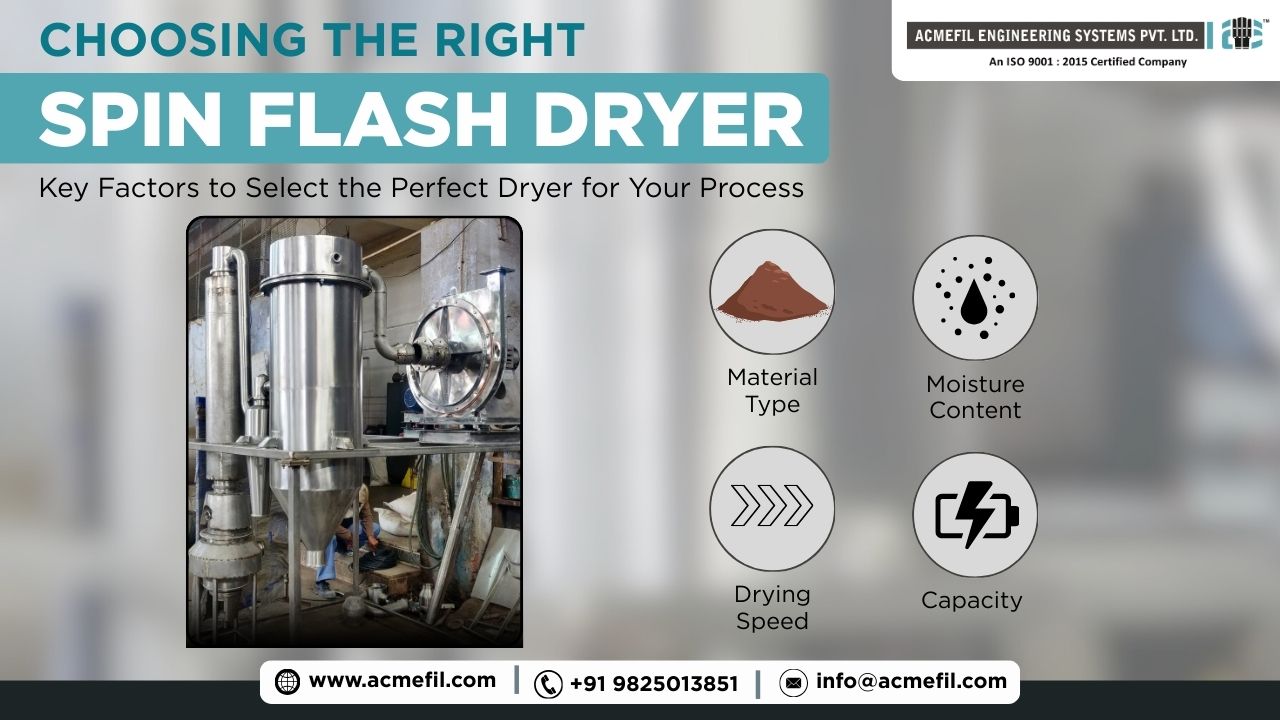
Choose a spin flash dryer when your feed is wet cake, filter cake, slimy paste, gelatinous material or high-viscosity sludge that cannot disperse properly in a standard flash dryer. The right selection depends on feed behaviour, moisture load, disintegrator design, feed screw control, heat sensitivity, dust separation, material of construction and pilot trial results.
In my experience, many drying problems start before the dryer is ordered. The buyer compares dryer prices, but does not first define the feed. For a spin flash dryer, the feed is the main design driver.
A good selection process should answer one practical question: will this material break, disperse, dry and discharge cleanly without choking the system?
What Is a Spin Flash Dryer?
A spin flash dryer is an industrial drying system designed to dry wet cakes, pastes and sludge by combining mechanical disintegration with hot air drying.
The wet feed enters near the drying chamber base. A rotating disintegrator breaks lumps and spreads the material into smaller fragments. Hot air contacts the exposed surface area. The dried powder is carried upward with the air stream and separated through cyclone and bag filter systems.
For the basic mechanism, read this detailed guide on the spin flash dryer working principle.
A standard flash dryer works better with free-flowing granular or powdery materials. A spin flash dryer is selected when the material needs mechanical breakup before it can dry properly. That is why it is commonly considered for filter press discharge, dye intermediates, pigments, agrochemicals and high-viscosity sludge.
Start With the Feed, Not the Dryer Price
Before asking for a quotation, define the material clearly. A spin flash dryer is not selected only by kg/hr feed rate. Two feeds with the same wet feed rate can behave very differently inside the chamber.
Ask these questions first:
- Is the feed a wet cake, paste, slurry, sticky sludge or semi-dry powder?
- Is it thixotropic, gelatinous, fibrous, crystalline or sandy?
- Does it form hard lumps after filter press discharge?
- Does it smear on metal surfaces?
- Does it soften, melt, char or degrade under heat?
- What is the initial moisture and final target moisture?
- Does the dried product need to remain free-flowing?
If the material is already free-flowing and only has surface moisture, a flash dryer may be more suitable. If the material is sticky, lumpy or paste-like, the spin flash dryer becomes a stronger option.
Spin Flash Dryer Selection Checklist
| Selection Factor | What to Check | Why It Matters | Red Flag |
|---|---|---|---|
| Feed form | Wet cake, paste, gelatinous mass, sludge or powder | Determines whether spin flash drying is suitable | Vendor quotes without asking feed behaviour |
| Moisture load | Initial moisture, final moisture, wet feed rate | Drives evaporation duty and hot air requirement | Capacity quoted only in kg/hr wet feed |
| Disintegrator type | Cage mill or pin mill type | Breaks feed at entry and prevents large wet lumps | No explanation of disintegrator selection |
| Feed screw system | Variable speed feed screw and lump breaker | Controls feed rate and reduces choking risk | Fixed feed system for sticky material |
| Heat sensitivity | Product degradation, melting, colour change | Determines temperature limits and residence strategy | “High temperature is fine” without trial |
| Product separation | Cyclone, bag filter, rotary valve | Affects product recovery and dust handling | No dust load or filtration discussion |
| MOC | SS, MS, SS contact parts, corrosion allowance | Depends on pH, salts, solvents, hygiene and product purity | MOC selected only by budget |
| Pilot trial | Trial on actual material | Confirms drying behaviour before full-scale design | Supplier refuses trial for uncertain feed |
| Maintenance access | Disintegrator, feed screw, chamber cleaning | Important for sticky and abrasive feeds | No access plan for cleaning and inspection |
| Utility scope | Hot air generator, blower, ducting, controls | Impacts installed cost and operating reliability | Dryer quoted without utility boundaries |
Check Whether Your Feed Really Needs Spin Flash Drying
A spin flash dryer is usually worth evaluating when a simple pneumatic flash dryer cannot disperse the feed.
Typical suitable feeds include:
- Filter cakes from dye intermediates
- Reactive dyes and dye intermediates
- Pigment cakes
- Agrochemical wet cakes
- High-viscosity sludge
- Sticky paste-like chemical intermediates
- Gelatinous materials
- Filter press discharge that forms lumps
For sludge-specific selection, see this guide on spin flash dryer for sludge drying.
A spin flash dryer may not be the first choice when the product is very coarse, requires long residence time, needs very gentle fluidization or has strict particle-size morphology requirements. In those cases, compare it with other drying technologies before final selection. This comparison of spin flash dryers vs other drying technologies can help you shortlist the right system.
Calculate Water Evaporation Load Correctly
Do not select a spin flash dryer only by wet feed capacity. The real drying duty is water evaporation.
Use this logic:
Dry solids = Wet feed rate × (1 – initial moisture fraction)
Final product rate = Dry solids ÷ (1 – final moisture fraction)
Water to evaporate = Wet feed rate – final product rate
Example:
If wet feed is 500 kg/hr at 40% moisture and target final moisture is 5%:
- Dry solids = 500 × 0.60 = 300 kg/hr
- Final product rate = 300 ÷ 0.95 = 315.8 kg/hr
- Water to evaporate = 500 – 315.8 = 184.2 kg/hr
That 184.2 kg/hr water evaporation duty is more important than the 500 kg/hr wet feed number.
This is where many RFQs become weak. A buyer writes “500 kg/hr spin flash dryer required” but does not mention initial moisture, final moisture, bulk density or feed consistency. The quote becomes approximate, and the real issue appears during commissioning.
Confirm the Disintegrator Design
The disintegrator is the heart of a spin flash dryer. It breaks the wet feed at the point where hot air contact begins.
ACMEFIL’s spin flash dryer range includes cage mill type and pin mill type disintegrator options. The correct choice depends on how the material breaks, how sticky it is, how abrasive it is and what final powder characteristics are expected.
Do not accept a generic answer here. Ask the supplier:
- Why are you selecting cage mill or pin mill for this material?
- What feed lump size can the system handle?
- What happens if the filter cake comes with uneven lumps?
- How will the disintegrator handle sticky or gelatinous feed?
- How easy is it to inspect and maintain the disintegrator?
- What parts are expected to wear faster if the product is abrasive?
For deeper system understanding, read design and operation inside spin flash dryers.
Give Equal Importance to the Feed Screw
In sticky-feed applications, the feed screw is not a small accessory. It controls how steadily the material enters the dryer.
A variable speed feed screw helps match feed rate with drying capacity. A lump breaker helps prevent large agglomerates from entering the chamber suddenly. This matters because uneven feeding can cause choking, wet discharge, unstable outlet temperature and inconsistent final moisture.
A properly selected spin flash dryer should not depend on operators manually forcing wet cake into the system. The feed arrangement should be designed around the actual filter press discharge condition.
Evaluate Heat Sensitivity Before Finalizing Temperature
Spin flash dryers use hot air, but the product residence time is short. This can help with certain heat-sensitive products, provided the design is validated.
Still, do not assume every heat-sensitive material is automatically safe. Some products may darken, soften, oxidize or degrade depending on temperature and exposure. Dyes, pigments, agrochemicals and pharmaceutical intermediates can behave differently even when the moisture percentage looks similar.
Ask for:
- Maximum allowable product temperature
- Expected inlet and outlet air temperature range
- Colour change risk
- Active ingredient stability, if applicable
- Product degradation limits
- Trial results on actual material
The safest route is a pilot plant trial before full-scale procurement, especially when the feed is new, sticky, expensive or quality-sensitive.
Check Air Handling and Product Separation
Drying is only one part of the system. The air must carry the dried powder and then separate it efficiently.
A complete spin flash drying system normally needs:
- Hot air generation
- Air distribution
- Drying chamber
- Disintegrator
- Feed screw and lump breaker
- Cyclone separator
- Bag filter or dust collection system
- Rotary air lock valve
- Exhaust air handling
- Controls and instrumentation
If the product is fine, dusty or valuable, cyclone and bag filter design becomes commercially important. Poor separation can increase product loss, housekeeping problems and dust exposure.
A clean operating environment also depends on proper sealing, air balance and discharge design. This is especially important for dyes, pigments and chemical powders.
Select Material of Construction Based on Product Chemistry
Material of construction should not be selected only to reduce capital cost. For chemical and dye industry applications, product chemistry can affect corrosion, contamination and maintenance.
Check:
- pH
- Chlorides and salts
- Abrasiveness
- Solvent traces
- Product purity requirements
- Washing and cleaning procedure
- Operating temperature
- Contact and non-contact parts
For many industrial chemical applications, the final MOC decision should be made after reviewing the product data sheet and trial behaviour. If the supplier does not ask for these details, the selection is not complete.
Match the Dryer With the Full Process Line
A spin flash dryer does not work alone. It sits inside a process line.
Before ordering, check upstream and downstream equipment:
- Filter press or centrifuge discharge condition
- Feed storage and transfer method
- Manual or automatic feeding requirement
- Hot air generator fuel availability
- Product conveying and packing
- Dust collection
- Utility load
- Floor space and height
- Operator access
- Maintenance access
- Safety and instrumentation
You can also review spin flash drying best practices for operation to understand how design decisions affect day-to-day running.
For complete engineering scope, ACMEFIL’s design and engineering support page is a useful reference.
When Should You Run a Pilot Trial?
Run a pilot trial when the feed is sticky, gelatinous, heat-sensitive, new to your plant, expensive, hazardous, or difficult to describe from a data sheet.
A trial helps confirm:
- Whether the material disperses properly
- Whether the disintegrator can break lumps
- Whether target final moisture is achievable
- Whether product colour or quality changes
- Whether dried powder is free-flowing
- Whether cyclone and bag filter separation is practical
- Whether the system is likely to choke
- Whether the estimated full-scale evaporation duty is realistic
ACMEFIL has an in-house pilot plant facility for spin flash dryer trials with 10 kg/hr water evaporation capacity. For uncertain materials, that trial can save a buyer from selecting the wrong dryer size or wrong drying technology.
For a broader view of applications, see applications of spin flash dryers in industries.
Common Mistakes When Choosing a Spin Flash Dryer
Mistake 1: Giving only wet feed rate
Wet feed rate alone does not define dryer size. Moisture percentage, final moisture, bulk density and drying behaviour are essential.
Mistake 2: Treating all wet cakes the same
A crystalline filter cake, sticky pigment paste and gelatinous sludge may all be called “wet cake” in an RFQ, but they do not behave the same in the dryer.
Mistake 3: Ignoring the disintegrator
If the disintegrator cannot break the feed correctly, the dryer will not perform consistently.
Mistake 4: Underestimating dust collection
Fine powder recovery, bag filter sizing and air balance affect product loss, cleanliness and maintenance.
Mistake 5: Skipping pilot testing
For difficult materials, skipping a trial may look faster at quotation stage but can create commissioning problems later.
Mistake 6: Comparing only basic dryer price
A cheaper quote may exclude hot air generator, cyclone, bag filter, controls, installation support, maintenance access or proper feed handling. Compare scope, not just price.
RFQ Data to Send Before Asking for a Quote
A serious spin flash dryer RFQ should include:
| Data Required | What to Provide |
|---|---|
| Product name | Chemical name, trade name or product family |
| Feed form | Wet cake, paste, sludge, powder or gelatinous material |
| Wet feed rate | kg/hr or kg/batch |
| Initial moisture | Percentage by weight |
| Target final moisture | Percentage by weight |
| Bulk density | Wet and dry, if available |
| Feed source | Filter press, centrifuge, reactor discharge or other source |
| Lump size | Typical and maximum lump size |
| Heat sensitivity | Maximum allowable product temperature |
| Abrasiveness | Low, medium, high or known wear concern |
| Corrosion risk | pH, salts, chlorides, solvent traces |
| Final product use | Packing, blending, further reaction or direct sale |
| Utility available | Fuel type, steam, power, compressed air |
| Dust concern | Fine powder, toxic dust, product recovery requirement |
| Trial material availability | Quantity available for pilot test |
This data helps the dryer manufacturer make a technical proposal instead of a generic price offer.
Final Selection Decision: Good Fit vs Poor Fit
| Situation | Spin Flash Dryer Fit |
|---|---|
| Filter cake from dye or pigment process | Strong fit |
| Slimy paste that chokes standard flash dryer | Strong fit |
| High-viscosity sludge needing fast drying | Strong fit |
| Gelatinous material requiring lump breaking | Strong fit |
| Free-flowing powder with only surface moisture | May not need spin flash dryer |
| Product requiring long, gentle residence time | Evaluate other dryer types |
| Feed with unknown heat sensitivity | Pilot trial required |
| Highly abrasive product | Design and wear parts need careful review |
| Product with very strict particle morphology | Trial and comparison required |
Conclusion
The best way to choose a spin flash dryer is to start from the material, not from the machine. Define the feed behaviour, moisture load, disintegrator requirement, feed screw control, heat sensitivity, dust separation and utility scope before comparing quotations.
For wet cake, slimy paste, gelatinous material and high-viscosity sludge, a properly designed spin flash dryer can solve problems that a simple flash dryer cannot handle. But the design must be proven against the actual material.
If your product is sticky, lumpy or difficult to dry, review the main spin flash dryer guide and then speak with ACMEFIL through the contact page for application-specific evaluation. For manufacturer-level details, you can also visit ACMEFIL’s spin flash dryer manufacturer page.
FAQs
How do I know if I need a spin flash dryer instead of a flash dryer?
Choose a spin flash dryer when the feed is wet cake, paste, gelatinous material or high-viscosity sludge that needs mechanical disintegration before drying. A standard flash dryer is more suitable for free-flowing powders, granules or centrifuged cakes with surface moisture.
What data is required to size a spin flash dryer?
You need wet feed rate, initial moisture, target final moisture, dry product rate, bulk density, feed form, lump size, heat sensitivity, product chemistry, utility availability and final powder requirement. For difficult feeds, trial results are strongly recommended.
Why is the disintegrator important in a spin flash dryer?
The disintegrator breaks wet lumps at the feed point so the material can expose more surface area to hot air. Without correct disintegration, sticky feed may choke, dry unevenly or leave wet lumps in the final product.
Can a spin flash dryer handle sludge?
Yes, spin flash dryers can be evaluated for high-viscosity sludge and filter cake type sludge, especially when the material needs lump breaking and short-residence hot air drying. The final decision should be based on sludge composition, moisture, stickiness and pilot trial behaviour.
Should I run a pilot trial before buying a spin flash dryer?
Yes, a pilot trial is strongly recommended when the feed is sticky, gelatinous, heat-sensitive, expensive, abrasive or new to your process. The trial confirms whether the material disperses, dries and separates properly before full-scale investment.

Siddharth Nair is the Technical Director at Acmefil Engineering Systems Pvt. Ltd., an ISO 9001:2015 certified manufacturer of industrial drying and evaporation systems headquartered in Ahmedabad, Gujarat, he has led technical evaluation, application engineering and customer solution design for spray dryers, multi-effect evaporators, agitated thin film dryers, spin flash dryers and zero liquid discharge systems.