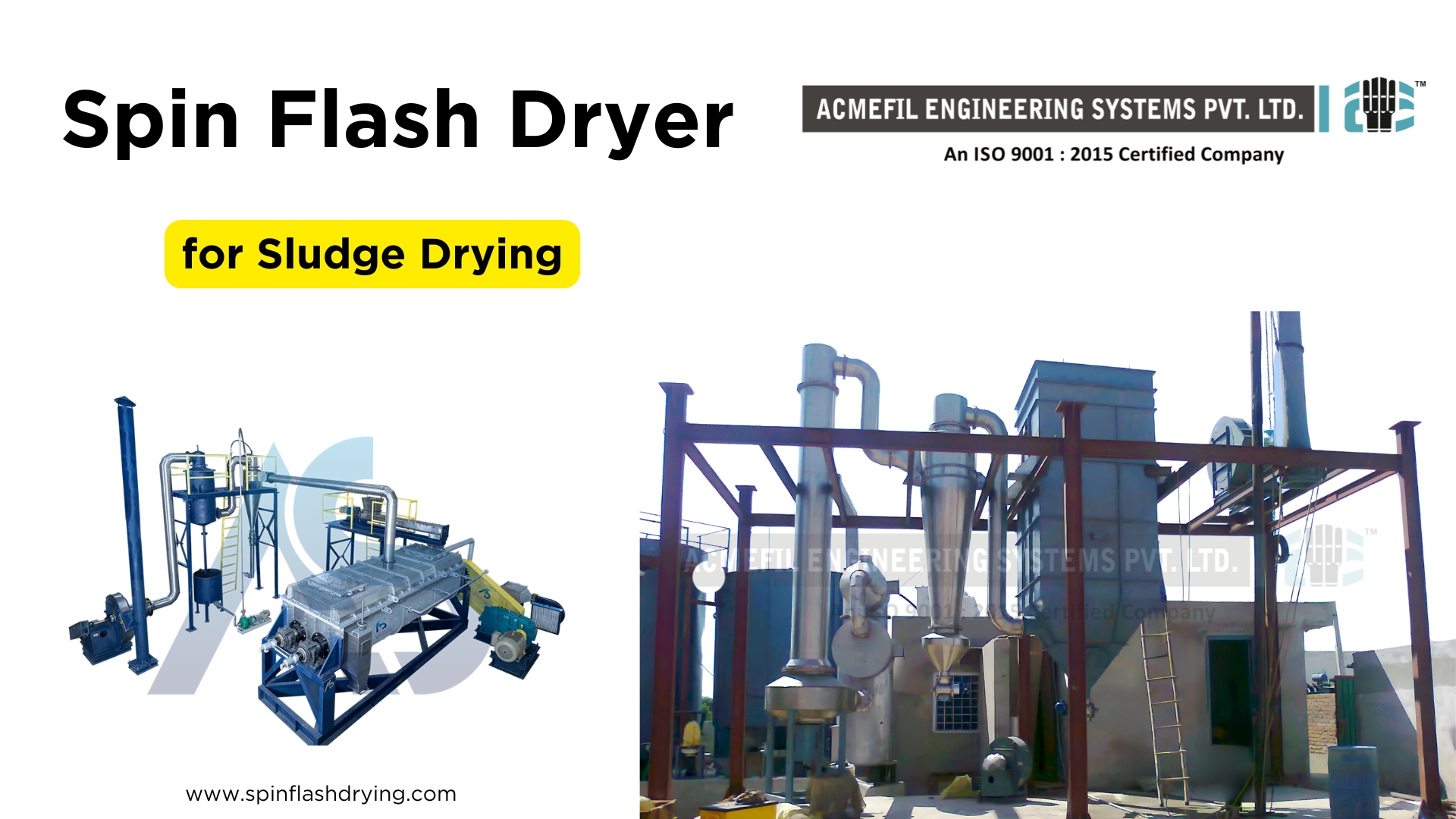
A spin flash dryer for sludge drying is suitable when the feed behaves like wet cake, sticky paste, gelatinous material, or high-viscosity sludge that cannot disperse properly in a normal flash dryer. The key difference is the disintegrator at the feed point. It breaks the wet feed while hot air starts drying it, helping convert difficult sludge-like material into a dry, more free-flowing powder in one continuous system.
In my experience, sludge drying problems usually start before the dryer. The real issue is feed behavior. If the sludge forms lumps, sticks near the inlet, or enters from a filter press as uneven cake, a simple hot air dryer may not open the material fast enough for uniform drying.
That is where a spin flash dryer becomes useful.
Why Sludge Is Difficult to Dry
Sludge is not just “wet material”. It can behave differently at different moisture levels.
Some sludge is pumpable. Some becomes sticky during drying. Some leaves a filter press as thick wet cake. Some contains fine solids that hold moisture inside the structure. If the dryer is selected only by moisture percentage and capacity, the plant can face problems later.
Common issues include:
- Material sticking near the feed zone
- Lumps entering the drying chamber
- Uneven moisture in final product
- Frequent choking in the inlet or screw feeder
- Product build-up inside the chamber
- High cleaning frequency
- Dust handling problems after drying
- Wrong dryer selection because feed behavior was not tested
A standard flash dryer works well when the feed is already free-flowing or easy to suspend in hot air. But sludge and wet cake often need mechanical breakup before pneumatic drying can work properly.
What Is a Spin Flash Dryer for Sludge Drying?
A spin flash dryer for sludge drying is a continuous drying system designed to dry wet cake, paste, gelatinous feed, and high-viscosity sludge by combining mechanical disintegration with hot air drying.
The system does two things at the same time:
- It breaks the wet sludge or filter cake into smaller particles.
- It dries those particles in a stream of hot air.
This is different from a normal flash dryer, where the feed must already be suitable for dispersion. In a spin flash dryer, the disintegrator at the feed point helps open the sludge structure before drying becomes the main action.
For a deeper process explanation, connect this article with the spin flash dryer working principle guide.
How a Spin Flash Dryer Handles Sludge
The working sequence is simple, but each step must be designed correctly.
Feed enters through a controlled feeding system
Sludge or wet cake is usually introduced through a screw feeder. For difficult feeds, variable speed feeding is important because the dryer must receive material at a stable rate. Overfeeding can cause choking, incomplete drying, or unstable outlet moisture.
If the feed comes from a filter press, the spin flash dryer can be evaluated for direct wet cake drying. This is useful in dye, pigment, agrochemical, and chemical applications where the upstream process produces cake rather than liquid slurry.
Disintegrator breaks the wet feed
This is the heart of spin flash drying.
The disintegrator breaks lumps, wet cake, sticky paste, or high-viscosity sludge at the feed point. Acmefil’s verified spin flash dryer configuration includes cage mill type and pin mill type disintegrator options. The right choice depends on the sludge structure, stickiness, fiber content, particle hardness, heat sensitivity, and final product requirement.
If the feed is not broken properly, hot air cannot dry it evenly. The outside of the lump may dry, but the inside can stay wet.
Hot air contacts the smaller particles
Once the material is broken, hot air contacts a much larger exposed surface area. This improves moisture removal compared with trying to dry a large wet mass.
Short hot air contact is also useful where the product cannot tolerate long heat exposure. But temperature selection must still be validated by material trials. Do not assume that high inlet temperature is safe only because residence time is short.
Dried product moves to separation
The dried material travels with the air stream toward separation equipment. In typical systems, cyclone and bag filter arrangements are used to separate dried powder from the air stream.
This section must be designed carefully for dust load, powder fineness, material safety, and clean plant operation.
For system layout and component understanding, refer to design and operation inside spin flash dryers.
When Spin Flash Drying Is a Good Fit for Sludge
A spin flash dryer is worth evaluating when the sludge or wet cake needs rapid breakup and drying.
| Feed condition | Fit for spin flash dryer | Why it matters |
|---|---|---|
| Wet cake from filter press | Strong fit | The disintegrator can break cake before hot air drying |
| Sticky paste | Strong fit after trial | Feed screw and disintegrator design become critical |
| Gelatinous material | Strong fit after trial | Material must be opened before drying |
| High-viscosity sludge | Strong fit after trial | Normal flash drying may fail due to poor dispersion |
| Free-flowing powder with surface moisture | Usually not required | A standard flash dryer may be enough |
| Liquid slurry | Usually not the first choice | Spray dryer, evaporator, or other systems may fit better |
| Sludge needing long gentle heating | Evaluate carefully | Paddle dryer or indirect dryer may be more suitable |
| Abrasive sludge | Needs material selection check | Wear protection and metallurgy become important |
The main question is not “Is spin flash drying efficient?” The first question is, “Can my sludge be broken, dispersed, and dried without clogging?”
Spin Flash Dryer vs Paddle Dryer for Sludge Drying
Both technologies can be used in sludge-related applications, but they solve different problems.
| Selection factor | Spin flash dryer | Paddle dryer |
|---|---|---|
| Heat transfer style | Direct hot air contact | Indirect contact through heated surfaces |
| Best feed behavior | Wet cake, sticky paste, gelatinous feed, high-viscosity sludge that needs disintegration | Sludge that needs controlled residence time and indirect heating |
| Main mechanical action | Disintegrator breaks feed at the inlet | Rotating paddles mix and move material |
| Product movement | Pneumatic conveying with hot air | Mechanical conveying through the dryer body |
| Drying style | Fast breakup and drying in air stream | Slower contact drying |
| Dust handling | Needs cyclone and bag filter design | Usually lower pneumatic dust load, depends on discharge |
| When to test first | Always for sticky or uncertain sludge | Always for sticky phase, scaling, or fouling risk |
I would not select between these two machines from a brochure alone. For sludge, a small change in moisture, stickiness, pH, or solids composition can change the dryer behavior completely.
That is why pilot testing matters.
Spin Flash Dryer vs Normal Flash Dryer
A normal flash dryer is a pneumatic dryer. It is suitable when the feed can disperse easily in hot air.
A spin flash dryer adds mechanical disintegration. This makes it more suitable when the feed is wet cake, sticky paste, or high-viscosity sludge.
| Question | Better direction |
|---|---|
| Is the feed free-flowing or easily dispersible? | Flash dryer |
| Is the feed sticky, lumpy, or paste-like? | Spin flash dryer |
| Is the feed from a filter press? | Spin flash dryer trial |
| Is the moisture mainly surface moisture? | Flash dryer may be enough |
| Does the feed need lump breaking before drying? | Spin flash dryer |
| Is the feed behavior uncertain? | Pilot trial before final selection |
If you are comparing options, also read comparing spin flash dryers vs other drying technologies.
Sludge and Wet Cake Applications Where Spin Flash Drying May Help
A spin flash dryer can be evaluated for difficult wet solids from chemical, dyestuff, pigment, agrochemical, and effluent-related processes.
Relevant feed types include:
- Filter cakes
- Dye intermediate cake
- Reactive dye cake
- Pigment cake
- Agrochemical wet cake
- Gelatinous paste
- High-viscosity sludge
- Sludge from ETP or process treatment streams, after suitability testing
- Sticky chemical paste where normal flash drying is not stable
Acmefil’s spin flash dryer reference applications include filter cakes, dye intermediates, reactive dyes, J-Acid, N-Methyl J-Acid, Acetanilide, Sulfotobias Acid, pastes, pigments, agro chemicals, and high-viscous sludge.
For broader application mapping, connect this page with applications of spin flash dryers in key industries.
Key Components to Check Before Buying a Sludge Spin Flash Dryer
For sludge drying, the main dryer body is only one part of the decision. The supporting system decides whether the plant runs cleanly and consistently.
Feed screw and lump breaker
The feed system must handle uneven sludge without bridging or choking. Variable speed feed control is useful because sludge does not always behave uniformly.
A lump breaker before or near the feed point can reduce large chunks before they reach the disintegrator.
Disintegrator design
Cage mill and pin mill type disintegrators are used based on the feed and drying objective.
The disintegrator must be selected with attention to:
- Lump size
- Stickiness
- Abrasion
- Moisture level
- Heat sensitivity
- Final powder requirement
- Cleaning access
- Wear parts
Hot air generator
The hot air system must be matched to moisture load and product sensitivity. Direct or indirect heating should be evaluated based on contamination risk, fuel availability, process safety, and product requirements.
Drying chamber
The chamber design must support proper contact between disintegrated wet feed and hot air. Poor chamber design can create build-up zones or inconsistent product moisture.
Cyclone and bag filter
The separation system must match powder fineness and dust load. For sludge-derived powders, dust handling must be treated seriously because final product behavior can change after drying.
Acmefil also supports related drying and separation equipment through its spin flash dryer manufacturer and sludge dryer capabilities.
Process Data Required Before Final Dryer Selection
Before asking for a commercial quote, prepare process data. Without this, capacity and price comparison can become misleading.
| Data required | Why it matters |
|---|---|
| Feed source | Filter press, centrifuge, ETP, process cake, or paste source affects feeding design |
| Initial moisture | Determines evaporation load |
| Target final moisture | Decides drying duty and outlet condition |
| Feed consistency | Pumpable, cake, paste, sticky, crumbly, gelatinous, or lumpy |
| Bulk density | Affects feed system, chamber loading, and discharge |
| Particle or lump size | Influences lump breaker and disintegrator selection |
| Heat sensitivity | Controls inlet and outlet temperature strategy |
| Stickiness range | Helps predict build-up and choking risk |
| Abrasion or corrosiveness | Affects metallurgy and wear protection |
| Dusting tendency | Affects cyclone, bag filter, and plant cleanliness |
| Required output form | Powder, granule, coarse powder, or further processed product |
| Operating hours | Impacts equipment sizing, wear, spares, and maintenance planning |
This is also why the how to choose a spin flash dryer guide should be linked from this article.
Pilot Testing Is the Safest Way to Validate Sludge Drying
For sludge, I strongly prefer trial validation before final equipment sizing. A data sheet tells you moisture and solids. A pilot run tells you behavior.
Acmefil has an in-house R&D pilot plant facility where the spin flash dryer pilot capacity is verified at 10 kg/hr water evaporation. This is useful for checking whether the feed can be handled, disintegrated, dried, separated, and discharged as expected before moving to full-scale design.
A good pilot trial should answer:
- Does the sludge feed consistently?
- Does it bridge or choke in the screw feeder?
- Does the disintegrator open the wet cake properly?
- Is there chamber build-up?
- What outlet moisture is practically achievable?
- Does the dried product remain powdery or become sticky again?
- What dust load is expected at separation?
- What temperature range is safe for the product?
- What cleaning frequency should the plant expect?
A pilot trial does not remove all scale-up engineering work, but it reduces the biggest uncertainty: material behavior.
Operating Best Practices for Sludge Spin Flash Drying
Once the plant is installed, stable operation depends on controlled feeding, temperature discipline, and cleaning discipline.
Practical operating points:
- Keep feed rate steady. Sudden feeding changes create moisture variation.
- Avoid feeding oversized lumps without pre-breaking.
- Monitor inlet and outlet temperature together, not separately.
- Watch pressure drop across the bag filter.
- Inspect the feed screw and disintegrator for build-up.
- Track final moisture at defined intervals.
- Keep a record of sludge source changes.
- Do not change feed moisture without reviewing dryer conditions.
- Clean before build-up becomes a choking event.
- Maintain rotary valves, seals, and discharge points.
For operators, the spin flash drying best practices for operation article can support training and SOP development.
Maintenance Risks in Sludge Drying Applications
Sludge drying is tougher on equipment than clean powder drying. Moisture, stickiness, abrasion, and fine dust can all increase maintenance needs.
Important maintenance areas include:
- Feed screw wear
- Disintegrator pin, cage, or rotor wear
- Bearing temperature and vibration
- Chamber build-up points
- Rotary air lock leakage
- Cyclone erosion
- Bag filter pressure drop
- Gasket and seal condition
- Hot air duct build-up
- Instrument calibration
Maintenance cost should not be judged only by spare parts. Downtime, cleaning time, product rejection, and operator load matter equally.
For cost evaluation, link this page with spin flash dryer maintenance and cost analysis.
Common Buying Mistakes in Sludge Drying Projects
The most common mistake is treating sludge like a normal wet powder.
Avoid these errors:
- Selecting dryer capacity only from inlet moisture and final moisture.
- Ignoring stickiness during the intermediate drying phase.
- Assuming a normal flash dryer can handle filter cake directly.
- Not testing feed from the actual plant.
- Under-sizing the feed screw or lump breaker.
- Ignoring dust collection and bag filter loading.
- Asking for the lowest price before confirming dryer suitability.
- Not sharing heat sensitivity or decomposition limits.
- Using one sample when the process produces variable sludge.
- Not planning cleaning access and maintenance access.
A spin flash dryer can solve a difficult sludge drying problem, but only when the feed system, disintegrator, hot air system, chamber, and separation system are engineered as one process.
Conclusion
A spin flash dryer for sludge drying is a strong option when the feed is wet cake, sticky paste, gelatinous material, filter cake, or high-viscosity sludge that needs mechanical disintegration before drying. Its value is not only fast drying. Its value is opening the wet feed at the right point so hot air can dry smaller particles more uniformly.
For simple free-flowing powders, a flash dryer may be enough. For sludge that needs slow indirect heating, a paddle dryer may be better. For liquid feed, a spray dryer or evaporator route may be more relevant. The correct decision depends on feed behavior, moisture load, heat sensitivity, stickiness, dust handling, and final product requirement.
If your sludge is difficult, do not finalize the dryer only from a capacity chart. Share the feed data, run a pilot trial where possible, and then decide whether spin flash drying is technically suitable for your plant.
To discuss sludge drying suitability, use the SpinFlashDrying.com contact page or review Acmefil’s design and engineering support for industrial drying systems.
FAQs
Is a spin flash dryer suitable for sludge drying?
Yes, a spin flash dryer can be suitable for sludge drying when the feed behaves like wet cake, sticky paste, gelatinous material, or high-viscosity sludge. It is especially useful when the material needs mechanical disintegration before hot air drying.
What is the main advantage of a spin flash dryer for sludge?
The main advantage is simultaneous disintegration and drying. The disintegrator breaks wet sludge or filter cake at the feed point, while hot air dries the smaller particles. This helps reduce lumping, uneven drying, and feed-zone choking.
Can a normal flash dryer dry sludge?
A normal flash dryer may dry free-flowing powders or easy-to-disperse centrifuged cakes. It is usually not the right first choice for sticky sludge, gelatinous paste, or lumpy wet cake because it lacks the same feed-point disintegration action.
Which sludge data is needed before selecting a spin flash dryer?
The most important data includes initial moisture, final moisture target, feed consistency, stickiness, lump size, bulk density, heat sensitivity, dusting tendency, corrosiveness, abrasion, operating hours, and sludge source variation.
Should sludge be pilot tested before buying a spin flash dryer?
Yes. Pilot testing is strongly recommended for sludge and wet cake because lab data does not fully show feeding behavior, stickiness, build-up risk, disintegration response, outlet moisture stability, or powder discharge behavior.

Siddharth Nair is the Technical Director at Acmefil Engineering Systems Pvt. Ltd., an ISO 9001:2015 certified manufacturer of industrial drying and evaporation systems headquartered in Ahmedabad, Gujarat, he has led technical evaluation, application engineering and customer solution design for spray dryers, multi-effect evaporators, agitated thin film dryers, spin flash dryers and zero liquid discharge systems.