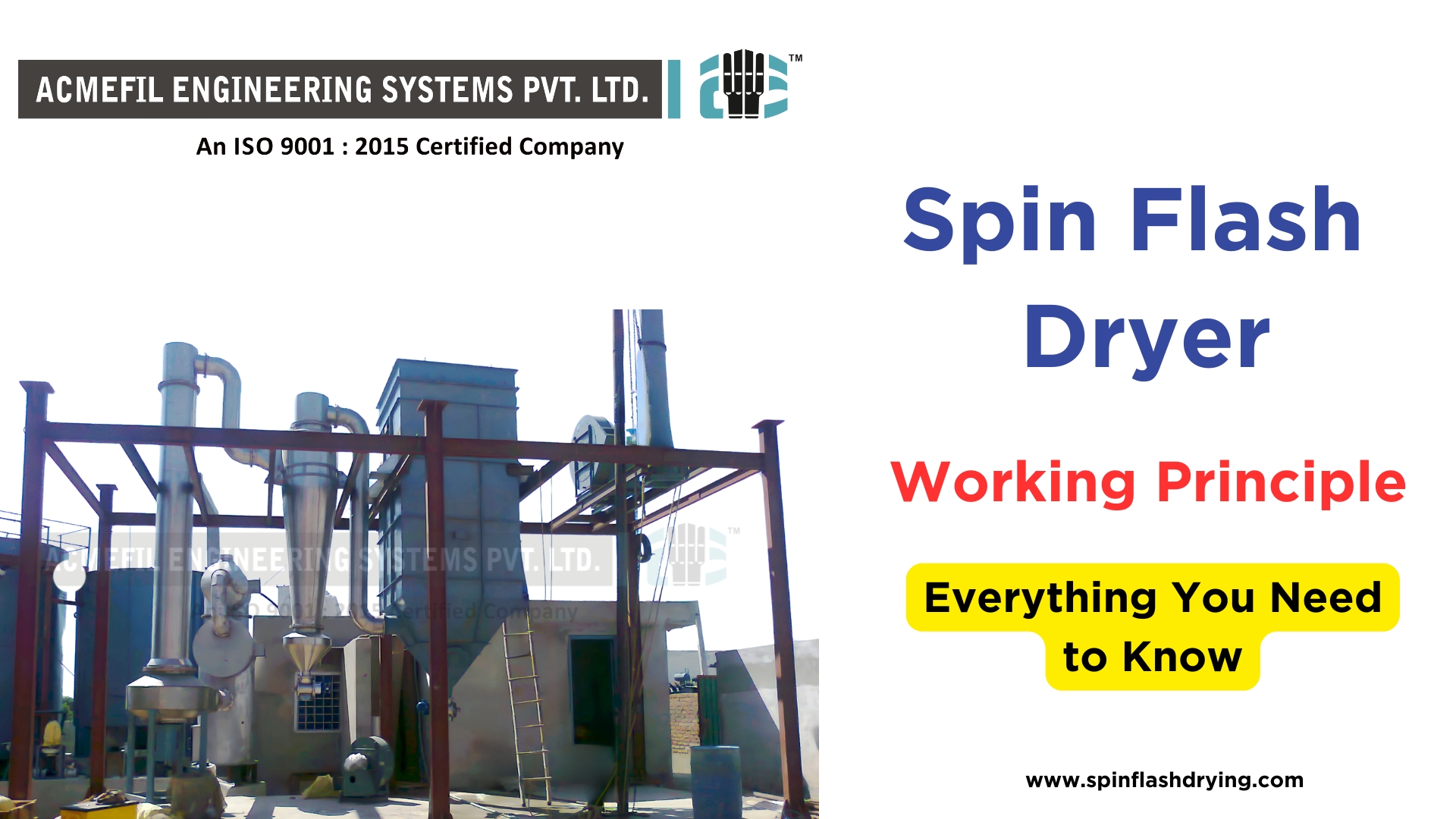
The spin flash dryer working principle is based on one simple idea: wet cake must be broken before it can be dried properly. A spin flash dryer feeds wet cake, paste, gelatinous material, or high-viscosity sludge into a hot air stream while a rotating disintegrator breaks the material into smaller particles. These particles dry in suspension and move with the air stream to a cyclone separator or bag filter for powder collection.
That disintegrator is the real difference.
A standard flash dryer depends mainly on pneumatic conveying and hot air contact. That works for free-flowing powder or easily dispersible centrifuged cake. It does not work reliably when the feed enters as sticky filter cake, slimy paste, or sludge. The material clumps, blocks the feed zone, and dries unevenly.
A spin flash dryer solves this by combining feeding, lump breaking, hot air drying, pneumatic conveying, and powder separation in one continuous system.
What Is a Spin Flash Dryer?
A spin flash dryer is an industrial drying system used to convert difficult wet feeds into dry powder. It is commonly selected for materials such as:
- Filter cake from filter press discharge
- Slimy or gelatinous paste
- High-viscosity sludge
- Dye intermediates
- Reactive dyes
- J-Acid and N-Methyl J-Acid
- Acetanilide
- Sulfotobias Acid
- Pigments
- Agrochemical intermediates
In my experience, the question is not only “How much moisture is in the feed?” The more important question is, “Will this material disperse when it enters hot air?”
If the answer is no, a simple flash dryer may struggle. The feed needs mechanical breaking at the entry point. That is where the spin flash dryer becomes useful.
For a broader technical overview, you can also read this guide on understanding spin flash dryers.
Spin Flash Dryer Working Principle Step by Step
Wet Material Enters Through a Controlled Feed System
The process starts with controlled feeding. Wet cake, paste, or sludge is usually introduced through a screw feeder or similar feeding arrangement.
The feed system has to do more than move material. It must keep the feed rate stable. If the feed enters in surges, the drying chamber may face choking, uneven drying, high exhaust moisture, or unstable powder quality.
For sticky materials, the feed zone is one of the most critical parts of the system. A variable speed feed screw and lump-breaking arrangement help prevent bridging and clogging before the material reaches the disintegrator.
The Disintegrator Breaks Wet Cake Into Smaller Particles
The disintegrator is the heart of the spin flash dryer.
As the wet feed enters the drying chamber, the rotating disintegrator breaks lumps and paste into smaller fragments. This increases the surface area available for hot air contact.
This step decides whether the dryer will run smoothly or keep choking.
If the wet cake remains in large lumps, hot air cannot remove moisture evenly. The outside may dry, but the inside remains wet. That leads to inconsistent final moisture, recycling problems, and possible product deposits inside the system.
ACMEFIL’s spin flash dryer catalogue includes cage mill type and pin mill type disintegrator options. The right choice depends on the feed’s stickiness, lump hardness, abrasiveness, fibre content, and target powder behavior.
Hot Air Contacts the Disintegrated Feed
After the wet cake is broken, hot air contacts the dispersed particles.
The hot air may come from a direct or indirect hot air system depending on the product. For products where direct contact with combustion gases is acceptable, a direct-fired arrangement may be considered. For products where contamination risk is important, an indirect fired hot air generator may be more suitable.
The main point is this: heat selection should follow product behavior, not only fuel availability.
Temperature, airflow, feed rate, moisture load, and residence time must work together. A dryer cannot compensate for poor feed dispersion only by increasing temperature. If the material is not broken properly, more heat may simply create overheated outer surfaces and wet inner lumps.
Moisture Evaporates During Short Residence Drying
Once the material is dispersed, drying happens while the particles remain suspended in the hot air stream.
This is why spin flash drying can be useful for many heat-sensitive products. The product is not held for a long static period inside the dryer. Moisture removal happens rapidly during pneumatic movement.
However, heat-sensitive does not automatically mean suitable. The product’s outlet temperature tolerance, oxidation behavior, final moisture target, dust risk, and product chemistry still need review.
For difficult materials, pilot testing is more reliable than assumption.
Dried Powder Travels to the Separation System
After drying, the powder moves with the air stream toward the separation system.
Most spin flash dryer layouts use a cyclone separator, a bag filter, or a combination of both. The cyclone collects the main powder fraction. The bag filter helps capture fine particles from the exhaust air.
This part should not be treated as a minor accessory.
If the cyclone, bag filter, exhaust fan, rotary valve, or ducting is not selected correctly, the plant may face powder loss, dust leakage, pressure imbalance, filter choking, or unstable discharge.
Dry Powder Discharges Through a Rotary Air Lock Valve
The final dry powder is discharged through a controlled outlet. A rotary air lock valve helps discharge powder while reducing unwanted air leakage.
Air leakage matters because spin flash drying depends on airflow balance. Poor air sealing can disturb conveying velocity, drying stability, powder collection, and plant cleanliness.
Main Components in a Spin Flash Dryer System
| Component | Function | Why It Matters |
|---|---|---|
| Feed hopper | Receives wet cake, paste, or sludge | Must handle sticky and lumpy material |
| Screw feeder | Controls feed rate into dryer | Prevents feed surging and choking |
| Lump breaker / feed agitator | Breaks large lumps before drying | Improves feeding consistency |
| Disintegrator | Breaks wet cake into smaller particles | Core difference from standard flash drying |
| Drying chamber | Provides hot air contact and drying path | Controls residence and dispersion |
| Hot air generator | Supplies drying heat | Direct or indirect heating depends on product |
| Cyclone separator | Collects major dry powder fraction | Must match airflow and particle load |
| Bag filter | Captures fine powder and controls dust | Important for product recovery and clean operation |
| Rotary air lock valve | Discharges powder while limiting air leakage | Maintains system pressure balance |
| Exhaust fan / blower | Maintains airflow through the system | Must handle pressure drop across dryer and filters |
For more detail on internal design, read design and operation inside spin flash dryers.
Why a Standard Flash Dryer Fails With Sticky Wet Cake
A standard flash dryer works best when the feed can disperse easily in high-velocity hot air. It is suitable for free-flowing powders, centrifuged cakes, and materials where surface moisture removal is the main requirement.
Wet cake behaves differently.
It may stick to the feed screw. It may bridge in the hopper. It may form lumps in the feed zone. It may smear instead of breaking. Once that happens, hot air cannot reach the internal moisture properly.
This creates four common problems:
- Choking at the feed entry
- Uneven final moisture
- Undried lumps in powder discharge
- Deposits inside the drying chamber or duct
The spin flash dryer solves this by adding mechanical disintegration before and during hot air drying.
For a direct technology comparison, see comparing spin flash dryers vs other drying technologies.
Spin Flash Dryer vs Standard Flash Dryer
| Selection Factor | Spin Flash Dryer | Standard Flash Dryer |
|---|---|---|
| Best feed type | Wet cake, paste, gelatinous material, high-viscosity sludge | Free-flowing powder or easily dispersible cake |
| Core action | Mechanical disintegration plus hot air drying | Pneumatic hot air drying |
| Feed challenge handled | Stickiness, lumps, poor dispersion | Surface moisture in dispersible feed |
| Mechanical breaking | Central to the process | Limited or not central |
| Common collection system | Cyclone, bag filter, or both | Cyclone, bag filter, or both |
| Wrong selection risk | Choking, deposits, uneven moisture | Poor drying if feed is too sticky |
| Buyer decision point | Choose when feed needs breaking before drying | Choose when feed already disperses in hot air |
A simple rule helps: if your feed can already flow and disperse properly, evaluate a flash dryer first. If the feed is sticky, gelatinous, or needs mechanical breaking, evaluate a spin flash dryer.
Where Spin Flash Dryers Are Most Useful
Spin flash dryers are most useful when the feed is wet, cohesive, and difficult to dry by ordinary pneumatic drying.
Typical applications include:
- Dye intermediates
- Reactive dyes
- Pigments
- Agrochemicals
- Filter press cake
- Chemical paste
- High-viscosity sludge
- Slimy or gelatinous wet material
In dye and chemical plants, the practical advantage is often material handling. If wet cake can be fed directly from a filter press to the dryer, manual handling reduces and plant cleanliness improves.
For sludge-specific applications, read spin flash dryer for sludge drying.
When Spin Flash Drying May Not Be the Right Choice
A spin flash dryer is not the answer for every drying problem.
It may not be the first choice when:
- The material is already a free-flowing powder
- The product must remain as large granules
- The product cannot tolerate mechanical breaking
- Internal moisture diffusion needs long residence time
- The feed is a pumpable liquid better suited to spray drying
- The process involves solvent or reactive material requiring special safety design
- Product contamination risk demands a different heating arrangement
This is why equipment selection should begin with product behavior, not only hourly capacity.
The correct question is not “Which dryer is best?” The correct question is “Which dryer matches this feed form, moisture target, thermal sensitivity, and operating risk?”
For procurement-level selection criteria, use this guide on how to choose a spin flash dryer.
Process Data Needed Before Spin Flash Dryer Selection
A correct spin flash dryer design starts with feed data.
| Data Required | Why It Matters |
|---|---|
| Feed form | Confirms whether material is cake, paste, sludge, slurry, or powder |
| Initial moisture | Determines evaporation load |
| Required final moisture | Defines drying target |
| Feed rate | Helps size heat load and equipment duty |
| Stickiness | Affects feeding and clogging risk |
| Lump strength | Influences disintegrator selection |
| Bulk density | Affects conveying and chamber loading |
| Heat sensitivity | Controls inlet and outlet temperature approach |
| Particle size target | Affects disintegrator, classifier, cyclone, and bag filter |
| Corrosion or hygiene requirement | Decides material of construction |
| Dust behavior | Affects bag filter and plant safety review |
| Product collection need | Decides cyclone, bag filter, rotary valve, and packing approach |
A mistake I often see is asking for a dryer quotation with only feed rate and moisture percentage. That is not enough.
Two wet cakes can have the same moisture content but behave completely differently. One may be brittle and easy to disintegrate. Another may be sticky, fibrous, and difficult to feed. The dryer design must reflect that difference.
Why Pilot Testing Matters
Pilot testing is important when the material is sticky, gelatinous, heat-sensitive, difficult to feed, or new to the plant.
ACMEFIL has an in-house R&D pilot plant with a spin flash dryer pilot capacity of 10 kg/hr water evaporation. A pilot trial can help evaluate:
- Whether the material feeds continuously
- Whether the disintegrator breaks the wet cake properly
- Whether the product sticks in the feed zone
- Whether drying reaches the target moisture
- Whether final powder quality is acceptable
- Whether cyclone and bag filter separation is suitable
- Whether heat exposure affects product behavior
- Whether scale-up is technically sensible
For many difficult wet cake applications, a pilot trial answers questions that a datasheet cannot answer.
Practical Operating Points for Stable Spin Flash Drying
Once the dryer is installed, stable operation depends on discipline around feed, air, heat, and separation.
Key operating points include:
- Keep feed rate steady
- Avoid sudden wet cake surges
- Monitor inlet and outlet air temperature
- Check pressure drop across the bag filter
- Inspect the feed screw and disintegrator for buildup
- Maintain rotary valve sealing
- Avoid overloading the cyclone and bag filter
- Clean the system based on product behavior, not only calendar schedule
- Track final moisture trends, not just one sample
For plant teams, the best results usually come when production, maintenance, and quality teams all understand the dryer’s working principle. Operators should know why feed consistency matters. Maintenance teams should know why air leakage matters. Quality teams should know why final moisture can change when feed behavior changes.
You can refer to spin flash drying best practices for operation for deeper operating guidance.
Conclusion
The spin flash dryer working principle is not only about heating wet material. It is about breaking, dispersing, drying, conveying, and separating difficult feed in one continuous process.
For wet cake, filter cake, paste, gelatinous material, high-viscosity sludge, pigments, reactive dyes, and agrochemical intermediates, the disintegrator is the deciding component. If the material breaks properly at the feed zone, hot air can remove moisture uniformly. If it does not, the dryer may face choking, deposits, uneven drying, and poor powder quality.
Before selecting a spin flash dryer, confirm the feed behavior, moisture load, heat sensitivity, particle requirement, dust behavior, and collection arrangement. When the material is difficult or commercially important, pilot testing is the safest route before full-scale design.
For technical evaluation, share your feed details through the contact page or review ACMEFIL’s spin flash dryer manufacturer page for equipment-level information.
FAQs
How does a spin flash dryer work?
A spin flash dryer works by feeding wet cake, paste, or sludge into a drying chamber where a rotating disintegrator breaks the material into smaller particles. Hot air then evaporates moisture, and the dried powder is carried to a cyclone separator or bag filter for collection.
What is the main difference between a spin flash dryer and a flash dryer?
A flash dryer mainly uses high-velocity hot air to dry feed that already disperses well. A spin flash dryer adds a mechanical disintegrator, making it more suitable for sticky wet cake, gelatinous paste, and high-viscosity sludge.
Why is the disintegrator important in spin flash drying?
The disintegrator breaks wet lumps into smaller particles and increases surface area for drying. Without proper disintegration, hot air may not reach the internal moisture, causing wet lumps, choking, and uneven final moisture.
Which materials are suitable for a spin flash dryer?
Spin flash dryers are commonly used for filter cake, paste, high-viscosity sludge, pigments, agrochemicals, dye intermediates, reactive dyes, J-Acid, N-Methyl J-Acid, Acetanilide, and Sulfotobias Acid. Final suitability depends on feed behavior and process requirements.
Should material be tested before buying a spin flash dryer?
Yes, pilot testing is recommended for sticky, gelatinous, heat-sensitive, or unfamiliar materials. ACMEFIL’s pilot spin flash dryer has 10 kg/hr water evaporation capacity, which helps evaluate feeding, disintegration, drying, separation, and scale-up behavior before final selection.