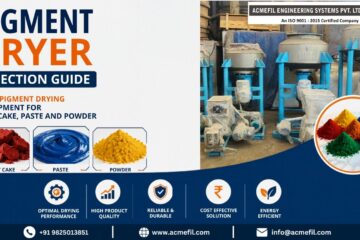
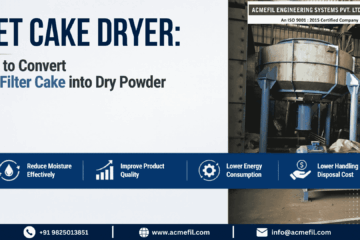
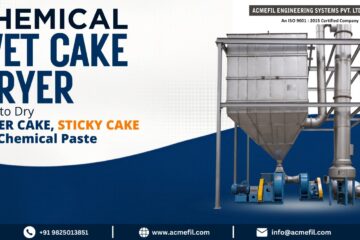
A spin flash dryer is an industrial drying system used for wet cake, filter cake, paste, gelatinous material, and high-viscosity sludge that cannot disperse properly in a standard flash dryer. The key difference is the disintegrator at the feed point. It breaks sticky or lumpy feed into smaller fragments while hot air removes moisture rapidly, so the product can move toward the cyclone and bag filter as a dry powder.
In my experience, most spin flash dryer mistakes happen before the dryer is even ordered. The buyer treats “wet material” as one category. It is not. A filter cake from a dye intermediate plant, a pigment paste, and an ETP sludge behave very differently inside a dryer.
That is why this guide explains the working principle, components, applications, advantages, limitations, and selection checks in practical terms.
What Is a Spin Flash Dryer?
A spin flash dryer is a continuous industrial dryer designed to dry wet solids by combining mechanical disintegration and hot air drying in one system.
The feed enters the dryer through a controlled feeding arrangement. A lump breaker, cage mill type disintegrator, or pin mill type disintegrator breaks the wet feed at the drying zone. Hot air contacts the smaller particles immediately. Moisture evaporates quickly, and the dried material is carried with the air stream to the separation system.
For a deeper mechanism explanation, you can also read this guide on spin flash dryer working principle.
Why a Standard Flash Dryer Fails With Sticky Wet Cake
A normal flash dryer works well when the material is already granular, powdery, or easy to disperse. It depends mainly on high-velocity hot air to carry and dry the product.
That logic fails when the feed is sticky.
If the feed is a slimy cake, paste, or gelatinous mass, it does not separate easily in the air stream. It can form lumps, stick near the feed point, block the column, or pass through as partially dried agglomerates. This causes unstable outlet moisture, choking, poor powder quality, and frequent cleaning stoppages.
A spin flash dryer solves this by attacking the real problem first: dispersion.
The disintegrator breaks the incoming wet material before and during hot air contact. Once the particle size is reduced and exposed to airflow, drying becomes more uniform.
How a Spin Flash Dryer Works
The spin flash dryer working principle can be understood in six practical stages.
Feed Preparation and Controlled Feeding
The feed is usually received as wet cake, filter press discharge, centrifuged cake, paste, sludge, or semi-solid mass.
A variable speed screw feeder controls how much material enters the dryer. This is important because sticky feed cannot be dumped into the dryer randomly. If the feed rate is too high, the system overloads and moisture rises. If the feed rate is too low, temperature control becomes unstable.
In many wet cake drying applications, a lump breaker is used before the main disintegrator zone to reduce large lumps and prevent clogging.
Mechanical Disintegration at the Feed Point
This is the heart of the spin flash dryer.
The disintegrator breaks the wet material into smaller particles. Depending on feed behavior, the design may use a cage mill type disintegrator or pin mill type disintegrator.
The disintegrator helps in three ways:
It breaks lumps.
It exposes more surface area to hot air.
It keeps sticky material moving instead of allowing it to settle or choke the system.
This is why spin flash drying is commonly considered for wet cake drying, filter cake drying, paste drying, and sludge drying where simple pneumatic drying is not enough.
Hot Air Contact and Moisture Evaporation
Hot air enters the drying chamber and contacts the dispersed wet particles.
Because the material has already been broken into smaller fragments, moisture removal becomes faster. The system uses short residence time, which is useful when the product is heat-sensitive and cannot stay long inside a high-temperature environment.
The actual inlet air temperature, outlet air temperature, feed rate, and airflow must be selected based on product characteristics. A dye intermediate cake and an agrochemical paste cannot be sized with the same assumptions.
Particle Classification Inside the Dryer
Inside the dryer, heavier or wetter particles tend to remain longer in the drying zone until they become light enough to travel with the air stream.
This internal classification helps reduce the chance of wet lumps escaping directly into the product collection system. However, this depends strongly on correct air velocity, disintegrator speed, chamber geometry, and feed control.
Separation Through Cyclone and Bag Filter
After drying, the powder is conveyed with the exhaust air to the separation system.
A cyclone separator removes the bulk of the dried powder from the air stream. A bag filter or pulse jet bag filter captures fine particles and helps maintain cleaner exhaust handling.
For plants comparing separation and dust collection choices, ACMEFIL also has support information on bag filter systems.
Powder Discharge and Collection
The dried powder is discharged through an air lock rotary valve or suitable discharge system.
At this stage, the buyer should check final moisture, powder flowability, bulk density, colour change, thermal degradation, dust load, and collection efficiency. These final product properties matter as much as water evaporation capacity.
Main Components of a Spin Flash Dryer
| Component | Practical Role | What to Check Before Buying |
|---|---|---|
| Feed hopper | Receives wet cake, paste, or sludge | Bridging, sticking, live bottom need |
| Variable speed screw feeder | Controls feed rate | Torque, speed range, material compatibility |
| Lump breaker | Breaks large wet lumps before drying | Required for filter press discharge and hard cake |
| Disintegrator | Breaks and disperses wet feed in hot air | Cage mill vs pin mill suitability |
| Drying chamber | Main hot air contact zone | Residence time, material hold-up, cleanability |
| Hot air generator | Supplies drying heat | Direct or indirect firing, fuel, contamination risk |
| Cyclone separator | Separates main dried powder | Particle size, recovery efficiency |
| Bag filter | Captures fines and controls dust | Cloth material, cleaning system, temperature rating |
| Rotary air lock | Discharges powder while limiting air leakage | Sealing, abrasion, powder flow |
| Control panel | Manages temperature, feed, airflow, interlocks | Automation level and instrumentation |
For complete system engineering, not just equipment purchase, refer to ACMEFIL’s design and engineering capability.
Materials Commonly Dried in Spin Flash Dryers
Spin flash dryers are especially useful when the material is difficult to disperse in normal air drying.
Common applications include:
Wet cake from filter presses
Dye intermediate filter cakes
Reactive dyes and related dye products
J-Acid and N-Methyl J-Acid type materials
Acetanilide
Sulfotobias Acid
Pigments
Agrochemical pastes
High-viscosity sludge
ETP sludge with suitable drying characteristics
Gelatinous pastes
Chemical filter cakes
The dryer is not selected only by industry. It is selected by feed behavior. A free-flowing powder may not need spin flash drying. A sticky cake with lumping tendency often does.
You can explore more use cases in this page on applications of spin flash dryers across industries.
Spin Flash Dryer vs Other Drying Technologies
| Dryer Type | Best Suited For | Limitation | Where Spin Flash Dryer Has Advantage |
|---|---|---|---|
| Standard flash dryer | Free-flowing powders and centrifuged cakes | Poor handling of sticky wet cake | Better for paste, gelatinous cake, and lumpy feed |
| Tray dryer | Batch drying of small lots | Slow, labour-intensive, larger floor area | Faster continuous drying |
| Rotary dryer | Granular solids, minerals, bulk materials | Longer residence time, not ideal for fine sticky powders | Shorter residence time and better dispersion |
| Fluid bed dryer | Fluidizable granules and powders | Feed must fluidize properly | Better for wet cake that first needs disintegration |
| Paddle dryer | Sludge, paste, indirect drying applications | Different drying principle, longer contact drying | Better where rapid hot air drying and powder output are required |
For a deeper comparison, use the detailed guide on spin flash dryers vs other drying technologies.
Advantages of Spin Flash Dryers
Handles Wet Cake and Paste-Like Feed
The biggest advantage is feed flexibility for difficult materials. Spin flash dryers are designed for wet cake, paste, gelatinous material, and high-viscosity sludge where standard flash drying may choke or produce uneven drying.
Reduces Manual Handling
In many conventional drying systems, wet cake must be manually unloaded, spread, turned, dried, and handled again. A spin flash dryer can accept material directly from upstream dewatering equipment when the system is designed properly.
This reduces manual handling and improves process continuity.
Short Residence Time
The product remains in the hot drying zone for a short period compared with many conventional dryers. This helps reduce heat exposure, especially for products where long thermal contact can affect quality.
Short residence time does not mean every heat-sensitive material is automatically safe. The actual product must still be tested.
Cleaner Operating Environment
A properly designed spin flash dryer is a closed or semi-closed drying system with material transfer, drying, separation, and dust collection integrated into one line.
This helps reduce open handling, floor contamination, and dust escape compared with open drying methods.
Continuous Operation
Spin flash dryers are suitable for continuous industrial drying where feed rate, airflow, and temperature can be controlled.
This makes them useful for chemical, pigment, dye, and agrochemical plants that need predictable daily output instead of batch drying delays.
Better Product Uniformity
When feed dispersion, air temperature, and residence time are correctly designed, the final dried powder is more consistent than manually dried or poorly dispersed material.
Uniformity depends on feed stability. If the upstream filter press produces highly inconsistent cake moisture, the dryer will also face variation.
Limitations of Spin Flash Dryers
A spin flash dryer is not the right answer for every drying problem.
It may not be suitable when:
The feed contains hard foreign particles that damage the disintegrator.
The material melts, softens, or becomes stickier at drying temperature.
The product requires large granule preservation.
The feed moisture varies too widely without upstream control.
The material is highly abrasive and the design does not account for wear.
The powder is explosive or solvent-laden without proper safety design.
The final product needs very specific particle morphology that spin flash drying cannot maintain.
This is why I always recommend product trials for difficult materials before finalizing full-scale dryer design.
How to Select a Spin Flash Dryer
Spin flash dryer selection starts with process data, not brochure capacity.
Before asking for a quotation, prepare these details:
| Required Data | Why It Matters |
|---|---|
| Feed material name | Determines compatibility and design precautions |
| Feed form | Wet cake, paste, sludge, powder, granule |
| Initial moisture | Drives water evaporation load |
| Target final moisture | Defines dryer duty and outlet condition |
| Feed rate | Determines dryer size and heat load |
| Bulk density | Affects conveying and separation |
| Stickiness | Determines disintegrator and feeder design |
| Heat sensitivity | Controls drying temperature and residence time |
| Particle size requirement | Affects disintegrator speed and powder quality |
| Abrasion tendency | Impacts metallurgy and wear protection |
| Solvent or flammability risk | Requires special safety review |
| Upstream equipment | Filter press, centrifuge, reactor discharge, sludge handling |
| Downstream requirement | Packing, conveying, blending, storage |
For a full buying checklist, read how to choose a spin flash dryer.
Cage Mill vs Pin Mill Type Disintegrator
| Disintegrator Type | Typical Use Case | Practical Selection Point |
|---|---|---|
| Cage mill type | Wet cake, fibrous or lumpy material needing strong breakup | Useful when feed must be aggressively opened before drying |
| Pin mill type | Paste, fine cake, or material needing finer dispersion | Useful where particle breakup and size reduction are more controlled |
The choice should not be made only by preference. It should be made after checking feed texture, lump strength, stickiness, required particle size, abrasion, and cleaning needs.
Why Pilot Trials Matter
Pilot trials are not a formality in spin flash drying. They are a risk-control step.
ACMEFIL has an in-house pilot facility where spin flash dryer trials can be conducted at 10 kg/hr water evaporation capacity. This allows the buyer to check whether the material disperses correctly, whether it dries without sticking, and whether the final powder meets moisture and quality expectations.
A trial can answer questions that a datasheet cannot:
Will the wet cake break properly?
Does it stick near the feed point?
What outlet moisture is realistically achievable?
Does colour or product quality change?
Is the powder too fine or too dusty?
Does the bag filter load become excessive?
Does the feed need pre-breaking before the dryer?
For difficult feeds, pilot validation should happen before full-scale procurement.
You can also contact ACMEFIL through the spin flash dryer manufacturer page for equipment-level evaluation.
Spin Flash Dryer Operating Best Practices
Good design is only one part of successful drying. Operation matters every day.
Keep the feed rate stable.
Avoid feeding oversized lumps without pre-breaking.
Monitor inlet and outlet air temperature.
Do not operate with unstable upstream cake moisture.
Inspect the disintegrator for wear.
Maintain the bag filter cleaning cycle.
Check rotary air lock sealing.
Watch pressure drop across cyclone and bag filter.
Avoid sudden feed surges.
Record final moisture trends batch-wise or shift-wise.
Train operators to respond to temperature and pressure changes.
For a more detailed operations checklist, refer to spin flash drying best practices for operation.
Common Problems in Spin Flash Drying
| Problem | Likely Cause | Corrective Direction |
|---|---|---|
| Dryer choking | Oversized wet lumps, excessive feed rate, poor disintegration | Check feeder speed, lump breaker, disintegrator condition |
| High final moisture | Low air temperature, high feed moisture, high feed rate | Review heat input, feed moisture, outlet temperature |
| Product overheating | Incorrect temperature control or low feed rate | Stabilize feed and control inlet/outlet temperatures |
| Excessive fines | High disintegrator speed or fragile product | Recheck speed and product particle requirement |
| Powder loss | Poor cyclone or bag filter performance | Inspect separation system and filter media |
| High pressure drop | Bag filter choking or airflow imbalance | Clean filter, inspect fan and ducting |
| Uneven powder quality | Variable feed cake moisture | Improve upstream dewatering control |
When Should You Choose a Spin Flash Dryer?
Choose a spin flash dryer when your material is wet, sticky, lumpy, paste-like, or gelatinous and needs to become a dry powder through a continuous process.
It is especially worth evaluating when:
A normal flash dryer is choking.
Tray drying is too slow.
Manual drying causes contamination or inconsistent moisture.
Wet cake handling is increasing labour.
The product must be dried quickly.
The material comes directly from a filter press.
The plant needs cleaner, enclosed operation.
The buyer needs powder output instead of semi-dried mass.
For sludge-specific decision-making, use this dedicated guide on spin flash dryer for sludge drying.
What to Ask Before Sending an RFQ
Before sending a spin flash dryer RFQ, ask yourself these questions:
Is my material free-flowing, sticky, slimy, paste-like, or gelatinous?
What is the moisture before and after drying?
Can the wet cake be fed through a screw feeder?
Does the material form hard lumps?
Is there any heat sensitivity?
Is the product abrasive?
Is the powder dusty?
Do I need cyclone only, or cyclone plus bag filter?
Do I need direct or indirect hot air generation?
Is the product solvent-based or combustible?
Can I provide a representative sample for trial?
If these answers are not clear, the quotation will also be unclear.
Conclusion
A spin flash dryer is not just a faster version of a flash dryer. It is a different solution for a different type of feed. Its value comes from combining controlled feeding, lump breaking, mechanical disintegration, hot air drying, cyclone separation, and bag filtration in one continuous drying system.
For wet cake, filter cake, paste, gelatinous material, pigments, dye intermediates, agrochemical products, and high-viscosity sludge, this design can solve problems that standard flash dryers and conventional drying systems struggle with.
My practical advice is simple: do not finalize a spin flash dryer only from catalogue capacity. Share feed data, test a representative sample where possible, and evaluate the dryer around moisture target, stickiness, heat sensitivity, powder quality, and separation load.
For project discussion or trial-based evaluation, use the SpinFlashDrying.com contact page or ACMEFIL’s contact page.
FAQs
What is a spin flash dryer used for?
A spin flash dryer is used to dry wet cake, filter cake, paste, gelatinous material, pigments, dye intermediates, agrochemical products, and high-viscosity sludge into dry powder. It is useful when the feed needs mechanical disintegration before hot air drying.
How is a spin flash dryer different from a flash dryer?
A standard flash dryer mainly uses hot air velocity to dry and convey free-flowing material. A spin flash dryer adds a disintegrator at the feed point, which breaks wet cake or paste before drying. This makes it better for sticky, lumpy, or gelatinous feed.
Can a spin flash dryer handle sludge?
Yes, a spin flash dryer can handle certain high-viscosity sludges when the sludge can be fed, disintegrated, and dried properly. Sludge composition, moisture, stickiness, ash content, odour, and final disposal requirement must be checked before selection.
What data is needed to size a spin flash dryer?
The main data includes feed rate, initial moisture, final moisture, material form, bulk density, stickiness, heat sensitivity, particle size target, abrasion level, upstream equipment, and required powder quality. A representative sample is strongly useful for trial validation.
Is pilot testing needed before buying a spin flash dryer?
Pilot testing is strongly recommended for sticky, heat-sensitive, abrasive, or unusual materials. ACMEFIL’s pilot spin flash dryer facility supports 10 kg/hr water evaporation trials, which helps verify drying behaviour before full-scale plant design.