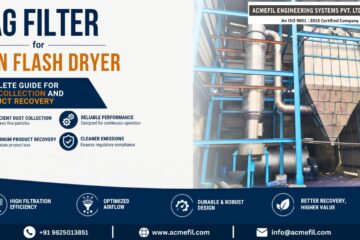
Spin flash dryer applications are strongest where the feed is not a free-flowing powder, but a wet cake, filter cake, sticky paste, slimy mass, gelatinous material or high-viscosity sludge. In my experience, this is where many plants make the wrong dryer selection. A standard flash dryer can move dry or semi-dry particles, but it struggles when the feed enters as lumps. A spin flash dryer adds mechanical disintegration at the feed point, so the material is broken, exposed to hot air and dried in a short residence time.
For a detailed mechanism view, first understand the spin flash dryer working principle and the design and operation inside spin flash dryers. This article focuses on industries, materials and selection logic.
What Makes a Material Suitable for Spin Flash Drying?
A material is usually suitable for spin flash drying when it has moisture that can be removed by hot air contact and the wet mass can be mechanically dispersed inside the dryer.
The key question is not only, “Which industry is this material from?” The better question is, “How does the material behave at the feed point?”
A spin flash dryer is worth evaluating when the material has one or more of these conditions:
- Wet cake from a filter press or centrifuge
- Sticky or cohesive paste
- Gelatinous material that forms lumps
- High-viscosity sludge
- Heat-sensitive material that needs short exposure time
- Material that must be converted into dry powder continuously
- Product that causes choking or uneven drying in conventional drying systems
The disintegrator is the important difference. Cage mill and pin mill type disintegrators break the wet mass as it enters the hot air stream. This improves surface exposure and reduces the risk of large wet lumps moving through the system.
Main Spin Flash Dryer Applications by Industry
| Industry | Typical Materials | Feed Problem | Why Spin Flash Dryer Fits | Selection Caution |
|---|---|---|---|---|
| Dyestuff and dye intermediates | Reactive dyes, dye intermediates, J-Acid, N-Methyl J-Acid, Acetanilide, Sulfotobias Acid | Wet filter cake, sticky lumps, uneven moisture | Disintegrator breaks lumps and hot air dries dispersed particles | Check color contamination, corrosion and dust handling |
| Pigments | Organic and inorganic pigment cakes | Sticky pigment cake, product build-up, lump formation | Short residence drying with mechanical de-lumping | Material of construction and cleaning are critical |
| Chemical intermediates | Selected organic and inorganic chemicals | Wet cake or paste after filtration | Continuous drying from filter press discharge | Check thermal sensitivity and decomposition risk |
| Agrochemicals | Selected agrochemical wet cakes and pastes | Cohesive or sticky feed | Better fit than simple flash drying when feed is not free-flowing | Safety, dust and formulation stability must be reviewed |
| High-viscosity sludge | ETP sludge, industrial filter cake, process sludge | Heavy wet cake, poor flow, difficult manual handling | Feed screw and lump breaker help controlled feeding | Final disposal, emissions and product handling must be planned |
| Ceramics and minerals | Selected mineral cakes, clay-type materials, ceramic-related powders | Moist cake, agglomerates, uneven drying | Can reduce moisture and produce dry powder when wear is manageable | Abrasion and particle size requirement must be checked |
| Food, pharma and biochemical intermediates | Selected heat-sensitive cakes or pastes | Product degradation risk with long drying time | Short exposure time may help protect sensitive materials | Hygiene, GMP, contamination and validation requirements decide suitability |
Dyestuff and Dye Intermediate Drying
Dyestuff and dye intermediate plants are among the most practical users of spin flash drying because the feed often comes as a wet cake after filtration. Materials like reactive dyes, dye intermediates, J-Acid, N-Methyl J-Acid, Acetanilide and Sulfotobias Acid are not always easy to handle in a normal flash dryer.
The problem is simple. The wet cake does not disperse on its own.
If it enters a hot air stream as a lump, the outside dries first while the inner mass remains wet. This creates uneven moisture, build-up, choking and inconsistent powder quality. A spin flash dryer solves this by combining controlled feeding, disintegration and hot air drying in one continuous path.
For dyestuff applications, I usually look closely at:
- Feed moisture after filter press
- Stickiness during feeding
- Whether the cake forms rubbery lumps
- Heat sensitivity of the dye intermediate
- Product color contamination risk
- Dust collection and bag filter design
- Cleaning time between product changes
This is also why pilot testing is valuable before scaling. A small product trial tells you more than assumptions from a datasheet.
Pigment and Inorganic Chemical Drying
Pigment drying needs careful attention because the product may be sticky, fine, dusty, abrasive or color-sensitive. A spin flash dryer can be useful when the pigment is discharged as a wet cake and must be converted into a free-flowing dry powder.
The disintegrator helps expose more surface area to hot air. The short residence time helps reduce prolonged thermal exposure. The cyclone and bag filter section then separates dried powder from the air stream.
For pigment and inorganic chemical applications, the main design points are:
- Abrasion resistance
- Corrosion resistance
- Particle size target
- Product recovery efficiency
- Bag filter suitability
- Cleaning between shades or grades
- Dust control and safe venting
For applications where most moisture is only surface moisture on free-flowing powder, a flash dryer may be enough. But where the feed is a sticky cake or paste, a spin flash dryer is usually the more relevant technology to evaluate.
Agrochemical and Specialty Chemical Applications
Agrochemical and specialty chemical plants often handle wet cakes, intermediates and formulation materials where drying must be fast but controlled. Spin flash drying can be considered when the material is cohesive and needs de-lumping before it can dry properly.
The engineering check should not stop at the word “agrochemical.” The real decision depends on:
- Whether the material is thermally stable at the proposed drying temperature
- Whether it forms dust with explosion or inhalation risk
- Whether any solvent or volatile component is present
- Whether final product particle size is acceptable
- Whether the dryer can be cleaned safely between batches
- Whether the selected material of construction can handle the chemistry
In these applications, the dryer should be selected with process safety, dust collection and plant operating practice in mind. Drying speed alone is not enough.
High-Viscosity Sludge and Filter Cake Drying
Spin flash dryers are also used for selected high-viscosity sludge and industrial filter cake applications. This is especially relevant when the plant wants to reduce moisture, improve handling and convert a difficult wet mass into a drier powder or solid form.
For sludge applications, the main advantage is controlled feeding. A variable speed feed screw and lump breaker reduce the chance of sudden overfeeding. The disintegrator breaks the wet mass, and hot air removes moisture from the dispersed particles.
But sludge drying needs careful evaluation. Not every sludge belongs in a spin flash dryer. Some sludge is too sticky, too abrasive, too variable or better suited to another drying system. For this topic, also review the dedicated guide on spin flash dryer for sludge drying.
Key checks include:
- Initial moisture variation
- Organic or inorganic load
- Ash content
- Stickiness at different moisture levels
- Odor and emission control
- Bag filter loading
- Final disposal or reuse plan
- Site safety and operator exposure
Food, Pharma and Biochemical Materials
Spin flash drying can be useful for selected food, pharma and biochemical materials, but this category needs more caution than chemical drying.
A liquid feed such as milk, juice extract or solution usually points toward spray drying, not spin flash drying. A granular product may point toward a fluid bed dryer. Spin flash drying becomes relevant only when the material is a wet cake, paste or cohesive semi-solid that can be disintegrated and dried in hot air.
For pharma and biochemical applications, suitability depends on:
- Product stability
- Allowable heat exposure
- Cleaning validation
- GMP expectations
- Contact part material
- Dust containment
- Batch traceability
- Cross-contamination control
For some heat-sensitive intermediates, short residence time can be an advantage. But it should be confirmed through trials, not assumed from the dryer name.
Ceramics, Minerals and Advanced Powder Materials
Selected ceramic, mineral and powder-processing applications can also use spin flash drying when the material is a wet cake and needs rapid moisture removal. Examples may include clay-type materials, ceramic-related powders and mineral cakes where the final particle specification is compatible with the dryer.
The biggest caution here is wear. Mineral and ceramic materials can be abrasive. That affects the disintegrator, drying chamber, bends, cyclone and conveying path. If the material is highly abrasive, the design must account for wear protection and maintenance access.
This is where a comparison with other dryers is useful. The article on comparing spin flash dryers vs other drying technologies can help buyers decide whether spin flash, flash, fluid bed, tray, rotary or another drying method is more appropriate.
Why Standard Flash Dryers Fail in Sticky Feed Applications
A standard flash dryer is designed for particles that can be carried by hot air. It works well when the feed is already powdery, granular or free-flowing enough for pneumatic conveying.
It struggles when the feed is:
- Wet and lumpy
- Sticky under heat
- Gelatinous
- Paste-like
- High in viscosity
- Coming directly from filter press discharge
In these cases, the material may not disperse. It may cling to the feed area, create wet lumps, block the drying column or leave the system with uneven moisture. A spin flash dryer adds mechanical energy at the feed zone, which is why it is better suited for difficult wet cake and paste drying.
How the Spin Flash Dryer Handles Wet Cake
A typical wet cake drying sequence works like this:
- Wet cake or paste is fed from the upstream process, often after filtration.
- A variable speed feed screw controls feed rate into the dryer.
- A lump breaker or disintegrator breaks the wet material at the feed point.
- Hot air contacts the smaller fragments inside the drying chamber.
- Moisture evaporates quickly due to increased surface exposure.
- Dried particles travel with air to the separation system.
- Cyclone separator and bag filter recover the dry product and control dust.
This is why the dryer is useful for difficult feeds. The process is not only drying. It is feeding, disintegration, drying and separation working together.
Cage Mill vs Pin Mill Disintegrator Selection
Cage mill and pin mill disintegrators are selected based on material behavior. This selection should be made after understanding the wet cake, not before.
| Disintegrator Type | Better Fit For | Main Benefit | What to Check |
|---|---|---|---|
| Cage mill type | Softer wet cakes, paste-like materials, materials needing stronger lump breaking | Good mechanical breakup of wet mass | Build-up risk, cleaning access, product sensitivity |
| Pin mill type | Materials needing finer dispersion and controlled de-agglomeration | Helps break smaller agglomerates effectively | Wear, heat generation, product fineness |
| Trial-based selection | Uncertain, sticky or variable feed | Confirms real behavior before full-scale design | Feed sample must represent actual plant discharge |
In practical projects, the correct disintegrator is not selected only from the material name. Two plants may call the material “dye intermediate,” but one cake may be friable and another may be rubbery. The dryer design must follow the feed behavior.
When Spin Flash Dryer Is Not the Right Choice
Spin flash drying is useful, but it is not universal. Choosing it for the wrong material can create more problems than it solves.
| Feed Condition | Better Technology to Evaluate | Reason |
|---|---|---|
| Pumpable liquid, solution or slurry requiring droplet drying | Spray dryer | Spray drying is designed for atomized liquid feed |
| Free-flowing powder with only surface moisture | Flash dryer | Disintegrator may not be needed |
| Granular product needing gentle final drying | Fluid bed dryer or Vibratory Fluid Bed Dryer | Better for controlled bed drying of particles |
| Highly viscous concentrate after evaporation | ATFD or other suitable dryer | Thin-film drying may be more suitable |
| Material requiring very large granules | Fluid bed or granulation route | Spin flash tends to break agglomerates |
| Highly abrasive mineral feed | Case-specific evaluation | Wear may dominate operating cost |
| Product with strict sterile or cleanroom requirements | Pharma-grade validated system | Hygiene and validation decide suitability |
For buyer-side selection, read how to choose a spin flash dryer before finalizing technical scope.
Process Data Required Before Selecting a Spin Flash Dryer
A serious RFQ should include more than capacity. If you send only “we need a 500 kg/hr dryer,” the supplier still cannot design correctly.
Before requesting a spin flash dryer proposal, prepare:
- Material name and application
- Feed form, such as wet cake, paste, sludge or powder
- Initial moisture percentage
- Required final moisture percentage
- Feed rate or water evaporation load
- Bulk density
- Particle size expectation
- Stickiness and lump formation behavior
- Heat sensitivity and maximum safe product temperature
- pH, corrosiveness and abrasive nature
- Solvent, flammability or dust explosion risk
- Upstream equipment, such as filter press or centrifuge
- Downstream packing, conveying or storage system
- Utility availability, fuel, steam, power and compressed air
- Site layout and height constraints
- Cleaning requirement and product changeover frequency
This information helps the manufacturer choose the feed screw, disintegrator, hot air generator, material of construction, cyclone, bag filter and control system.
Pilot Plant Testing Before Full-Scale Procurement
For difficult wet cakes and sticky feeds, pilot testing is often the safest step. ACMEFIL has pilot plant facilities for spin flash dryer trials with 10 kg/hr water evaporation capacity. This helps buyers check whether the material can be fed, broken, dried and recovered as expected before committing to a full-scale dryer.
A good pilot trial should answer:
- Does the material feed continuously?
- Does it choke at the screw feeder or disintegrator?
- Does it form deposits in the drying chamber?
- Is the final moisture achievable?
- Does the product remain stable under drying conditions?
- Is the powder recoverable through cyclone and bag filter?
- Does the system create excessive fines?
- Is cleaning practical after the run?
This is especially important for new materials, export projects, specialty chemical products and high-value intermediates.
Maintenance and Operating Considerations
The main maintenance areas in spin flash dryer applications are the feed system, disintegrator, hot air path, cyclone, bag filter and rotary valve. Sticky materials can create build-up. Abrasive materials can create wear. Fine powders can load the bag filter. Poor feed control can cause unstable outlet moisture.
Plant teams should monitor:
- Feed screw condition
- Disintegrator wear
- Product build-up near feed zone
- Inlet and outlet temperature stability
- Airflow and pressure drop
- Cyclone performance
- Bag filter differential pressure
- Rotary valve sealing
- Product moisture trend
- Dust leakage or housekeeping issues
For operating discipline, use the guide on spin flash drying best practices for operation and the article on spin flash dryer maintenance cost analysis.
Conclusion
Spin flash dryer applications are strongest in industries that handle wet cake, filter cake, sticky paste, gelatinous material and high-viscosity sludge. Dyestuff, pigments, chemical intermediates, agrochemicals and selected sludge drying applications are natural candidates because these feeds often need mechanical disintegration before they can dry properly.
The safest selection method is not to choose the dryer by industry name alone. Study the feed behavior, moisture load, heat sensitivity, product specification, dust risk, cleaning requirement and upstream process. Then confirm the design through a pilot trial where the material is difficult or new.
For application-specific evaluation, review Acmefil’s Spin Flash Dryer capability and prepare a proper RFQ with feed sample details, target moisture and plant operating conditions.
FAQs
Which industries commonly use spin flash dryers?
Spin flash dryers are commonly evaluated for dyestuff, dye intermediates, pigments, inorganic chemicals, agrochemicals, specialty chemicals, selected sludge drying, ceramics, minerals and some food, pharma or biochemical wet cake applications. The final decision depends on feed behavior, not only the industry.
Is a spin flash dryer suitable for wet cake from a filter press?
Yes, spin flash dryers are often suitable for filter press wet cake when the cake can be metered through a feed screw and broken by the disintegrator. Suitability still depends on moisture, stickiness, heat sensitivity, abrasiveness and final product specification.
What is the difference between flash dryer and spin flash dryer applications?
A flash dryer is better for free-flowing powders or centrifuged cakes that can already move in hot air. A spin flash dryer is better for wet cake, paste, gelatinous material and high-viscosity sludge because it uses a disintegrator to break lumps at the feed point.
Can spin flash dryers handle heat-sensitive materials?
Spin flash dryers can be useful for some heat-sensitive materials because the residence time is short. However, suitability must be verified with product temperature limits, degradation behavior and pilot testing. Short residence time does not automatically make every heat-sensitive material safe.
What data is needed before asking for a spin flash dryer quote?
Prepare the material name, feed form, initial moisture, final moisture, feed rate, water evaporation load, bulk density, stickiness, heat sensitivity, corrosiveness, abrasiveness, solvent or dust risk, upstream equipment and cleaning requirement. A representative feed sample is strongly recommended for difficult materials.

Siddharth Nair is the Technical Director at Acmefil Engineering Systems Pvt. Ltd., an ISO 9001:2015 certified manufacturer of industrial drying and evaporation systems headquartered in Ahmedabad, Gujarat, he has led technical evaluation, application engineering and customer solution design for spray dryers, multi-effect evaporators, agitated thin film dryers, spin flash dryers and zero liquid discharge systems.