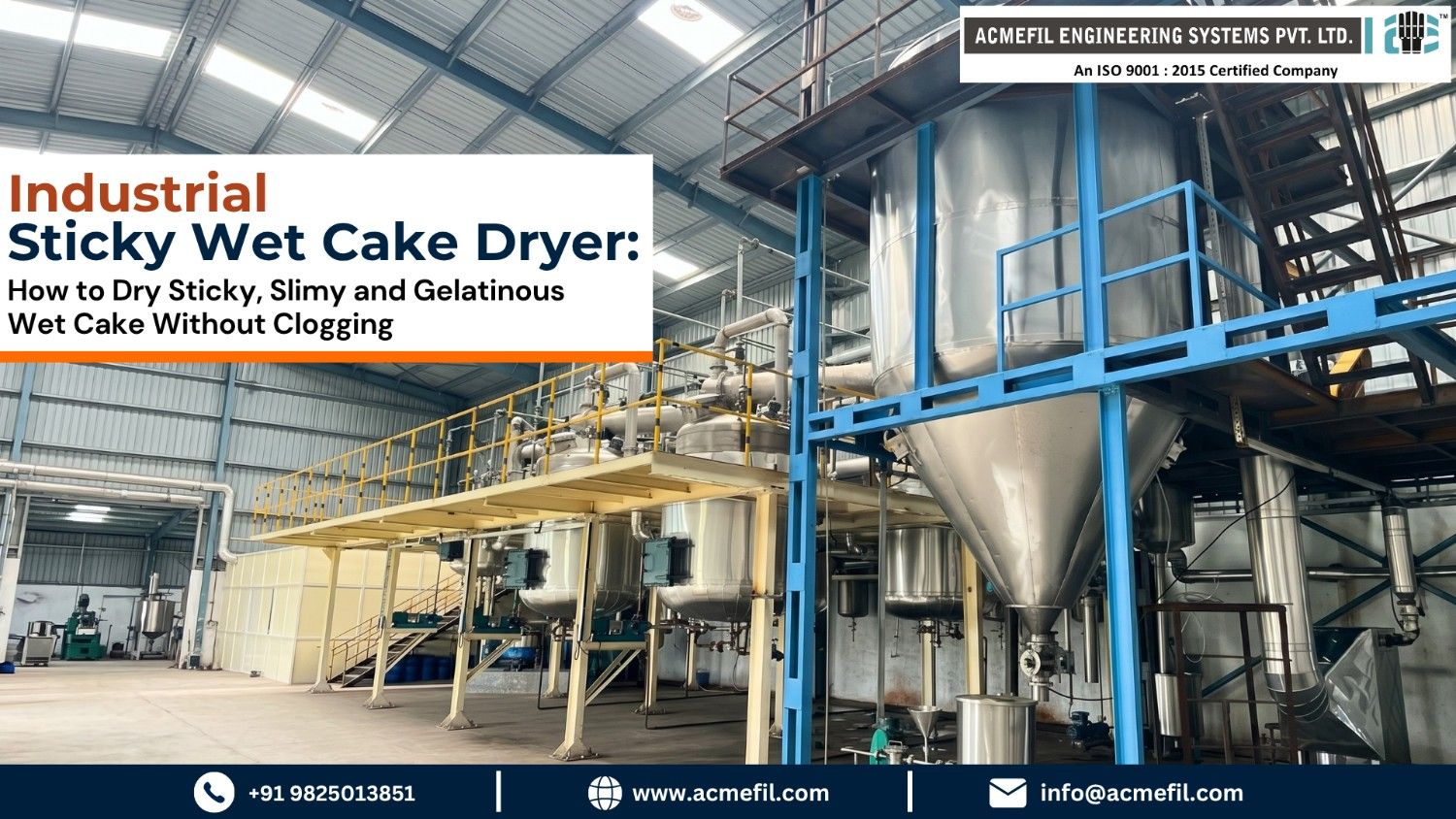
A sticky wet cake dryer is used when filter cake, paste, slimy cake, gelatinous material or high-viscosity sludge cannot disperse properly in a normal flash dryer. For this type of feed, the drying problem is not only moisture removal. The real problem is material handling. The cake must be broken, dispersed and contacted with hot air before it can dry into powder.
In my experience, many wet cake drying problems start because the buyer selects a dryer only by moisture percentage. For sticky wet cake, you also need to understand stickiness, lump formation, feed consistency, thermal sensitivity and how the cake behaves at the feed point.
What Is a Sticky Wet Cake Dryer?
A sticky wet cake dryer is industrial drying equipment designed to convert wet, cohesive or pasty cake into dry powder or granules. The feed normally comes from a filter press, centrifuge, reactor discharge, ETP sludge handling system or chemical process line.
Sticky wet cake may look solid, but it does not behave like free-flowing powder. It can form lumps, bridge inside the hopper, smear on equipment surfaces and block the feed entry if the dryer is not designed correctly.
A standard flash dryer works well when the feed can disperse quickly in hot air. A sticky wet cake dryer needs an additional mechanical action at the feed point. This is why spin flash drying is commonly selected for wet cake, filter cake, paste and sludge applications.
For a deeper process explanation, you can also read our guide on spin flash dryer working principle.
Why Sticky Wet Cake Is Difficult to Dry
Sticky wet cake creates four common problems inside a drying system.
First, it does not flow consistently. The cake may bridge inside the feed hopper or move in uneven lumps through the screw feeder.
Second, it does not disperse easily. If the cake enters hot air as one large lump, only the outside surface dries. The core remains wet.
Third, it can stick to internal surfaces. This causes buildup, uneven drying and frequent cleaning shutdowns.
Fourth, it can clog the feed entry. Many drying failures happen before the material even enters the drying chamber properly.
This is why the feed mechanism is just as important as the hot air system.
Best Dryer for Sticky Wet Cake
For sticky wet cake, a spin flash dryer is usually the most practical option when the target is continuous drying into powder. It combines controlled feeding, mechanical disintegration and rapid hot air contact in one drying system.
A standard flash dryer depends mainly on pneumatic conveying. That works for free-flowing powders or relatively dry centrifuged cakes. It does not solve the lump-breaking problem for sticky cake.
A spin flash dryer adds a disintegrator near the feed point. The disintegrator breaks the wet cake while hot air enters the drying zone. Smaller fragments expose more surface area, dry faster and move with the drying air toward the separation system.
ACMEFIL’s spin flash dryer is designed for wet cake, slimy paste, gelatinous material, filter cake and high-viscosity sludge. The system can use cage mill type or pin mill type disintegrators depending on the material behavior.
Sticky Wet Cake Dryer Working Principle
A sticky wet cake dryer based on spin flash drying normally works in this sequence:
- Wet cake is discharged from a filter press, centrifuge or process equipment.
- A feed screw moves the cake into the dryer at a controlled rate.
- A lump breaker or disintegrator breaks the sticky cake into smaller particles.
- Hot air contacts the broken material inside the drying chamber.
- Moisture evaporates rapidly because the cake has been dispersed.
- The dried powder is carried with air toward a cyclone separator or bag filter.
- The final product is collected as powder, while exhaust air is handled through the separation and filtration system.
The key point is simultaneous disintegration and drying. If the cake is not broken properly, hot air alone cannot solve the problem.
You can read more about dryer internals in design and operation inside spin flash dryers.
Sticky Wet Cake Dryer vs Other Drying Equipment
| Dryer Type | Suitable for Sticky Wet Cake? | Main Limitation | Best Fit |
|---|---|---|---|
| Tray Dryer | Limited | Batch process, labour-intensive, slow drying | Small batches, simple products |
| Standard Flash Dryer | Usually not suitable | Wet cake may clump and clog | Free-flowing powders or centrifuged cakes |
| Fluid Bed Dryer | Limited | Feed must fluidize properly | Granules and particles that can suspend in air |
| Paddle Dryer | Suitable in selected cases | Longer residence time, indirect drying | Sludge, paste and heat-sensitive viscous material |
| Spin Flash Dryer | Strong fit | Feed must be tested for stickiness and drying behavior | Sticky wet cake, filter cake, paste, gelatinous material and high-viscosity sludge |
The best dryer is not decided by equipment name alone. It is decided by feed behavior. If the material is sticky, lumpy or gelatinous, always test how it breaks, feeds and dries before finalizing the dryer.
For a wider selection view, see our comparison guide on spin flash dryers vs other drying technologies.
Where Sticky Wet Cake Dryers Are Used
Sticky wet cake dryers are used in industries where filtration or reaction produces a wet solid that must be converted into dry powder.
Common applications include:
- Dye intermediates
- Reactive dyes
- Pigments
- Agrochemicals
- Filter press cake
- Chemical paste
- Gelatinous material
- High-viscosity sludge
- ETP and process sludge
- J-Acid and N-Methyl J-Acid
- Acetanilide
- Sulfotobias Acid
In dye, pigment and chemical plants, the feed often changes from batch to batch. One batch may behave like a soft cake. Another may behave like a sticky paste. This is why dryer selection should include a product trial wherever possible.
Why Standard Flash Dryers Fail With Sticky Wet Cake
A standard flash dryer is a good machine when the feed is already easy to disperse. It uses high-velocity hot air to dry and convey material quickly.
The problem starts when the feed is sticky.
Sticky wet cake does not enter the air stream as fine particles. It enters as lumps or smeared paste. These lumps resist airflow, remain wet inside and may accumulate near the feed zone. The operator then increases temperature or airflow, but the root problem remains unsolved.
The issue is not always insufficient heat. It is poor feed dispersion.
A sticky wet cake dryer solves this by breaking the cake mechanically before and during hot air contact. That is the real difference between a standard flash dryer and a spin flash dryer.
Important Components in a Sticky Wet Cake Dryer
Feed Hopper
The hopper must accept wet cake without bridging. Poor hopper geometry causes irregular feeding and dryer instability.
Variable Speed Feed Screw
A variable speed feed screw helps control the feed rate. This is important because wet cake moisture and density may vary during operation.
Lump Breaker or Disintegrator
This is the heart of sticky wet cake drying. The disintegrator breaks wet lumps into smaller particles so moisture can evaporate quickly.
Hot Air Generator
The hot air system supplies the heat required for evaporation. Direct or indirect heating selection depends on product sensitivity and contamination risk.
Drying Chamber
The drying chamber must provide proper air-material contact and short residence time.
Cyclone Separator
The cyclone separates dried product from the conveying air.
Bag Filter
A bag filter helps capture fine powder and keeps the operating environment cleaner.
ACMEFIL also manufactures supporting equipment such as flash dryers and bag filters for drying and powder handling systems.
Selection Criteria for Sticky Wet Cake Drying Equipment
Before selecting a sticky wet cake dryer, collect the following data.
| Selection Factor | Why It Matters |
|---|---|
| Initial moisture content | Determines evaporation load |
| Final moisture requirement | Defines drying duty and product quality target |
| Stickiness level | Decides feed screw and disintegrator design |
| Cake source | Filter press, centrifuge, reactor or sludge system affects feed behavior |
| Lump size | Helps decide lump breaker and disintegrator intensity |
| Heat sensitivity | Affects inlet air temperature and residence time |
| Product abrasiveness | Influences material of construction and wear allowance |
| Corrosiveness | Impacts contact parts, metallurgy and maintenance plan |
| Bulk density | Affects feed system, collection and conveying |
| Required output form | Powder, granules or semi-dry product require different settings |
| Dust behavior | Decides cyclone and bag filter design |
| Cleaning requirement | Important for colour-changing, chemical and pharma-linked operations |
A proper RFQ should include this data. Without it, any dryer quotation is only a rough assumption.
When a Spin Flash Dryer Is a Good Fit
A spin flash dryer is a good fit when:
- Wet cake comes directly from a filter press
- The material is sticky, slimy or gelatinous
- The feed forms lumps during handling
- The target output is dry powder
- The process needs continuous drying
- The product should have short heat exposure
- Manual tray drying is too slow or labour-heavy
- A standard flash dryer is causing clogging or uneven moisture
For sludge-specific applications, you can also review our article on spin flash dryer for sludge drying.
When a Sticky Wet Cake Dryer May Need Extra Validation
Not every sticky cake automatically becomes a successful spin flash dryer application. Some feeds need careful testing.
Be cautious when:
- The material becomes harder and stickier during partial drying
- The cake melts, softens or decomposes at higher temperature
- The feed contains solvents or flammable vapours
- The product is highly abrasive
- The final powder is extremely fine and dusty
- The material changes behavior between batches
- The cake contains large hard lumps or foreign particles
In these cases, a pilot trial is more reliable than theoretical selection.
ACMEFIL has an in-house pilot plant facility for product trials. For spin flash dryer, flash dryer and vibratory fluid bed dryer trials, the available pilot capacity is 10 kg/hr water evaporation. This helps validate feed behavior before full-scale plant design.
Common Mistakes Buyers Make
The first mistake is asking only for dryer capacity in kg/hr without sharing water evaporation load. A dryer is not sized only by wet feed quantity. It is sized by how much moisture must be removed.
The second mistake is treating sticky wet cake like normal powder. Sticky material needs controlled feeding and mechanical breakup.
The third mistake is ignoring the separation system. A good dryer still needs a properly designed cyclone and bag filter.
The fourth mistake is comparing only dryer price. If the wrong dryer clogs every shift, the lower purchase price becomes irrelevant.
The fifth mistake is skipping trials for difficult feed. For sticky wet cake, a trial can reveal feed bridging, lump behavior, drying response, dusting and product collection issues before a full-size system is purchased.
RFQ Checklist for Sticky Wet Cake Dryer
Send this information when asking for a sticky wet cake dryer quotation:
- Wet feed rate in kg/hr
- Initial moisture percentage
- Required final moisture percentage
- Feed source, such as filter press, centrifuge or reactor
- Cake texture, such as sticky, slimy, pasty, granular or gelatinous
- Lump size at feed point
- Product bulk density
- Heat sensitivity limit
- Available fuel or heat source
- Required material of construction
- Product corrosiveness or abrasiveness
- Desired powder size or final product form
- Dust handling requirement
- Available plant space
- Existing upstream and downstream equipment
- Whether pilot testing is required
This data helps the dryer manufacturer recommend the correct feed system, disintegrator type, drying chamber, air handling system and powder collection arrangement.
Best Practical Recommendation
For sticky wet cake drying, do not start with “Which dryer is cheapest?” Start with “Can this dryer feed, break and disperse my cake without choking?”
A spin flash dryer is usually the right starting point for filter cake, wet cake, paste, gelatinous material and high-viscosity sludge when the final requirement is dry powder. The critical design areas are the feed screw, lump breaker, disintegrator, hot air contact, drying chamber and separation system.
For plant teams evaluating equipment, our guide on how to choose a spin flash dryer will help you compare feed characteristics, capacity, product sensitivity and operating requirements.
FAQs
What is the best dryer for sticky wet cake?
A spin flash dryer is usually the best dryer for sticky wet cake when the goal is continuous drying into powder. It uses a feed screw and disintegrator to break sticky cake before hot air dries the material.
Can a flash dryer dry sticky wet cake?
A standard flash dryer is not ideal for sticky wet cake because the material may clump, smear or clog at the feed point. A spin flash dryer is better suited because it includes mechanical disintegration.
What is the difference between wet cake and filter cake?
Wet cake is a general term for moist solid material after separation or processing. Filter cake specifically refers to the wet solid discharged from filtration equipment such as a filter press.
Can sticky wet cake be fed directly from a filter press to a dryer?
Yes, in suitable applications, wet cake from a filter press can be fed to a spin flash dryer through a controlled feed system. The feed behavior should still be checked because some cakes bridge, lump or smear more than others.
Why is pilot testing important for sticky wet cake drying?
Pilot testing shows how the material feeds, breaks, dries and separates under real drying conditions. For sticky wet cake, this is important because lab moisture data alone does not reveal clogging, lumping or powder collection behavior.
Conclusion
Sticky wet cake drying is a material handling problem before it is a heat transfer problem. If the cake cannot feed properly, break into smaller particles and disperse in hot air, the dryer will struggle even with enough temperature and airflow.
For filter cake, slimy paste, gelatinous material and high-viscosity sludge, a spin flash dryer gives a practical path from wet cake to dry powder because it combines controlled feeding, disintegration and rapid drying in one system.
If your plant is dealing with sticky wet cake, start by testing the feed behavior and evaporation load. Then select the dryer around the material, not around a generic capacity number.
For equipment selection support, visit the Spin Flash Drying contact page or review ACMEFIL’s spin flash dryer manufacturer page for system-level details.

Siddharth Nair is the Technical Director at Acmefil Engineering Systems Pvt. Ltd., an ISO 9001:2015 certified manufacturer of industrial drying and evaporation systems headquartered in Ahmedabad, Gujarat, he has led technical evaluation, application engineering and customer solution design for spray dryers, multi-effect evaporators, agitated thin film dryers, spin flash dryers and zero liquid discharge systems.