Filter Cake Dryer: What Works Best for Filter Press Cake Drying?
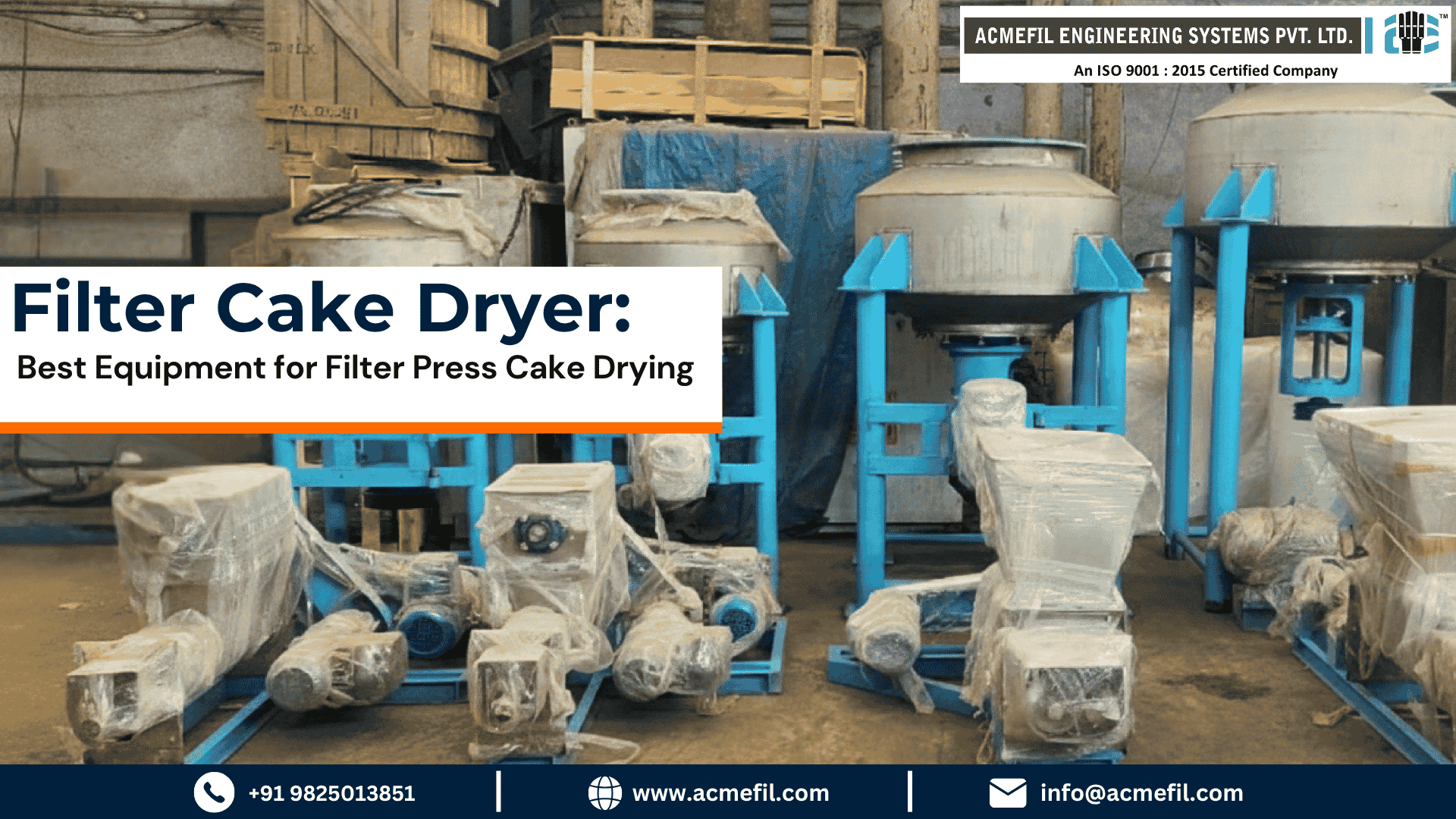
A filter cake dryer is used to convert wet filter press cake into a dry powder or low-moisture solid. For sticky, slimy, pasty or gelatinous filter cake, a spin flash dryer is usually one of the most practical drying equipment options because it breaks the wet cake at the feed point before drying it in a hot air stream. A standard flash dryer works better for free-flowing powder or centrifuged cake, but it often struggles when the feed enters as lumps from a filter press.
In filter press cake drying, the first problem is not always moisture. The first problem is dispersion.
If the wet cake does not open up, hot air cannot contact enough surface area. The dryer may have enough heat, but the material still comes out unevenly dried, partly wet, or stuck near the feed entry.
That is why dryer selection must start with the physical behavior of the cake, not only with the moisture percentage.
What Is a Filter Cake Dryer?
A filter cake dryer is industrial drying equipment designed to remove moisture from solid cake discharged from a filter press, centrifuge or filtration system.
The feed may look like a solid block, but it normally contains moisture inside the cake structure. Depending on the product, it may be:
- Crumbly and easy to break
- Sticky and pasty
- Slimy or gelatinous
- Heat-sensitive
- Abrasive
- Dust-forming after drying
- Difficult to discharge from the feed system
In practical plant language, a filter cake dryer must do three things well:
- Feed the wet cake without choking.
- Break the cake into smaller particles or fragments.
- Expose enough surface area to hot air for controlled moisture removal.
For many chemical, dyestuff, pigment and agrochemical applications, the spin flash dryer becomes relevant because it combines cake disintegration and drying in one continuous system.
Why Filter Press Cake Drying Is Difficult
Filter press cake is not the same as dry powder. It is compressed, wet and often non-uniform.
I have seen buyers compare dryers only by evaporation capacity. That is risky. Two cakes may both contain the same moisture percentage, but their behavior inside the dryer can be completely different.
The main difficulties are:
| Filter Cake Problem | What Happens in the Dryer | Why It Matters |
|---|---|---|
| Sticky cake | Material sticks near feed entry or chamber wall | Causes choking, downtime and uneven drying |
| Large wet lumps | Hot air dries only the outer surface | Inner moisture remains high |
| Gelatinous cake | Material smears instead of breaking | Standard pneumatic drying becomes difficult |
| Heat-sensitive product | Product may degrade if exposure is poorly controlled | Needs short residence time and correct temperature profile |
| Fine powder after drying | Dust load increases | Cyclone, bag filter and discharge design become important |
| Variable filter press discharge | Feed rate fluctuates | Screw feeder and lump breaker design become critical |
This is why filter cake drying equipment should be selected after checking feed behavior, not only after reading a catalogue.
Best Dryer for Filter Press Cake Drying
For wet, sticky, slimy or gelatinous filter press cake, a spin flash dryer is often the better direction than a simple flash dryer.
A spin flash dryer uses a mechanical disintegrator at the feed point. The wet cake enters through a feed system, is broken by the disintegrator, and then dries in contact with hot air. The dried particles are carried to the separation system, typically cyclone and bag filter arrangement.
This is different from a standard flash dryer, where the material must already be reasonably dispersible.
For a deeper equipment-selection view, read this guide on how to choose a spin flash dryer.
Spin Flash Dryer vs Flash Dryer for Filter Cake
| Selection Point | Spin Flash Dryer | Standard Flash Dryer |
|---|---|---|
| Feed form | Wet cake, filter cake, paste, slimy cake, gelatinous material | Free-flowing powder, granular material, centrifuged cake |
| Main mechanism | Mechanical disintegration plus hot air drying | Pneumatic conveying plus hot air drying |
| Cake lump handling | Better, because the feed is broken at entry | Limited, unless cake is already friable |
| Choking risk | Lower when feed screw, lump breaker and disintegrator are correctly designed | Higher with sticky or large wet lumps |
| Typical fit | Dye intermediates, reactive dyes, pigments, agrochemicals, sludge-type cakes | Surface moisture removal from powders or easier centrifuged cakes |
| Best use case | Filter press cake to dry powder | Powder or cake that already disperses well |
A standard flash dryer is not a bad machine. It is simply not the right answer for every filter cake. If the cake cannot break and disperse, air velocity alone will not solve the drying problem.
You can also read the detailed spin flash dryer working principle to understand the internal drying mechanism.
How a Spin Flash Dryer Dries Filter Cake
A spin flash dryer for filter cake drying normally works in the following sequence:
Wet Cake Feeding
The wet cake is fed from the filter press discharge area into the dryer feed system. A variable speed feed screw helps control the feed rate.
This matters because filter cake discharge is not always uniform. If feed comes in surges, the dryer may see overload at one moment and underload the next.
Lump Breaking and Disintegration
The wet cake passes into the disintegrator zone. Cage mill type or pin mill type disintegrators are commonly used for wet cake, paste and high-viscosity sludge applications.
This is the section that separates spin flash drying from simple flash drying. The material is not expected to break by air flow alone. It is mechanically opened before drying.
Hot Air Contact
Once the cake is broken into smaller fragments, hot air contacts more surface area. Moisture removal becomes faster and more uniform.
The short residence time is useful for many heat-sensitive products, but the exact suitability still depends on product trials, inlet temperature, outlet temperature, target moisture and product stability.
Powder Separation
The dried material is carried with the air stream and separated through cyclone and bag filter systems. The final product can then be discharged as a dry powder or low-moisture solid, depending on the process target.
For a practical view of equipment layout, see design and operation inside spin flash dryers.
Applications of Filter Cake Drying Equipment
A filter cake dryer is commonly evaluated in industries where filtration produces wet cake before final drying.
Typical applications include:
| Industry | Filter Cake Examples | Dryer Direction |
|---|---|---|
| Dyestuff and dye intermediates | Reactive dyes, J-Acid, N-Methyl J-Acid, Acetanilide, Sulfotobias Acid | Spin flash dryer |
| Pigments | Pigment cake from filtration | Spin flash dryer after trials |
| Agrochemicals | Wet cake or paste-type intermediates | Spin flash dryer depending on feed behavior |
| Chemical processing | Filter press cake, centrifuged cake, inorganic or organic chemical solids | Spin flash or flash dryer depending on cake friability |
| Sludge and effluent solids | High-viscosity sludge or sticky solids | Spin flash dryer or sludge dryer based on material properties |
For sludge-type wet solids, this related guide on spin flash dryer for sludge drying will help you understand the difference between sludge drying and standard powder drying.
When a Filter Cake Dryer Is the Right Choice
A filter cake dryer is a good fit when your plant has a wet solid that must be converted into dry powder or low-moisture material after filtration.
It is especially relevant when:
- The material comes directly from a filter press.
- Manual tray drying is too slow or labour-heavy.
- The cake forms lumps during discharge.
- The final product must be dry, powdery and easier to pack.
- The feed is sticky, slimy, pasty or gelatinous.
- The drying system must reduce open handling.
- The plant wants a cleaner operating environment compared with manual cake handling.
A spin flash dryer is not selected only because the keyword says “filter cake dryer”. It is selected when the cake needs mechanical breaking and rapid hot air drying together.
When You Should Not Select a Spin Flash Dryer Blindly
A spin flash dryer is powerful for the right feed, but it should not be treated as a universal dryer.
You should verify before selection if:
- The material is solvent-based.
- The product has strict low-temperature drying requirements.
- The product is highly abrasive.
- The dry powder has dust explosion risk.
- The material requires very specific particle morphology.
- The feed has large foreign particles or hard impurities.
- The product changes chemically at drying temperature.
In these cases, a process trial and safety review are not optional. They are part of responsible dryer selection.
Data Needed Before Buying Filter Cake Drying Equipment
Before asking for a filter cake dryer quotation, prepare the right process data. This avoids wrong sizing, wrong feed system design and unrealistic commercial comparison.
| Data Required | Why It Matters |
|---|---|
| Feed material name | Confirms application category and compatibility |
| Source of cake | Filter press, centrifuge or other filtration system |
| Initial moisture | Determines evaporation load |
| Target final moisture | Defines drying duty and outlet condition |
| Cake behavior | Sticky, crumbly, slimy, pasty, gelatinous or friable |
| Feed temperature | Affects heat balance |
| Heat sensitivity | Controls inlet and outlet temperature range |
| Bulk density | Affects feed screw, chamber and discharge design |
| Particle size requirement | Influences disintegration and final powder handling |
| Hourly feed rate | Defines dryer capacity |
| Operating hours per day | Affects duty cycle and utility planning |
| Available fuel or heat source | Helps select hot air generation method |
| Dust control needs | Influences cyclone, bag filter and plant layout |
| Material of construction requirement | Important for corrosion, hygiene or contamination control |
A serious vendor should ask for this data before promising a dryer model.
For filter press cake drying, the wrong feed assumption can be more damaging than a small sizing error.
Common Mistakes in Filter Press Cake Drying Projects
Mistake 1: Selecting a Dryer Only by Moisture Percentage
Moisture percentage is important, but it is not enough.
A 45% moisture crumbly cake and a 45% moisture sticky gelatinous cake are not the same drying problem. One may disperse easily. The other may choke the feed entry.
Mistake 2: Assuming a Flash Dryer Can Handle Every Cake
A flash dryer works well when the material can be carried and dried by high-velocity hot air. But if the feed enters as sticky lumps, the dryer may not get proper surface exposure.
For difficult wet cake, evaluate spin flash drying before finalizing a standard flash dryer.
You can compare the options in this guide on spin flash dryers vs other drying technologies.
Mistake 3: Ignoring the Feed Screw and Lump Breaker
Many drying failures start before the material enters the drying chamber.
A filter cake dryer needs a feed system that can handle inconsistent cake discharge. The feed screw, lump breaker and disintegrator must work together.
Mistake 4: Not Checking Product Temperature Sensitivity
Some products tolerate high inlet air temperature because residence time is short. Others degrade quickly.
Do not assume. Test the product, measure outlet conditions and check final powder quality.
Mistake 5: Comparing Only Machine Price
The lowest machine price may not be the lowest project cost.
For filter cake drying, evaluate:
- Feed handling
- Dryer capacity
- Fuel consumption
- Labour requirement
- Cleaning downtime
- Product loss
- Dust collection
- Installation space
- Maintenance access
- Trial support
A dryer that cannot run stable with your actual cake becomes expensive after installation.
Pilot Trials for Filter Cake Dryer Selection
For difficult filter cake, a pilot trial is one of the best ways to reduce procurement risk.
A trial can help answer:
- Will the wet cake feed smoothly?
- Does it break properly inside the disintegrator?
- What inlet and outlet temperature range is suitable?
- Can the dryer achieve the target final moisture?
- Does the product remain stable after drying?
- Is the dry powder easy to separate and collect?
- Does the system show signs of choking or buildup?
Acmefil’s spin flash dryer pilot facility is available for trials, with verified pilot capacity of 10 kg/hr water evaporation for spin flash dryer, VFBD and flash dryer equipment. For full-scale equipment evaluation, you can review Acmefil’s spin flash dryer manufacturer page.
RFQ Checklist for Filter Cake Drying Equipment
Before sending an RFQ, include these points:
- Material name and industry
- Whether the feed comes from filter press or centrifuge
- Initial moisture percentage
- Required final moisture percentage
- Feed rate in kg/hr
- Operating hours per day
- Cake form, such as sticky, pasty, slimy, gelatinous or crumbly
- Heat sensitivity details
- Product bulk density
- Final powder requirement
- Available fuel source
- Preferred material of construction
- Existing plant layout constraints
- Dust collection requirement
- Utility availability
- Whether pilot testing is required
This information helps the dryer manufacturer evaluate whether a spin flash dryer, flash dryer or another drying system is the better fit.
Conclusion
A filter cake dryer should be selected based on the actual behavior of the filter press cake, not only on moisture percentage or capacity.
If the cake is sticky, slimy, pasty, gelatinous or discharged as wet lumps from a filter press, a spin flash dryer is usually the stronger drying equipment direction because it combines feeding, lump breaking, disintegration and hot air drying in one continuous process.
If the cake is already friable or powder-like, a standard flash dryer may be enough. If the material is granular and needs uniform low-temperature drying, a fluid bed dryer may be evaluated. But for wet filter press cake drying, do not skip feed behavior testing.
To evaluate your material, collect the process data first and run a pilot trial where possible. For technical discussion, send your feed details through the contact page or connect with Acmefil through Acmefil contact support.
FAQs
What is a filter cake dryer?
A filter cake dryer is industrial drying equipment used to remove moisture from wet cake produced by a filter press, centrifuge or filtration system. The goal is to convert wet cake into dry powder, granules or low-moisture solids suitable for packing, reuse or further processing.
Which dryer is best for filter press cake drying?
For sticky, slimy, pasty or gelatinous filter press cake, a spin flash dryer is often the best fit because it breaks the cake with a disintegrator before hot air drying. For free-flowing powder or friable centrifuged cake, a standard flash dryer may be suitable.
Can a flash dryer dry filter cake?
A flash dryer can dry some filter cakes if the material is friable and disperses easily. It is not ideal for sticky filter cake, wet lumps or gelatinous material because the feed may not disperse properly in the air stream.
Why is spin flash drying useful for filter cake?
Spin flash drying is useful because the disintegrator breaks wet cake at the feed point. This increases surface exposure to hot air, reduces lump-related drying problems and helps convert difficult wet cake into dry powder more consistently.
What data is required before buying filter cake drying equipment?
You should provide material name, initial moisture, final moisture target, feed rate, cake behavior, heat sensitivity, bulk density, particle size requirement, operating hours, available fuel source, dust control needs and material of construction requirements.

Siddharth Nair is the Technical Director at Acmefil Engineering Systems Pvt. Ltd., an ISO 9001:2015 certified manufacturer of industrial drying and evaporation systems headquartered in Ahmedabad, Gujarat, he has led technical evaluation, application engineering and customer solution design for spray dryers, multi-effect evaporators, agitated thin film dryers, spin flash dryers and zero liquid discharge systems.