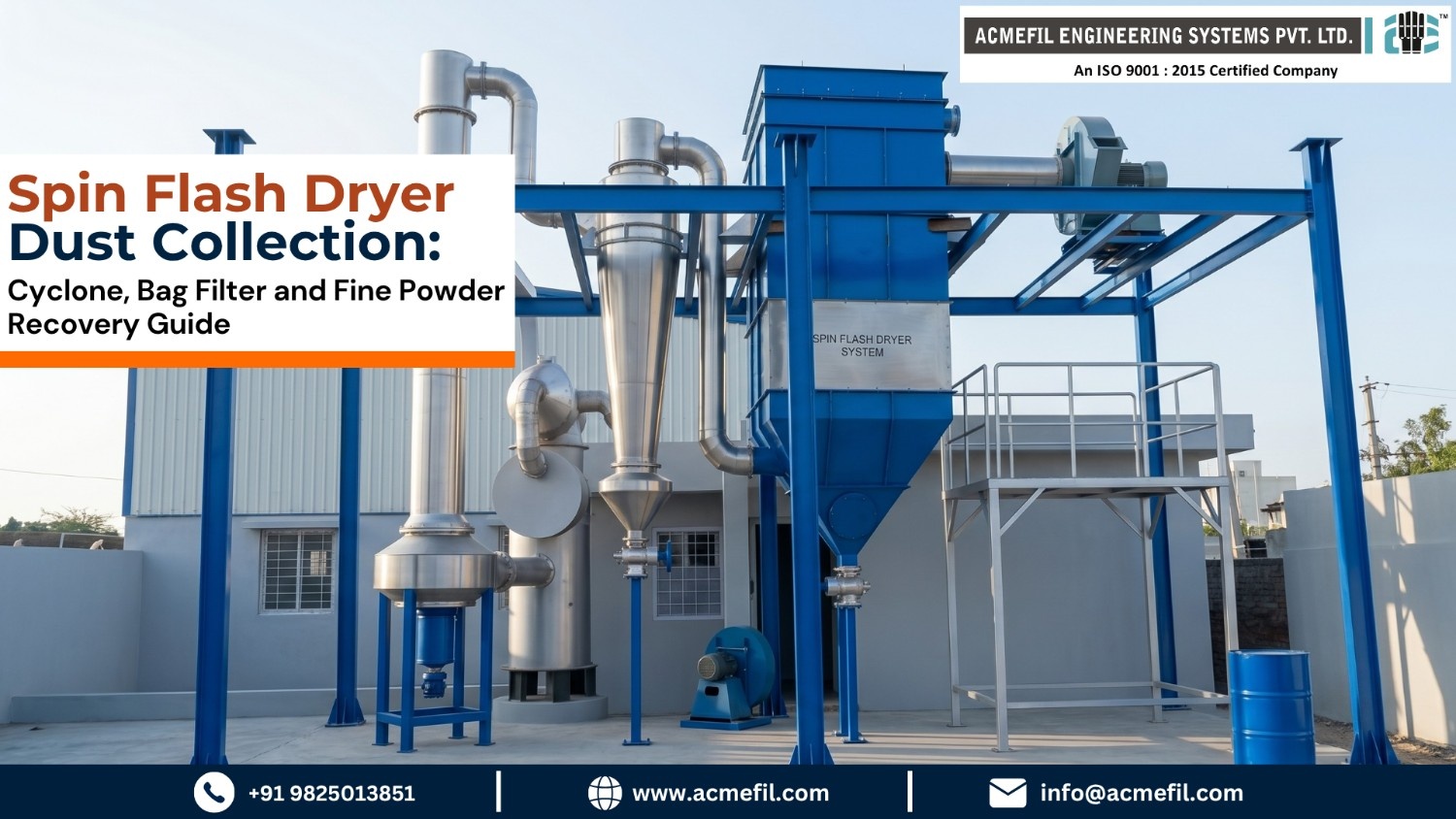
Spin flash dryer dust collection is not a separate accessory. It is part of the drying circuit. In a spin flash dryer, wet cake is broken by a disintegrator, dried in a hot air stream, and carried forward as powder-laden air. The cyclone separator collects the major powder fraction, while the bag filter captures fine particles before exhaust air leaves the system.
If the dust collection system is undersized or poorly selected, the dryer may still evaporate moisture, but the plant will face powder loss, high emissions, unstable airflow, filter choking, housekeeping problems and product recovery losses.
Why Dust Collection Matters in a Spin Flash Dryer
A spin flash dryer handles materials that are difficult for a standard flash dryer, such as filter cake, sticky wet cake, gelatinous paste, high-viscosity sludge, dyestuff cake, pigment cake and agrochemical intermediates.
Once this material enters the drying chamber, the disintegrator breaks lumps into smaller particles. Hot air removes moisture quickly. The dried particles move upward with the air stream and must be separated properly.
That is where dust collection becomes critical.
A well-designed spin flash dryer dust collection system does five jobs:
- Recovers dried powder from the air stream
- Reduces fine dust discharge from the exhaust
- Keeps airflow stable through the dryer
- Prevents fine powder from escaping into the plant area
- Protects downstream fan, ducting and stack from excess dust load
In my experience, buyers often focus only on the drying chamber and heat source. That is incomplete thinking. In spin flash drying, powder separation and dust collection decide whether the system remains clean, stable and commercially practical after commissioning.
For a deeper understanding of the core dryer mechanism, read the guide on spin flash dryer working principle.
How Dust Forms Inside a Spin Flash Dryer
Dust in a spin flash dryer is not always a waste stream. In many applications, fine dust is also saleable product. The issue is not only dust removal, it is controlled product recovery.
Dust generation normally happens at these points:
| Dust Generation Point | What Happens | Why It Matters |
|---|---|---|
| Feed disintegration zone | Wet cake lumps are broken by the rotating disintegrator | Creates fine particles and exposes surface area for drying |
| Drying chamber | Moisture evaporates and particles become lighter | Fine powder gets carried upward with hot air |
| Classifying zone or outlet | Oversized particles may fall back, lighter particles move forward | Affects final particle size and powder carryover |
| Cyclone separator | Major powder fraction separates by centrifugal action | Poor cyclone selection increases bag filter loading |
| Bag filter inlet | Fine dust reaches filter bags | Bag area, fabric and pulse cleaning must suit the dust |
| Rotary valve discharge | Powder exits the collector hopper | Air leakage can disturb system draft and powder discharge |
For detailed dryer layout logic, refer to design and operation inside spin flash dryers.
Typical Dust Collection Arrangement in a Spin Flash Dryer
A practical spin flash dryer dust collection line usually follows this sequence:
Wet cake feed screw → spin flash dryer chamber → cyclone separator → pulse jet bag filter → induced draft fan → exhaust stack
The cyclone separator handles the heavier powder fraction first. The bag filter then captures fine powder that escapes the cyclone. Rotary air lock valves are commonly used below the cyclone and bag filter hoppers to discharge powder while limiting air leakage.
In simple words:
The cyclone protects the bag filter from heavy dust loading.
The bag filter protects the exhaust air from fine powder discharge.
The fan maintains the required airflow and draft through the system.
This is why dust collection should be selected with the complete dryer line, not as a standalone item.
Cyclone Separator vs Bag Filter in Spin Flash Dryer Dust Collection
| Parameter | Cyclone Separator | Pulse Jet Bag Filter |
|---|---|---|
| Main role | Primary powder recovery | Fine dust collection and exhaust cleaning |
| Best for | Coarser and heavier dried particles | Fine powder, light dust and carryover |
| Working principle | Centrifugal separation | Filtration through fabric bags |
| Moving parts | No internal moving filtration element | Pulse cleaning system, valves and filter bags |
| Pressure drop | Usually lower than bag filter | Depends on dust load, bag area and cleaning cycle |
| Product recovery role | Collects major product fraction | Recovers fine product fraction |
| Risk if undersized | High carryover to bag filter | High emission, bag choking, fan load increase |
| Maintenance focus | Duct erosion, air leakage, rotary valve | Bag condition, pulse cleaning, differential pressure |
A cyclone alone is usually not enough when the product is fine, light or valuable. A bag filter alone may work in some fine-dust cases, but it can face heavy loading if no cyclone is placed upstream. The right arrangement depends on particle size, dust load, product value, emission requirement and plant layout.
For broader comparison of dust separation methods, ACMEFIL’s guide on cyclone separators and dust collection methods is a useful support reference.
What the Cyclone Does in a Spin Flash Dryer
The cyclone separator receives powder-laden air from the dryer outlet. The air enters tangentially, creating a swirling motion. Heavier particles move toward the cyclone wall and fall into the hopper. Cleaner air with finer particles moves toward the outlet and continues to the bag filter.
In spin flash drying, the cyclone must match:
- Airflow rate
- Powder loading
- Particle size distribution
- Bulk density
- Product abrasiveness
- Operating temperature
- Moisture carryover risk
- Rotary valve discharge rate
A cyclone that looks correct on paper can still perform poorly if the actual dried powder is much finer than expected. This is common with dyes, pigments and chemical intermediates where the product becomes light and dusty after drying.
What the Bag Filter Does in a Spin Flash Dryer
The bag filter captures fine particles that pass through the cyclone. In many spin flash dryer systems, a pulse jet bag filter is used because it supports continuous operation. Compressed air pulses clean the filter bags at controlled intervals, allowing dust to fall into the hopper.
The bag filter must be selected based on:
- Air volume
- Dust load after cyclone
- Dust fineness
- Dust stickiness
- Operating temperature
- Moisture and condensation risk
- Bag fabric compatibility
- Cleaning air pressure
- Required outlet emission level
- Product recovery value
A pulse jet bag filter is not just a box with filter bags. In a spin flash dryer, it is part of the process balance. If the filter blinds, the airflow drops. If the airflow drops, drying changes. If drying changes, final moisture can become unstable.
The Most Common Dust Collection Problems in Spin Flash Dryers
High dust emission from the exhaust
This usually happens when the bag filter is undersized, filter bags are damaged, pulse cleaning is weak, or the dust is finer than expected. It can also happen when the cyclone is not removing enough powder before the bag filter.
Bag filter choking
Bag choking often comes from high moisture carryover, condensation, sticky dust, incorrect bag fabric, low pulse pressure, poor hopper discharge or too high air-to-cloth ratio.
In sticky wet cake applications, this problem is serious because a small amount of undried or semi-dried material can blind filter bags quickly.
High pressure drop
A rising differential pressure across the bag filter is an early warning sign. It may indicate filter blinding, excessive dust loading, insufficient pulse cleaning, hopper build-up or airflow imbalance.
Product loss
If fine powder escapes through the exhaust, the plant loses saleable material. This matters especially in pigments, dyestuffs, pharmaceutical intermediates, specialty chemicals and agrochemical powders.
Dust leakage near rotary valves
Rotary air lock valves below the cyclone and bag filter must discharge powder without allowing uncontrolled air leakage. Poor sealing can disturb system draft and create dusting around the discharge point.
Condensation inside the bag filter
If exhaust temperature falls near dew point, moisture can condense on filter bags. Once sticky dust meets moisture, blinding becomes difficult to reverse. This is why temperature and moisture balance must be reviewed before finalizing the collector.
For operating discipline around such problems, see spin flash drying best practices for operation.
Design Data Needed Before Selecting Dust Collection
Do not buy a dust collector for a spin flash dryer based only on motor HP, vessel diameter or a generic airflow number. The correct design needs process data.
| Required Data | Why It Is Needed |
|---|---|
| Feed material name | Determines dust behavior and safety checks |
| Feed form | Wet cake, paste, sludge or filter press discharge |
| Initial moisture | Drives evaporation load and airflow |
| Final moisture target | Affects drying temperature and residence time |
| Particle size after drying | Determines cyclone and bag filter duty |
| Bulk density | Affects separation and hopper discharge |
| Hygroscopic nature | Indicates moisture pick-up and filter blinding risk |
| Stickiness | Affects ducting, hopper and filter bag behavior |
| Abrasiveness | Impacts cyclone, bends, ducts and valves |
| Operating temperature | Controls bag fabric and insulation selection |
| Dust load | Determines collector size and pressure drop |
| Combustible dust risk | Requires proper safety evaluation |
| Product recovery requirement | Decides whether fine dust is waste or valuable product |
This is also why pilot trials are useful for difficult materials. ACMEFIL has pilot plant facilities for spin flash dryer trials, which helps validate drying and separation behavior before full-scale procurement.
Dust Collection for Different Spin Flash Dryer Applications
Dyestuff and dye intermediate drying
Dyestuff cakes often create fine, coloured powder after drying. The dust collection system must focus on product recovery, colour cross-contamination control, filter cleaning and clean discharge.
Typical concerns:
- Fine powder carryover
- Staining around leakage points
- Bag cleaning effectiveness
- Product collection from cyclone and bag filter hoppers
- Safe handling of powder during discharge
Pigment cake drying
Pigments can be fine, dusty and valuable. The cyclone may collect the larger fraction, but the bag filter becomes important for fine pigment recovery. Bag fabric selection and hopper discharge are critical.
Agrochemical wet cake drying
Agrochemical powders may require careful dust containment and safety review. Do not treat this as only a drying problem. Dust handling, operator exposure, product recovery and cleaning access matter.
Sludge drying
Sludge drying creates a different challenge. The product may be dusty, irregular or sticky depending on composition. If the feed contains organics, salts or variable solids, the dust collector must be reviewed with actual feed data, not assumptions.
For sludge-specific selection logic, see spin flash dryer for sludge drying.
Heat-sensitive chemical powders
Spin flash dryers use short residence time, which can help reduce heat exposure. But fine powder collection still needs careful design because overheating, excessive residence in hot zones, or poor airflow control can affect product quality.
Bag Filter Selection Points for Spin Flash Dryer Dust Collection
A bag filter should be selected after reviewing the full process line. The main selection points are:
Filter area
The filter area must match airflow and dust loading. If the filter area is too low, velocity through the bags rises and pressure drop increases.
Bag fabric
Bag fabric must suit temperature, moisture, dust chemistry and cleaning method. This should not be selected generically.
Pulse cleaning system
Pulse jet cleaning must provide enough cleaning energy without damaging bags or disturbing powder discharge.
Hopper design
The hopper should allow collected powder to discharge smoothly. Sticky or hygroscopic powders may need special attention to avoid bridging.
Air lock rotary valve
The rotary valve must match powder flow, temperature and pressure condition. A poor rotary valve can become a hidden cause of dust leakage and unstable airflow.
Access for maintenance
Filter bag replacement, inspection doors, pulse valve access and hopper cleaning access must be considered during layout finalization.
For buyers comparing equipment options, this guide on how to choose a spin flash dryer gives a wider selection framework.
Maintenance Checklist for Spin Flash Dryer Dust Collection
A dust collection system performs well only when maintenance is disciplined. The following checks should be part of routine operation.
| Checkpoint | What to Monitor | Warning Sign |
|---|---|---|
| Differential pressure | Bag filter pressure drop | Rising DP means filter blinding or high dust load |
| Pulse jet cleaning | Pulse pressure and cycle | Weak pulse, continuous DP increase |
| Filter bags | Wear, holes, clogging | Dust at stack, powder leakage, poor cleaning |
| Cyclone hopper | Powder discharge | Build-up, bridging, irregular discharge |
| Rotary valve | Leakage and wear | Dust escape, unstable draft |
| Ducting | Bends, joints, insulation | Dust leakage, erosion, condensation |
| ID fan | Vibration, load, airflow | Airflow drop, abnormal sound |
| Exhaust stack | Visible dust | Bag leak or poor filtration |
| Housekeeping | Dust around equipment | Leakage from flange, valve or discharge point |
I prefer using differential pressure as a daily operating signal. Operators should not wait for visible dust before taking action. By the time dust is visible from the stack, the filter problem may already be advanced.
Safety Note for Combustible or Reactive Dust
Some powders can create fire or explosion hazards when dispersed in air. This depends on material properties, particle size, concentration, moisture, ignition sources and confinement.
For such materials, the dust collection system needs a proper safety review. That may include dust characterization, earthing and bonding, explosion protection, isolation, venting, housekeeping, ignition source control and site-specific compliance checks.
This should be reviewed by a competent safety professional. A standard bag filter should never be assumed safe for every powder just because it can capture dust.
Questions to Ask Before Finalizing the Dust Collection System
Before you approve a spin flash dryer dust collection design, ask these questions:
- What particle size is expected after drying?
- How much powder will the cyclone collect compared to the bag filter?
- What is the expected dust load at the bag filter inlet?
- What is the designed air-to-cloth ratio?
- What filter bag material is proposed and why?
- What is the expected operating temperature at the bag filter inlet?
- Is there any condensation risk?
- How will powder discharge from the cyclone and bag filter hoppers?
- What differential pressure range is acceptable during operation?
- Has combustible dust risk been reviewed for this material?
These questions are simple, but they prevent many commissioning problems.
When Pilot Testing Helps
Pilot testing is useful when the feed is sticky, new, expensive, hazardous, highly fine, hygroscopic or inconsistent.
A pilot trial can help answer:
- Does the wet cake disperse properly?
- What particle size is produced after drying?
- How much powder reaches the cyclone?
- How much fine dust reaches the bag filter?
- Does the powder stick inside ducts or hoppers?
- Does the product meet final moisture requirement?
- Does the dust collection behavior look stable?
For difficult products, this is much safer than selecting the dust collection system only from assumptions.
Conclusion
Spin flash dryer dust collection should be designed as part of the complete drying system, not added after the dryer is selected. The cyclone separator, pulse jet bag filter, rotary air lock valves, ducting, fan and exhaust arrangement all affect drying stability, product recovery and plant cleanliness.
If your product is a dyestuff cake, pigment cake, agrochemical wet cake, filter press discharge or high-viscosity sludge, share the material data before finalizing the system. A properly selected dust collection line will recover more powder, reduce emissions, protect airflow and make daily operation easier.
To discuss your material and drying requirement, use the contact page and share feed moisture, final moisture target, feed form, expected capacity and dust behavior.
FAQs
Is a cyclone separator enough for spin flash dryer dust collection?
A cyclone separator is useful for primary powder recovery, but it is usually not enough for fine dust control. Most spin flash dryer systems require a cyclone followed by a bag filter when fine powder carryover is expected.
What type of bag filter is used in a spin flash dryer?
A pulse jet bag filter is commonly used because it allows continuous filtration and automatic cleaning of filter bags. The final selection depends on airflow, dust load, temperature, powder fineness, moisture risk and material compatibility.
Why does a spin flash dryer bag filter choke?
Bag filter choking can happen because of moisture carryover, condensation, sticky dust, excessive dust load, wrong filter bag fabric, weak pulse cleaning, poor hopper discharge or undersized filter area.
Can dust collection improve product recovery?
Yes. In many spin flash dryer applications, fine dust is not waste. It is part of the dried product. A properly designed cyclone and bag filter system helps recover both coarse and fine powder fractions.
What information is needed to design a dust collector for a spin flash dryer?
The main data required includes feed material, feed moisture, final moisture, capacity, particle size, bulk density, dust load, operating temperature, stickiness, hygroscopic nature, product recovery requirement and safety classification of the dust.

Siddharth Nair is the Technical Director at Acmefil Engineering Systems Pvt. Ltd., an ISO 9001:2015 certified manufacturer of industrial drying and evaporation systems headquartered in Ahmedabad, Gujarat, he has led technical evaluation, application engineering and customer solution design for spray dryers, multi-effect evaporators, agitated thin film dryers, spin flash dryers and zero liquid discharge systems.