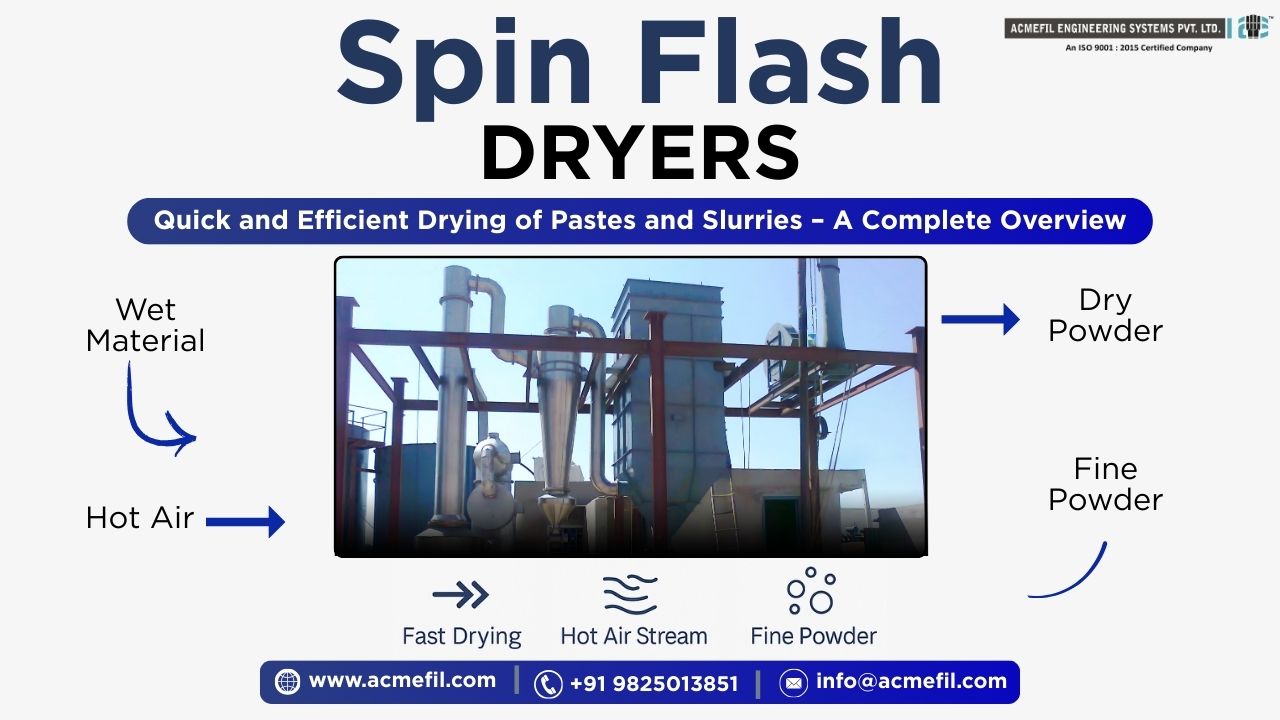
A spin flash dryer is a continuous industrial dryer used when the feed is not a free-flowing powder, but a wet cake, filter cake, sticky paste, gelatinous material, or high-viscosity sludge. It combines mechanical disintegration with hot air drying, so the wet feed breaks into smaller particles before moisture is evaporated and the dried powder is separated through a cyclone, bag filter, or both.
I normally explain spin flash drying with one practical question: can your wet material disperse properly in hot air by itself?
If the answer is no, a standard flash dryer may struggle. That is where a spin flash dryer becomes relevant.
What Is a Spin Flash Dryer?
A spin flash dryer is a drying system designed to convert wet, pasty, lumpy, or cohesive feed into dry powder in a short-residence-time drying process.
Unlike a normal flash dryer, the spin flash dryer has a mechanical disintegrator near the feed zone. This is the key difference. The disintegrator breaks the incoming wet cake or paste into smaller particles while hot air contacts the material. The smaller particles expose more surface area, moisture evaporates quickly, and the dried product moves with the air stream to the separation system.
For a deeper process-only explanation, read this separate guide on the spin flash dryer working principle.
Why Standard Flash Dryers Fail With Wet Cake and Paste
A standard flash dryer works well when the feed can disperse naturally into the hot air stream. That is usually true for centrifuged cakes, semi-dried materials, granules, or powders where surface moisture removal is the main job.
Wet cake behaves differently.
A filter cake from a dye, pigment, agrochemical, or sludge process may look manageable outside the dryer. Inside the feed zone, it may clump, bridge, smear, or stick near the inlet. If the dryer cannot break that material at the entry point, the hot air does not get proper contact with the wet surface.
The result is predictable:
- Unstable feed flow
- Build-up near the feed inlet
- Uneven drying
- Higher cleaning frequency
- Wet lumps in final product
- Lower actual throughput than design capacity
- Operator frustration because the problem looks like “low heat” but is actually poor feed dispersion
This is why I do not treat spin flash dryer selection as only a capacity calculation. Feed behavior decides the dryer first. Capacity comes after that.
How a Spin Flash Dryer Works
The spin flash drying process usually follows these steps.
Wet Feed Enters Through a Controlled Feeding System
The feed may come from a filter press, centrifuge, or upstream process. For difficult wet cake, a variable speed feed screw and lump breaking arrangement help control the material entering the drying chamber.
The feed system matters because a spin flash dryer cannot perform consistently if wet cake enters in uncontrolled lumps.
The Disintegrator Breaks the Material
At the lower section of the drying chamber, a rotating disintegrator breaks the wet feed into smaller fragments. Depending on the application, the disintegrator may be a cage mill type or pin mill type.
This mechanical action is what separates spin flash drying from basic pneumatic flash drying.
Hot Air Contacts the Dispersed Feed
Hot air enters the drying zone and contacts the smaller wet particles. Moisture evaporates rapidly because the feed has been broken and exposed to a much larger surface area.
The operating temperature approach depends on product heat sensitivity, inlet moisture, final moisture target, and whether direct or indirect heating is acceptable for the product.
Particles Dry in Suspension
As the material dries, the air stream carries the particles upward through the dryer. Heavier or wetter particles remain longer in the drying zone until they become light enough to travel with the air.
This short residence time is useful for many heat-sensitive products, but it does not mean every heat-sensitive feed is automatically suitable. The safe temperature profile still needs evaluation.
Dried Powder Is Separated From Air
The dried product is separated through a cyclone separator, bag filter, or a combination of both. Dust load, powder fineness, product recovery requirement, and environmental control decide the final separation system.
You can also read more about equipment layout and components in our guide on design and operation inside spin flash dryers.
Spin Flash Dryer vs Standard Flash Dryer
| Selection Point | Spin Flash Dryer | Standard Flash Dryer |
|---|---|---|
| Best feed form | Wet cake, filter cake, paste, gelatinous material, high-viscosity sludge | Free-flowing powder, granules, centrifuged cake, non-sticky material |
| Main mechanism | Mechanical disintegration plus hot air drying | Hot air drying and pneumatic conveying |
| Feed entry behavior | Designed to break lumps and reduce feed-zone clogging | Depends on natural feed dispersion |
| Stickiness tolerance | Better for sticky and cohesive wet feed | Limited |
| Residence time | Short | Short |
| Product separation | Cyclone, bag filter, or both | Cyclone, bag filter, or both |
| Best use case | Difficult wet material that must be converted into dry powder continuously | Surface moisture removal from powdery or semi-dry feed |
| Main risk if wrongly selected | Product degradation, excess fines, or wrong disintegrator selection | Blockage, wet lumps, unstable drying, poor throughput |
For a broader dryer-selection comparison, see spin flash dryers versus other drying systems.
Main Components of a Spin Flash Dryer System
A spin flash dryer is not only one vessel. It is a drying system. The performance depends on the full line.
Feed Screw and Lump Breaker
The feed system controls how wet cake enters the dryer. A variable speed feed screw helps match feed rate with drying capacity. Lump breaking at the feed point reduces the chance of large wet masses entering the chamber.
Disintegrator
The disintegrator is the core mechanical element. It breaks wet cake, paste, or sludge into smaller fragments. Cage mill and pin mill disintegrators are common options, but the correct choice depends on feed structure, stickiness, abrasiveness, and desired powder characteristics.
Drying Chamber
The drying chamber provides space for hot air contact, moisture evaporation, and particle movement. The geometry must support dispersion, avoid dead zones, and allow proper residence time.
Hot Air Generator
The hot air system provides the thermal energy required for evaporation. Direct fired and indirect fired hot air generators may be considered depending on contamination sensitivity, fuel availability, process requirement, and product safety.
Cyclone Separator
The cyclone separates a large portion of dried powder from the air stream. It is commonly used where particle size and dust load make centrifugal separation practical.
Bag Filter
A bag filter improves fine powder recovery and dust control. For fine pigments, dyes, agrochemical powders, and dusty chemical products, bag filter selection is not a side issue. It directly affects product recovery and plant cleanliness.
ACMEFIL’s related support equipment includes bag filters, flash dryers, and complete spin flash dryer systems for industrial drying applications.
Where Spin Flash Dryers Are Commonly Used
Spin flash dryers are selected when the feed is wet, cohesive, sticky, or difficult to disperse.
Common application areas include:
| Industry | Typical Material Behavior | Spin Flash Dryer Relevance |
|---|---|---|
| Dyestuff and dye intermediates | Filter cakes, sticky cakes, wet chemical intermediates | Helps break wet feed and dry it into powder |
| Pigments | Wet cakes, fine particles, dust-prone product | Useful where quick drying and powder recovery are required |
| Agrochemicals | Pasty or cake-like intermediates | Helps convert wet process discharge into dry product |
| Chemicals | High-moisture cakes, inorganic or organic intermediates | Useful when normal flash drying cannot disperse feed |
| Sludge handling | High-viscosity sludge, sticky residue | Useful when feed needs mechanical breakup before drying |
| Heat-sensitive materials | Product may degrade with long heat exposure | Short residence time can help, subject to trial validation |
For application-specific details, read applications of spin flash dryers across industries and the separate guide on spin flash dryer for sludge drying.
When a Spin Flash Dryer Is the Right Choice
A spin flash dryer is usually worth evaluating when:
- Feed comes from a filter press or centrifuge as wet cake
- Material is slimy, pasty, gelatinous, or high-viscosity
- A standard flash dryer faces clogging near the feed point
- Batch drying is taking too much time or labour
- The plant needs continuous drying instead of tray or batch drying
- Final product needs to be collected as dry powder
- Dust collection and cleaner operation are important
- Pilot testing is needed before full-scale investment
The strongest use case is not “any wet material.” The strongest use case is wet material that must be broken mechanically before hot air can dry it properly.
When a Spin Flash Dryer May Not Be the Right Choice
No dryer is correct for every product.
A spin flash dryer may not be suitable when:
- The product cannot tolerate mechanical disintegration
- Particle morphology must remain intact
- Long residence time is required for internal moisture diffusion
- The feed is a pumpable liquid better suited to spray drying
- The product is already free-flowing and only needs simple surface moisture removal
- The process requires very gentle low-temperature batch handling
- The material is highly abrasive and not evaluated for wear impact
- Explosion, solvent, or special containment risks have not been engineered properly
This is why selection should not be based only on catalogue capacity. For buyer-level selection guidance, refer to how to choose a spin flash dryer.
Data Buyers Should Share Before Asking for a Quote
A serious spin flash dryer inquiry should include more than “capacity per hour.” Capacity means very little unless the dryer manufacturer understands the material.
Share these details before asking for a technical proposal:
| Data Required | Why It Matters |
|---|---|
| Feed material name | Helps identify chemical, thermal, hygiene, and handling constraints |
| Feed form | Wet cake, paste, sludge, powder, granule, or slurry changes dryer selection |
| Initial moisture | Determines heat load and evaporation duty |
| Final moisture target | Decides drying intensity and residence-time requirement |
| Feed rate | Required for sizing air flow, heat duty, and equipment size |
| Bulk density | Affects conveying, separation, and discharge design |
| Stickiness and lump behavior | Critical for disintegrator and feed screw selection |
| Heat sensitivity | Decides safe inlet and outlet temperature approach |
| Abrasiveness or corrosiveness | Influences metallurgy and wear protection |
| Required material of construction | Important for chemicals, pharma, food, and corrosive applications |
| Dusting tendency | Affects cyclone, bag filter, and plant cleanliness |
| Available utilities | Fuel, steam, electricity, compressed air, and space constraints |
| Safety constraints | Toxicity, flammability, solvent presence, ATEX or explosion risk if applicable |
In my experience, the best RFQs include a small material sample, lab moisture data, and a clear final powder requirement. Without that, the proposal becomes a guess.
Pilot Testing Before Full-Scale Selection
Pilot testing is especially useful for spin flash drying because the difficult part is not only evaporation. It is feed behavior.
A lab report can tell you moisture. It cannot always tell you whether a sticky wet cake will smear, lump, break cleanly, or build up near the feed point. A pilot trial gives practical answers.
ACMEFIL has an in-house pilot plant facility where spin flash dryer trials can be evaluated at 10 kg/hr water evaporation pilot capacity. This is useful when the buyer wants to validate whether the material can be dried continuously before committing to full-scale equipment.
A trial can help check:
- Whether the feed enters smoothly
- Whether the disintegrator breaks the wet material properly
- Whether final moisture is achievable
- Whether the product becomes too fine
- Whether there is build-up inside the system
- Whether product recovery through cyclone and bag filter is acceptable
- Whether the temperature profile is safe for the material
For difficult materials, I would rather test first than oversell a dryer from a brochure.
Common Mistakes in Understanding Spin Flash Dryers
Mistake 1: Treating It Like a Normal Flash Dryer
A spin flash dryer is not just a flash dryer with a different name. The disintegrator and feed-zone design are the main reasons it works for wet cake and paste.
Mistake 2: Comparing Only Price and Capacity
The cheapest quote may become expensive if the dryer blocks, leaves wet lumps, or needs frequent cleaning. Compare feed handling, disintegrator design, dust collection, utility requirement, trial support, and after-sales capability.
Mistake 3: Ignoring Feed Variability
Wet cake from a filter press does not always behave the same every day. Moisture, cake thickness, washing, particle size, and upstream process changes affect drying behavior.
Mistake 4: Assuming Higher Temperature Solves Everything
More heat does not fix poor dispersion. If the feed remains in lumps, the outside may dry while the inside stays wet. Mechanical breakup and air contact are the main control points.
Mistake 5: Not Planning Cleaning and Maintenance
Sticky feeds can create build-up if the dryer is poorly selected or poorly operated. Maintenance planning should include feed screw inspection, disintegrator wear, cyclone and bag filter checks, rotary valve condition, and instrumentation review.
For operating discipline after installation, use this guide on spin flash drying best practices for operation.
Practical Advantages of Spin Flash Drying
When selected correctly, a spin flash dryer can offer several practical benefits:
- Continuous drying of wet cake and paste
- Reduced manual handling compared with many batch drying methods
- Short residence time for suitable heat-sensitive materials
- Better feed dispersion than a standard flash dryer
- Direct feeding from filter press discharge in suitable layouts
- Cleaner operating environment when cyclone and bag filter systems are properly designed
- Lower drying time compared with conventional slow drying methods
- Better suitability for sticky and cohesive feed materials
The exact power, fuel, and labour benefit must be validated for each plant. I would not publish a saving percentage unless it is supported by trial data or operating records.
Quick Selection Summary
Use this simple rule before shortlisting equipment:
| Feed Condition | Preferred Direction |
|---|---|
| Free-flowing powder with surface moisture | Standard flash dryer may be enough |
| Wet cake from filter press | Spin flash dryer should be evaluated |
| Sticky paste or gelatinous material | Spin flash dryer is often more suitable |
| Pumpable liquid feed | Spray dryer may be more suitable |
| Highly viscous sludge | Spin flash dryer or sludge dryer should be evaluated |
| Heat-sensitive material | Trial required before final selection |
| Product needs gentle particle preservation | Spin flash dryer may not be suitable |
FAQs
What is a spin flash dryer used for?
A spin flash dryer is used to dry wet cake, filter cake, paste, gelatinous material, high-viscosity sludge, pigments, dyes, dye intermediates, agrochemicals, and similar industrial materials. It is selected when the feed needs mechanical disintegration before rapid hot air drying.
How does a spin flash dryer work?
A spin flash dryer feeds wet material into a drying chamber through a controlled feed system. A rotating disintegrator breaks the wet feed into smaller particles. Hot air then evaporates moisture quickly, and the dried powder is carried to a cyclone separator, bag filter, or both for collection.
What is the difference between a flash dryer and a spin flash dryer?
A standard flash dryer is best for free-flowing or semi-dry materials that can disperse in hot air. A spin flash dryer is designed for wet cake, paste, sticky, slimy, or gelatinous materials that need mechanical breakup before drying.
Is a spin flash dryer suitable for heat-sensitive materials?
It can be suitable for some heat-sensitive materials because residence time is short, but this must be validated. Inlet temperature, outlet temperature, product degradation limit, moisture level, and actual feed behavior should be checked before final selection.
What information is required to size a spin flash dryer?
Important data includes feed rate, initial moisture, final moisture target, feed form, stickiness, bulk density, heat sensitivity, abrasiveness, corrosiveness, desired material of construction, dust behavior, and available utilities.
Conclusion
A spin flash dryer is best understood as a dryer for difficult wet feed, not just as another flash drying option. Its value comes from the combination of controlled feeding, mechanical disintegration, rapid hot air contact, and powder separation.
For wet cake, filter cake, sticky paste, gelatinous feed, pigments, agrochemicals, dye intermediates, and high-viscosity sludge, the first question should not be “What is the dryer capacity?” The first question should be “Will this feed disperse properly at the feed point?”
If the answer is uncertain, do not finalize selection only from a datasheet. Share your feed properties, moisture target, heat sensitivity, and sample behavior with a technical team. For difficult materials, a pilot trial is often the safest way to confirm whether a spin flash dryer is the right fit.
For technical evaluation, you can contact the Spin Flash Drying team or review ACMEFIL’s spin flash dryer system capability.

Siddharth Nair is the Technical Director at Acmefil Engineering Systems Pvt. Ltd., an ISO 9001:2015 certified manufacturer of industrial drying and evaporation systems headquartered in Ahmedabad, Gujarat, he has led technical evaluation, application engineering and customer solution design for spray dryers, multi-effect evaporators, agitated thin film dryers, spin flash dryers and zero liquid discharge systems.