A cyclone separator for spin flash dryer systems is not just a dust collection accessory. It is the primary powder recovery stage after wet cake, paste, sludge, pigment cake, dye intermediate, or agrochemical feed is dried and pneumatically carried out of the dryer.
In a good chemical drying equipment layout, the cyclone collects the major dry powder fraction, reduces the dust load on the bag filter, supports stable airflow, and helps keep product loss under control.
I have seen many drying discussions focus only on the dryer body. That is incomplete. In spin flash drying, the separation system decides whether the dried powder is recovered cleanly or lost into downstream filtration problems.
What Is a Cyclone Separator in a Spin Flash Dryer?
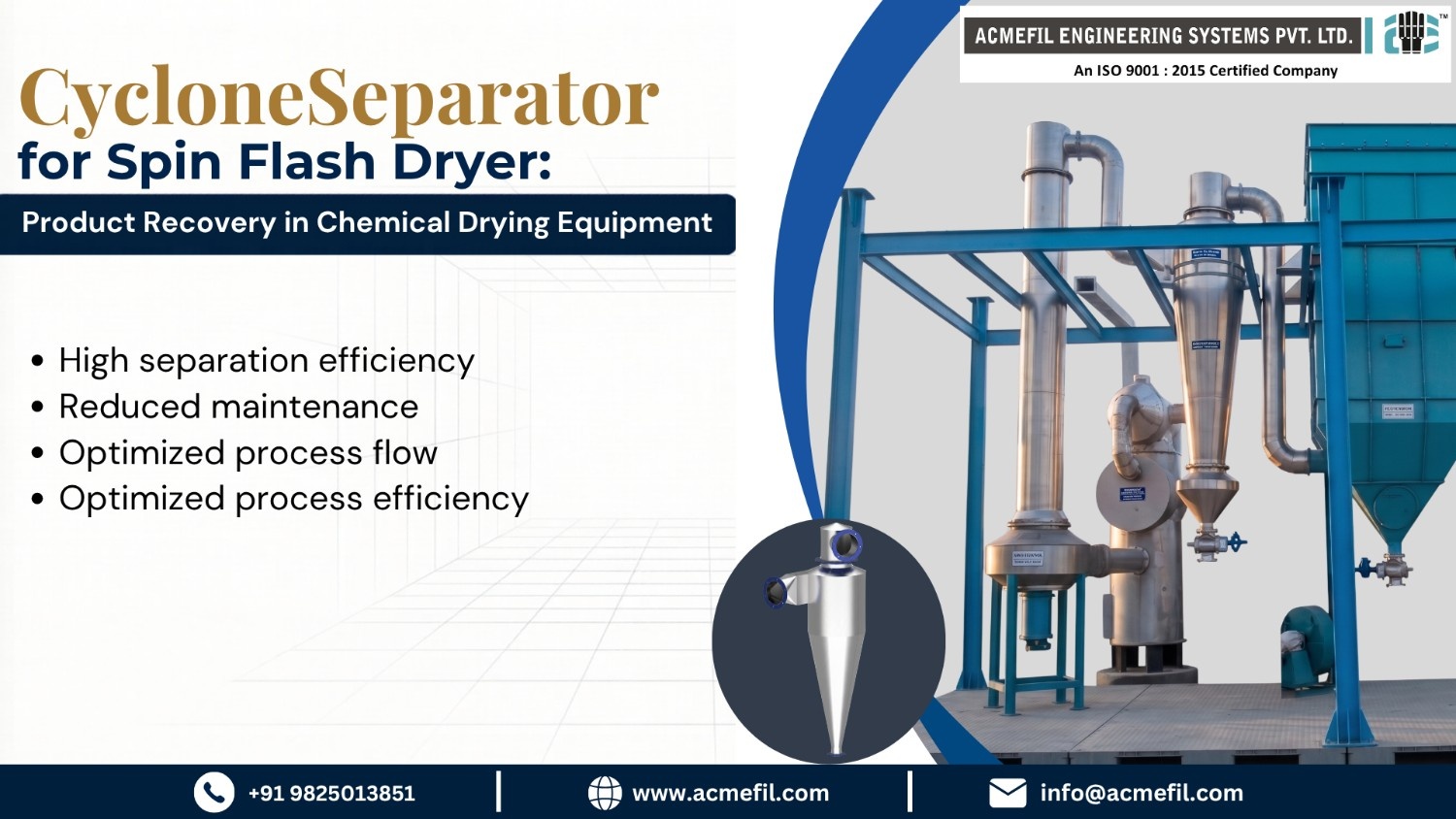
A cyclone separator is a mechanical powder separation device used after the spin flash dryer chamber. The hot air stream carries dried particles from the dryer outlet into the cyclone. Inside the cyclone, the air enters tangentially and creates a rotating vortex. Heavier powder particles move toward the cyclone wall, lose velocity, and fall into the collection hopper. Cleaner air exits from the top and normally moves toward a bag filter or final dust collection stage.
In simple terms:
The spin flash dryer dries and conveys the product.
The cyclone separator recovers the major dry powder fraction.
The bag filter captures the finer dust that escapes the cyclone.
This is why cyclone sizing should not be treated as a standard catalogue attachment. The cyclone must match the airflow, powder particle size, bulk density, moisture behavior, temperature, and final dust collection arrangement.
For a wider system view, refer to the spin flash dryer working principle guide.
Why Spin Flash Dryers Need a Cyclone Separator
A spin flash dryer is used when a standard flash dryer cannot properly handle sticky wet cake, gelatinous paste, filter press cake, or high-viscosity sludge. The feed enters through a controlled feeding system, gets broken by a disintegrator, contacts hot air, dries rapidly, and then moves with the air stream toward the separation system.
At this stage, the cyclone has four important duties.
| Cyclone duty | Why it matters in a spin flash dryer |
|---|---|
| Product recovery | Collects the major dry powder fraction from the air stream |
| Bag filter load reduction | Reduces the dust burden on downstream filter bags |
| Stable pneumatic conveying | Helps maintain practical separation after drying |
| Cleaner plant operation | Reduces uncontrolled powder carryover when properly matched with a bag filter |
If the cyclone is undersized, wrongly proportioned, or mismatched with the material, the plant can face high powder carryover, high bag filter loading, poor product yield, frequent cleaning, and unstable operation.
How the Cyclone Separator Works After Spin Flash Drying
The separation sequence is usually simple, but the engineering behind it must be correct.
Wet Cake Enters the Spin Flash Dryer
The wet feed may come from a filter press, centrifuge, or upstream process. In chemical plants, this feed may be sticky, slimy, pasty, gelatinous, abrasive, hygroscopic, or heat-sensitive.
Typical materials include:
- Dye intermediates
- Reactive dyes
- Pigments
- Inorganic chemical cakes
- J-Acid
- N-Methyl J-Acid
- Acetanilide
- Sulfotobias Acid
- Agrochemical intermediates
- High-viscosity sludge
The Disintegrator Breaks the Wet Material
The disintegrator is the reason spin flash drying works for difficult wet cake. Depending on the material behavior, a cage mill type or pin mill type disintegrator may be selected.
The purpose is not only lump breaking. It is also to expose more surface area to hot air so that moisture can evaporate quickly.
For sticky feed behavior, read the detailed guide on design and operation inside spin flash dryers.
Hot Air Dries and Carries the Product
Once the material is broken, hot air removes moisture and pneumatically carries the dry particles toward the outlet. This short residence time can be useful for many heat-sensitive products, but heat sensitivity still needs proper evaluation.
Temperature tolerance, outlet moisture target, product chemistry, and dust behavior must all be reviewed before design finalization.
The Cyclone Collects the Major Powder Fraction
The air-powder mixture enters the cyclone. The rotating flow separates larger and heavier particles from the gas stream. These particles fall into the cyclone cone and discharge through a rotary air lock valve or similar discharge arrangement.
The air leaving the cyclone still contains fine particles. That is why a bag filter is normally important after the cyclone.
The Bag Filter Captures Fine Dust
The cyclone does not replace the bag filter in most fine chemical powder applications. Pigments, dyes, agrochemical powders, and many inorganic chemicals can contain fine dust that needs secondary filtration.
A bag filter for spin flash dryer helps recover fine powder and improve dust control after the cyclone stage.
Cyclone Separator vs Bag Filter in Spin Flash Dryer Systems
A cyclone and a bag filter do different jobs. A common mistake is treating them as interchangeable.
| Selection point | Cyclone separator | Bag filter |
|---|---|---|
| Main role | Collects major powder fraction | Captures finer dust from exhaust air |
| Best at handling | Coarser and heavier particles | Fine particles and residual dust |
| Moving parts | No major internal moving parts | Pulse cleaning and filter bags involved |
| Pressure drop concern | Must be controlled through correct sizing | Increases if filter bags load heavily |
| Maintenance concern | Erosion, plugging, air leakage, hopper discharge | Bag blinding, pulse failure, leakage, cleaning frequency |
| In spin flash dryer | Primary product recovery stage | Final dust collection and fine powder recovery stage |
The best layout is often cyclone plus bag filter, not cyclone or bag filter alone.
For plants comparing complete dryer options, the spin flash dryer vs other drying technologies article can help with equipment-level selection.
Why Cyclone Design Is Critical for Chemical Drying Equipment
Chemical drying equipment is more demanding than general powder handling. The product may be corrosive, abrasive, temperature-sensitive, dusty, sticky, or hygroscopic. These properties directly affect cyclone design.
Particle Size and Density
Cyclone collection depends strongly on particle size and density. Coarser and denser particles separate more easily. Very fine and low-density particles are more likely to pass through the cyclone and reach the bag filter.
That is why powder behavior after drying must be understood, not guessed.
Airflow and Inlet Velocity
The cyclone must receive the right air volume at the right velocity. Too little velocity can reduce separation. Too much velocity can increase pressure drop, erosion, and re-entrainment.
This is a system design issue. The dryer, cyclone, ducting, bag filter, fan, and rotary valves must be evaluated together.
Moisture and Stickiness
If the product reaches the cyclone with residual stickiness, the cone or outlet may start building deposits. This can create unstable discharge, pressure imbalance, and cleaning problems.
Final moisture target and cyclone wall temperature both matter in sticky chemical powder service.
Abrasion and Corrosion
Some pigments, inorganic chemicals, and dye intermediates can be abrasive or corrosive. Material of construction, wall thickness, lining requirement, access doors, and maintenance planning should be selected accordingly.
Fine Dust Load
If too much fine powder escapes the cyclone, the bag filter may face high loading. This can increase pulse cleaning frequency, pressure drop, filter wear, and downtime.
A well-selected cyclone protects the bag filter from avoidable load.
Common Problems When the Cyclone Is Wrongly Selected
A weak cyclone design can make a good dryer look like a bad dryer. These are the problems I would check first during evaluation.
| Problem | Likely cause | Practical impact |
|---|---|---|
| High powder carryover | Cyclone not matched to particle size or airflow | Product loss and high bag filter load |
| Frequent cyclone choking | Sticky powder, poor discharge, wrong cone angle, moisture issue | Downtime and unstable drying |
| High bag filter pressure drop | Excess fine carryover from cyclone | Higher cleaning frequency and maintenance |
| Erosion inside cyclone | High-velocity abrasive particles | Metal wear and leakage risk |
| Product buildup in hopper | Poor discharge arrangement or air leakage | Irregular powder collection |
| Dust leakage at discharge | Poor rotary valve sealing or poor collection design | Housekeeping and safety concern |
| Moist powder in cyclone | Incomplete drying or wrong outlet condition | Deposits, lumps, and collection difficulty |
If these symptoms appear, do not only increase fan speed or adjust temperature blindly. Check the complete air and powder path.
Cyclone Separator in Chemical Drying Equipment: Where It Fits
In chemical drying equipment, the cyclone separator is usually part of a larger drying and powder handling system.
A practical spin flash dryer layout may include:
- Feed hopper or wet cake receiving arrangement
- Variable speed screw feeder
- Lump breaker or feed conditioning system
- Spin flash dryer with cage mill or pin mill disintegrator
- Hot air generator
- Drying chamber
- Cyclone separator
- Rotary air lock valve
- Bag filter
- Exhaust fan or blower
- Control panel and instrumentation
- Powder collection or conveying system
This layout must be built around the material. A dye intermediate cake and a high-viscosity sludge do not behave the same way. A pigment cake and an agrochemical intermediate may need different powder recovery and dust control decisions.
For difficult feed materials, the guide on how to choose a spin flash dryer explains the larger selection logic.
Cyclone Only or Cyclone Plus Bag Filter?
For most chemical powder drying applications, cyclone plus bag filter is safer than cyclone only.
A cyclone-only arrangement may be considered only when the product is coarse enough, emission control requirements are addressed, and fine dust carryover is acceptable within the process design. In fine chemical drying, this is often not the case.
A cyclone plus bag filter arrangement is preferred when:
- Product is fine or dusty
- Powder recovery is commercially important
- The plant needs cleaner exhaust handling
- The material is pigment, dye, inorganic chemical, or agrochemical powder
- The bag filter must be protected from excessive coarse powder load
- The process needs better control over product carryover
The cyclone should remove the major powder load. The bag filter should polish the remaining fine dust. That division of duty improves stability.
Key Design Data Needed Before Selecting the Cyclone
A cyclone separator should not be selected only by dryer capacity. Capacity tells only part of the story.
Before finalizing the cyclone in a spin flash dryer system, prepare these details:
| Required data | Why it matters |
|---|---|
| Feed material name | Helps identify chemical, corrosion, toxicity, and dust concerns |
| Feed form | Wet cake, paste, sludge, slurry, or powder behavior affects drying |
| Initial and final moisture | Determines drying load and risk of sticky discharge |
| Dry powder particle size | Strongly affects cyclone recovery |
| Bulk density | Affects separation and discharge behavior |
| Airflow rate | Needed for cyclone diameter and velocity selection |
| Operating temperature | Affects material selection and condensation risk |
| Abrasiveness | Impacts cyclone wear protection |
| Corrosiveness | Impacts material of construction |
| Hygroscopicity | Impacts deposit and post-drying handling risk |
| Dust explosibility or safety concern | Requires proper safety review before design |
| Bag filter arrangement | Decides downstream load and pressure balance |
| Rotary valve size and sealing | Affects powder discharge and air leakage |
Moisture percentage alone is not enough. Two cakes with the same moisture can behave very differently. One may break easily into powder, while another may smear, stick, and form deposits.
How ACMEFIL Approaches Cyclone Selection in Spin Flash Dryer Projects
ACMEFIL Engineering Systems Pvt. Ltd. manufactures drying and concentrating equipment for chemical, dye, pigment, pharmaceutical, food, ceramic, and effluent treatment applications. For spin flash dryer projects, the system is evaluated from feed behavior first, not from a fixed cyclone size.
The main engineering questions are:
- Can the wet cake feed continuously?
- Does the feed need a cage mill or pin mill type disintegrator?
- What final moisture is required?
- How fine will the dried powder be?
- Will the powder be abrasive, sticky, corrosive, or hygroscopic?
- Should the cyclone be followed by a bag filter?
- What rotary air lock valve is needed under the cyclone?
- Is a pilot trial needed before full-scale design?
ACMEFIL’s in-house pilot plant includes spin flash dryer trial capability with 10 kg/hr water evaporation capacity. For difficult wet cake, sludge, dye intermediate, pigment, or agrochemical drying, this trial can help validate feed behavior, drying response, cyclone collection behavior, and bag filter load before scaling the system.
For equipment-level inquiry, visit the spin flash dryer manufacturer page or submit product details through the contact page.
Buyer Checklist Before Requesting a Cyclone Separator Quote
Use this checklist before sending an RFQ for a cyclone separator for spin flash dryer systems:
- What is the material name and chemical category?
- Is the feed wet cake, paste, slurry, sludge, or powder?
- What is the feed rate?
- What is the initial moisture and required final moisture?
- Is the product heat-sensitive?
- What is the expected dry powder particle size?
- Is the product abrasive or corrosive?
- Does the material become sticky near final moisture?
- Is the powder hygroscopic after drying?
- Is dust recovery commercially important?
- Is the system cyclone-only or cyclone plus bag filter?
- What is the required material of construction?
- Is direct hot air acceptable, or is indirect heating required?
- Will the powder discharge into bags, bins, or conveying equipment?
- Is pilot testing required before final design?
The more complete this data is, the better the technical proposal will be.
Practical Conclusion
A cyclone separator for spin flash dryer systems directly affects product recovery, dust load, bag filter performance, powder discharge, and plant cleanliness. In chemical drying equipment, it should be selected as part of the complete drying system, not as a separate dust collector.
For wet cake, paste, high-viscosity sludge, pigments, dye intermediates, and agrochemical products, the correct question is not only “Which dryer do we need?” The better question is “How will the dried powder be separated, collected, filtered, and discharged after drying?”
That is where the cyclone separator becomes critical.
FAQs
What is the role of a cyclone separator in a spin flash dryer?
A cyclone separator collects the major dry powder fraction from the air stream after the spin flash dryer. The dryer removes moisture and pneumatically carries the powder. The cyclone separates much of that powder from the exhaust air before the air moves toward the bag filter.
Is a cyclone separator enough for chemical drying equipment?
Usually not for fine chemical powders. A cyclone can recover the major powder fraction, but fine dust often requires a downstream bag filter. For dyes, pigments, agrochemicals, and inorganic chemicals, cyclone plus bag filter is normally a more practical arrangement than cyclone alone.
Why does powder carry over from the cyclone to the bag filter?
Powder carryover can happen when particles are too fine or light, airflow is not correctly balanced, cyclone velocity is wrong, the cyclone is worn, discharge is leaking air, or the powder remains sticky. The dryer, cyclone, bag filter, fan, ducting, and rotary valve should be checked as one system.
Which materials need a cyclone separator after spin flash drying?
Typical materials include wet filter cake, dye intermediates, pigments, reactive dyes, J-Acid, N-Methyl J-Acid, Acetanilide, Sulfotobias Acid, agrochemical intermediates, paste-like chemicals, and high-viscosity sludge. Final suitability depends on feed behavior, powder size, moisture target, and dust characteristics.
What data is needed to design a cyclone separator for a spin flash dryer?
Important data includes material name, feed form, initial moisture, final moisture, feed rate, dry powder particle size, bulk density, airflow, operating temperature, abrasiveness, corrosiveness, hygroscopicity, dust behavior, bag filter arrangement, and discharge method.
Conclusion
For a spin flash dryer, the cyclone separator is one of the most important components after the drying chamber. It decides how much dried powder is recovered before the bag filter and how stable the downstream dust collection system will be.
If your plant is drying chemical wet cake, pigment cake, dye intermediate, agrochemical paste, or high-viscosity sludge, evaluate the cyclone, bag filter, fan, rotary valve, and dryer as one integrated system. Share your material data before finalizing the equipment configuration.

Siddharth Nair is the Technical Director at Acmefil Engineering Systems Pvt. Ltd., an ISO 9001:2015 certified manufacturer of industrial drying and evaporation systems headquartered in Ahmedabad, Gujarat, he has led technical evaluation, application engineering and customer solution design for spray dryers, multi-effect evaporators, agitated thin film dryers, spin flash dryers and zero liquid discharge systems.