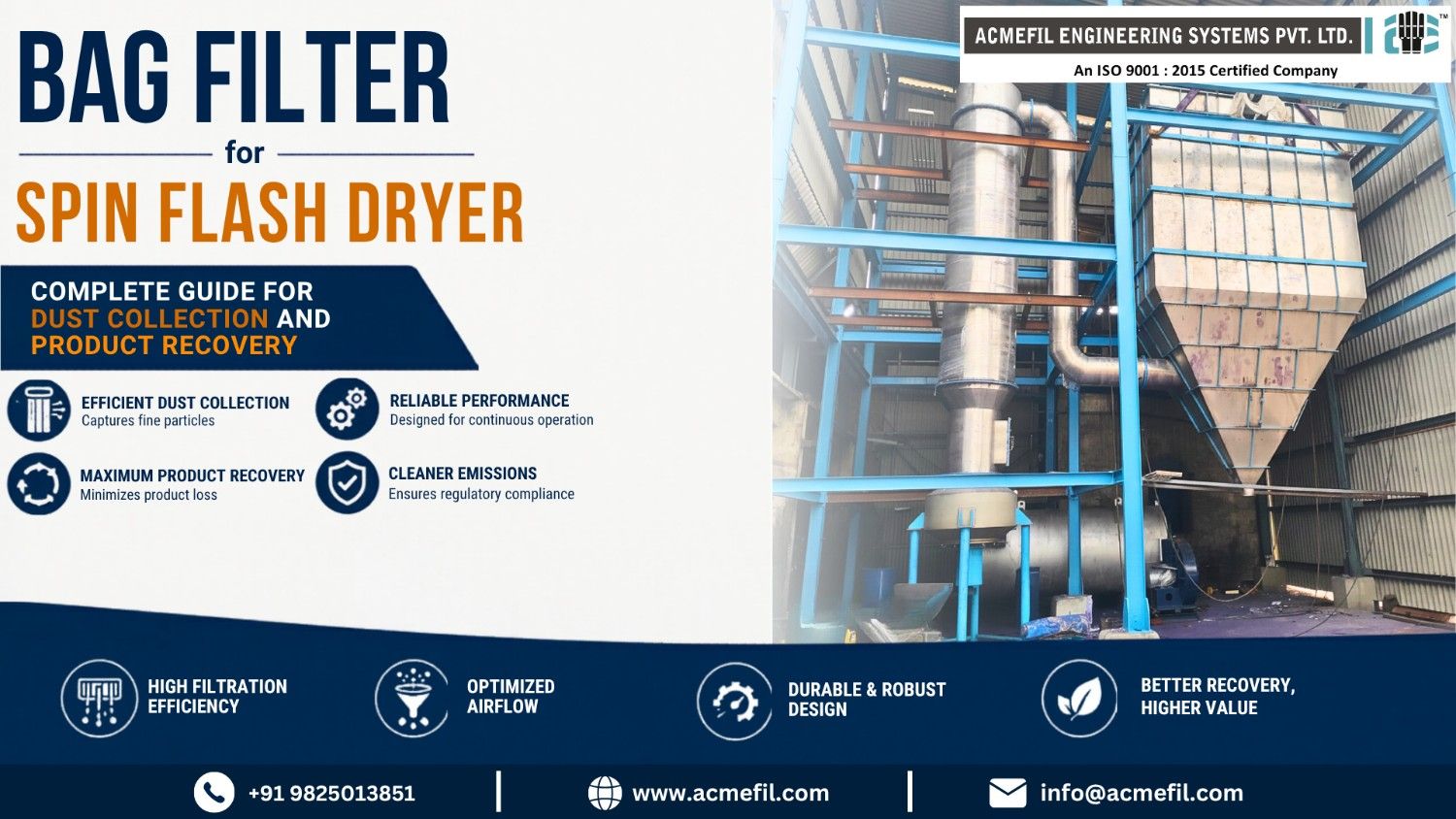
A bag filter for spin flash dryer is not just an air pollution control accessory. It is a critical part of the drying system that captures fine powder from exhaust air, improves product recovery, reduces dust discharge, and helps maintain stable airflow through the dryer. In spin flash drying, where wet cake, paste, gelatinous material, pigments, dyes, agrochemical products, and high-viscosity sludge are converted into dry powder, the bag filter protects both the plant environment and the final product yield.
In my experience, buyers often focus heavily on the dryer body, disintegrator, feed screw, and hot air generator. That is understandable. But if the powder recovery and exhaust filtration system is poorly selected, even a mechanically sound spin flash dryer can face powder loss, bag choking, unstable suction, high differential pressure, and dusty plant conditions.
For a complete understanding of the drying mechanism before the filtration stage, you can also read the detailed guide on spin flash dryer working principle.
What Is a Bag Filter in a Spin Flash Dryer System?
A bag filter, also called a baghouse filter or pulse jet bag filter, is a dust collection unit installed after the drying and separation stage of a spin flash dryer. Its job is to separate fine dry powder particles from the exhaust air before the air moves toward the induced draft fan and stack.
In a typical spin flash dryer system, wet feed enters through a screw feeder and passes into the drying zone, where a disintegrator breaks lumps and exposes more surface area to hot air. The material dries rapidly in suspension. Heavier dried particles are usually separated in a cyclone separator. Finer particles that escape the cyclone are then captured by the bag filter.
A well-designed spin flash dryer bag filter performs four main functions:
- Recovers fine powder that would otherwise be lost in exhaust air
- Reduces dust emission from the dryer exhaust
- Maintains cleaner operating conditions around the plant
- Protects downstream equipment such as the ID fan and ducting from excessive powder loading
For industrial drying plants handling valuable powders, fine pigments, reactive dyes, chemical intermediates, and agrochemical products, the recovery side is as important as the pollution control side.
Where Is the Bag Filter Installed in a Spin Flash Dryer?
The bag filter is normally installed after the cyclone separator and before the induced draft fan. The usual process flow is:
Wet cake or paste feed → Feed screw and lump breaker → Disintegrator → Hot air drying chamber → Cyclone separator → Bag filter → ID fan → Stack
This arrangement allows the cyclone to remove the larger dried powder fraction first. The bag filter then handles the fine particles that remain suspended in the exhaust air.
For very fine powders or products with high dust carryover, the bag filter becomes more important because the cyclone alone may not recover enough fines. That is why the dust collection section should be designed along with the dryer, not added later as a separate low-priority item.
If you are comparing different system layouts, the article on design and operation inside spin flash dryers will help you understand where filtration fits into the full process.
Bag Filter vs Cyclone in Spin Flash Drying
A cyclone and a bag filter do different jobs. One should not be treated as a direct replacement for the other without process evaluation.
| Parameter | Cyclone Separator | Bag Filter |
|---|---|---|
| Main role | Separates heavier dried powder particles | Captures fine powder and dust from exhaust air |
| Position in system | Usually before bag filter | Usually after cyclone and before ID fan |
| Best suited for | Coarser or heavier particles | Fine, light, dusty particles |
| Moving parts | No major internal moving parts | Pulse cleaning system, filter bags, cages, valves |
| Product recovery value | High for coarse powder fraction | High for fine powder fraction |
| Maintenance concern | Erosion, buildup, air leakage | Bag choking, differential pressure, pulse cleaning, bag wear |
| Common mistake | Expecting cyclone to catch all fines | Undersizing bag area or selecting wrong filter media |
In most spin flash dryer systems for dyes, pigments, filter cakes, and fine chemical powders, a cyclone plus bag filter arrangement gives more practical recovery and cleaner exhaust than a cyclone alone.
Why Bag Filter Design Is Critical for Spin Flash Dryer Performance
The bag filter affects the entire airflow balance of the dryer. A spin flash dryer depends on controlled hot air movement to disperse, dry, and convey the product. If the bag filter starts choking or the pressure drop rises sharply, the dryer may lose stable suction.
That can create several problems:
| Bag Filter Problem | What Happens in the Dryer |
|---|---|
| High differential pressure | Reduced airflow, poor powder conveying, unstable drying |
| Bag blinding due to sticky or moist fines | Frequent cleaning, production stoppage, powder buildup |
| Wrong filter media | Short bag life, poor dust capture, product contamination risk |
| Poor hopper discharge | Re-entrainment of powder, choking below bag filter |
| Air leakage | Loss of suction control and dusty operation |
| Condensation inside filter | Muddy powder buildup, bag choking, corrosion risk |
| Weak pulse cleaning | Filter bags do not release dust properly |
This is why I do not recommend treating the bag filter as a standard bought-out item selected only by inlet duct size. It must be matched to the feed, drying temperature, powder fineness, exhaust air volume, expected dust load, moisture behaviour, and product chemistry.
How a Pulse Jet Bag Filter Works in Spin Flash Dryer Exhaust
A pulse jet bag filter uses rows of filter bags mounted on cages. Dust-laden air enters the filter housing. Fine powder is retained on the outer surface of the filter bags while clean air passes through the fabric and moves toward the outlet.
As powder builds up on the bags, compressed air pulses are released at controlled intervals. These pulses shake off the collected dust cake from the bags. The recovered powder falls into the hopper and is discharged through an airlock or suitable discharge arrangement.
In a spin flash dryer, this pulse cleaning system must be stable because the dryer operates continuously. If pulse timing, compressed air quality, bag area, or hopper discharge is wrong, the filter can become the bottleneck of the entire drying line.
For wider operating guidance, see spin flash drying best practices for operation.
Key Selection Criteria for Bag Filter for Spin Flash Dryer
A good bag filter selection starts with the process data, not with the physical size of the filter body.
Product and Feed Characteristics
The first question is: what material are we drying?
A bag filter for pigment drying may need different attention than one used for sludge drying or dye intermediate drying. The powder may be fine, abrasive, hygroscopic, sticky at certain moisture levels, chemically reactive, or temperature-sensitive.
Important product details include:
- Product name and chemical nature
- Wet feed type, such as filter cake, paste, or sludge
- Inlet moisture and target outlet moisture
- Expected powder fineness after drying
- Bulk density of dried powder
- Stickiness or hygroscopic behaviour
- Corrosive or abrasive nature
- Heat sensitivity
- Dust explosibility review, where applicable
For sticky wet cake and paste applications, read this guide on how to choose a spin flash dryer before finalizing the system.
Exhaust Air Temperature and Moisture
The bag filter must operate above the dew point of the exhaust air. If the exhaust temperature drops too low, moisture can condense inside the bag filter. Once condensation combines with fine powder, the filter bags can blind quickly.
This is common when the dryer handles wet cake with high inlet moisture, or when ducting is long and poorly insulated. The issue is not always visible immediately. The system may run well during the first few hours, then pressure drop increases as moisture and powder form a sticky layer on the bags.
Good design must consider:
- Dryer outlet air temperature
- Moisture load in exhaust air
- Duct heat loss
- Startup and shutdown conditions
- Insulation requirement
- Bag filter location relative to dryer outlet
Dust Load and Air Volume
The bag filter must be sized for the exhaust air volume and dust load from the dryer. Undersizing the filter reduces capital cost on paper, but it usually increases maintenance and operating trouble.
When the filtration area is insufficient, air velocity through the bags becomes too high. The dust cake becomes harder to release, differential pressure rises faster, and the pulse cleaning system has to work harder.
For spin flash dryer applications, sizing should be based on actual process duty, not only a generic airflow estimate.
Filter Media Selection
Filter media selection depends on exhaust temperature, product chemistry, moisture, particle size, and abrasion tendency. The filter cloth should tolerate the operating condition and release dust efficiently during pulse cleaning.
Wrong media selection can create one of two failures:
- Fine powder passes through the bags and reaches the stack
- Powder sticks to the bags and does not release during pulse cleaning
Both failures are serious. One creates dust loss and emission issues. The other creates choking, downtime, and unstable dryer operation.
Material of Construction
The bag filter housing and contact parts should be selected based on product corrosivity, process temperature, and plant hygiene expectations.
For chemical, pigment, dye, and agrochemical applications, mild steel may be suitable in some duties, while stainless steel or lined construction may be needed where corrosion, contamination, or cleaning requirements are stricter. This should be confirmed from product data and plant environment.
Hopper and Discharge Arrangement
A bag filter is not only a filtration box. It is also a powder recovery point.
If the hopper angle, rotary airlock, discharge valve, or screw discharge is poorly selected, recovered powder may bridge, accumulate, or get re-entrained into the airflow. This creates unstable recovery and unnecessary dust loading inside the filter.
For fine powder, the hopper discharge arrangement must be discussed during RFQ, not after installation.
Common Bag Filter Problems in Spin Flash Dryer Plants
Bag Choking
Bag choking usually happens due to moisture condensation, sticky fines, undersized filtration area, wrong filter media, or weak pulse cleaning. In a spin flash dryer, it can also happen when partially dried material reaches the filter because the dryer is overloaded or feed rate is unstable.
High Differential Pressure
High differential pressure means the filter is resisting airflow. The ID fan then struggles to maintain proper suction. This affects the dryer’s ability to convey dry powder and maintain stable drying conditions.
Operators should not keep increasing fan load without identifying why the pressure drop is rising. The root cause may be bag blinding, hopper buildup, pulse failure, moisture carryover, or process imbalance.
Fine Powder Loss
Fine powder loss may happen if bags are damaged, media is unsuitable, sealing is poor, or pulse cleaning is too aggressive. In high-value products like pigments, dyes, and specialty chemicals, this directly affects yield.
Moisture Carryover
Moisture carryover from incomplete drying can cause powder to stick in the cyclone, duct, and bag filter. This is often wrongly blamed only on the bag filter. The actual problem may be feed rate fluctuation, insufficient hot air, poor disintegration, wrong outlet temperature control, or unsuitable dryer sizing.
Hopper Bridging
Fine powder can bridge in the hopper if the discharge angle, airlock, vibration, or screw discharge is not suitable. Once the hopper fills, dust can re-enter the filter body and increase loading on the bags.
Maintenance Checklist for Spin Flash Dryer Bag Filter
A bag filter needs disciplined maintenance. Small issues become expensive when the dryer is running continuously.
Use this checklist during regular operation:
| Area to Check | What to Look For |
|---|---|
| Differential pressure | Sudden rise, slow continuous increase, unstable readings |
| Pulse jet system | Solenoid valve function, pulse timing, compressed air pressure |
| Compressed air quality | Moisture or oil in pulse air |
| Filter bags | Wear, holes, blinding, poor dust release |
| Bag cages | Corrosion, bending, poor fitment |
| Hopper | Powder buildup, bridging, poor discharge |
| Rotary airlock | Leakage, jamming, worn blades |
| Ducting | Powder deposition, leakage, insulation gaps |
| Stack discharge | Visible dust, unusual colour, product loss |
| Access doors and seals | Air leakage and dust escape |
A practical maintenance plan should be part of the full dryer lifecycle cost, not only a post-installation activity. For cost-related planning, you can refer to spin flash dryer maintenance cost analysis.
When Does a Spin Flash Dryer Need a Stronger Bag Filter System?
A more carefully engineered bag filter system becomes necessary when:
- Product is very fine and dusty
- Powder has high value and recovery loss is expensive
- Feed has high moisture and risk of sticky carryover
- Product is hygroscopic
- Material is abrasive or corrosive
- Dryer operates continuously for long shifts
- Local dust emission requirement is strict
- Plant wants cleaner operating conditions
- Cyclone recovery alone is not enough
- Powder discharge from the filter must go back into product collection
Applications such as pigment drying, reactive dye drying, agrochemical powder drying, and sludge-to-powder drying often need careful bag filter selection because the product behaviour is not always forgiving.
For sludge-related drying, see spin flash dryer for sludge drying.
What Data Should You Give Before Selecting a Bag Filter?
A reliable RFQ for a bag filter for spin flash dryer should include:
| Data Required | Why It Matters |
|---|---|
| Product name and industry | Helps assess chemical compatibility and dust behaviour |
| Wet feed form | Filter cake, paste, sludge, granular cake, or semi-dry powder |
| Feed moisture and final moisture | Defines drying load and carryover risk |
| Feed rate | Helps estimate air volume and dust load |
| Dryer inlet and outlet temperature | Important for filter media and condensation control |
| Particle size or fineness | Affects cyclone and bag filter recovery split |
| Bulk density | Affects hopper and discharge design |
| Material of construction preference | Needed for corrosion and contamination control |
| Operating hours | Affects duty cycle and maintenance planning |
| Plant layout | Helps decide duct routing and filter location |
| Local emission requirement | Required for dust control target |
| Utility availability | Compressed air, power, space, access platform |
If this data is not available, pilot trials or small-scale process validation may be useful before final equipment sizing. Acmefil’s process capability includes spin flash dryer trials at 10 kg/hr water evaporation capacity, which can help evaluate difficult wet cake or paste behaviour before full-scale procurement.
How Bag Filter Design Affects Product Quality
Product quality in spin flash drying is not only decided inside the dryer chamber. It is also affected by how the dried powder is separated, collected, and discharged.
A poor bag filter design can create:
- Fine powder loss
- Cross-contamination risk from old powder deposits
- Heat exposure due to poor airflow balance
- Moisture pickup if condensation occurs
- Non-uniform product recovery between cyclone and bag filter fractions
- Dusty work area around discharge points
For powders where particle size, moisture, colour, or purity matters, the separation and collection section should be reviewed with the same seriousness as the drying section.
Bag Filter for Spin Flash Dryer in Dyes, Pigments, and Chemicals
Dyes and pigments often create fine dust. In these applications, a bag filter helps capture valuable fines and reduce powder escape into the exhaust stream.
For reactive dyes, dye intermediates, pigments, and agrochemical powders, the process team should check whether the dried powder is abrasive, sticky, corrosive, or sensitive to temperature. The bag filter media, housing material, pulse system, hopper discharge, and sealing arrangement should be selected accordingly.
This is also where a generic dust collector may fail. A bag filter connected to a spin flash dryer is part of a thermal process line. It must be compatible with hot, moist, product-laden exhaust air.
For broader material fit, read applications of spin flash dryers across industries.
Practical Buying Advice
Do not buy the bag filter separately based only on the lowest quotation. Buy it as a process-matched part of the spin flash dryer system.
Before finalizing the supplier, ask these questions:
- Is the bag filter sized for actual dryer exhaust airflow and dust load?
- What filter media is recommended and why?
- What is the expected operating temperature at the bag filter inlet?
- How will condensation be avoided during startup, normal running, and shutdown?
- How will recovered fine powder be discharged?
- Is the hopper designed for the powder’s flow behaviour?
- What maintenance access is provided for bag replacement?
- What differential pressure monitoring is included?
- Is the bag filter integrated with the dryer’s control logic?
- Has the product been tested or reviewed for sticky, corrosive, abrasive, or combustible dust behaviour?
These questions usually reveal whether the vendor understands the complete drying system or is only quoting a standalone dust collector.
For engineered support equipment, you can also review Acmefil’s bag filter product page and spin flash dryer manufacturer page for related equipment context.
Conclusion
A bag filter for spin flash dryer directly affects powder recovery, dust control, airflow stability, maintenance frequency, and plant cleanliness. In fine chemical, pigment, dye, agrochemical, and sludge drying applications, it should be treated as a process-critical component, not an optional add-on.
The correct approach is to size the spin flash dryer, cyclone, bag filter, ID fan, ducting, airlock, and discharge system as one integrated drying line. If the feed is sticky, gelatinous, heat-sensitive, corrosive, or very fine after drying, the bag filter design needs even more attention.
For wet cake, paste, pigment, dye, sludge, or agrochemical drying trials, share your product data and process requirement through the SpinFlashDrying.com contact page. A process review can help decide whether cyclone plus bag filter recovery is suitable for your material.
FAQs
Is a bag filter required in every spin flash dryer?
Not every application has the same dust load, but most industrial spin flash dryer systems handling fine powders benefit from a bag filter after the cyclone. It helps recover fine powder and reduce dust discharge from exhaust air.
Can a cyclone replace a bag filter in a spin flash dryer?
A cyclone can remove heavier powder particles, but fine particles may still pass through with the exhaust air. For fine, dusty, or high-value powders, a bag filter after the cyclone is usually more practical for fine recovery and cleaner exhaust.
Why does the bag filter choke in a spin flash dryer?
Common reasons include moisture condensation, sticky or partially dried powder carryover, wrong filter media, insufficient filter area, weak pulse cleaning, poor compressed air quality, or hopper discharge blockage.
What type of bag filter is used for spin flash dryer exhaust?
Pulse jet bag filters are commonly used because they can clean filter bags automatically during operation. The exact design depends on product dust load, exhaust temperature, moisture, powder fineness, chemistry, and operating duty.
What data is needed to size a bag filter for a spin flash dryer?
Key data includes product name, feed moisture, final moisture, feed rate, dryer outlet temperature, particle size, powder density, expected dust load, air volume, product chemistry, operating hours, plant layout, and emission requirement.

Siddharth Nair is the Technical Director at Acmefil Engineering Systems Pvt. Ltd., an ISO 9001:2015 certified manufacturer of industrial drying and evaporation systems headquartered in Ahmedabad, Gujarat, he has led technical evaluation, application engineering and customer solution design for spray dryers, multi-effect evaporators, agitated thin film dryers, spin flash dryers and zero liquid discharge systems.