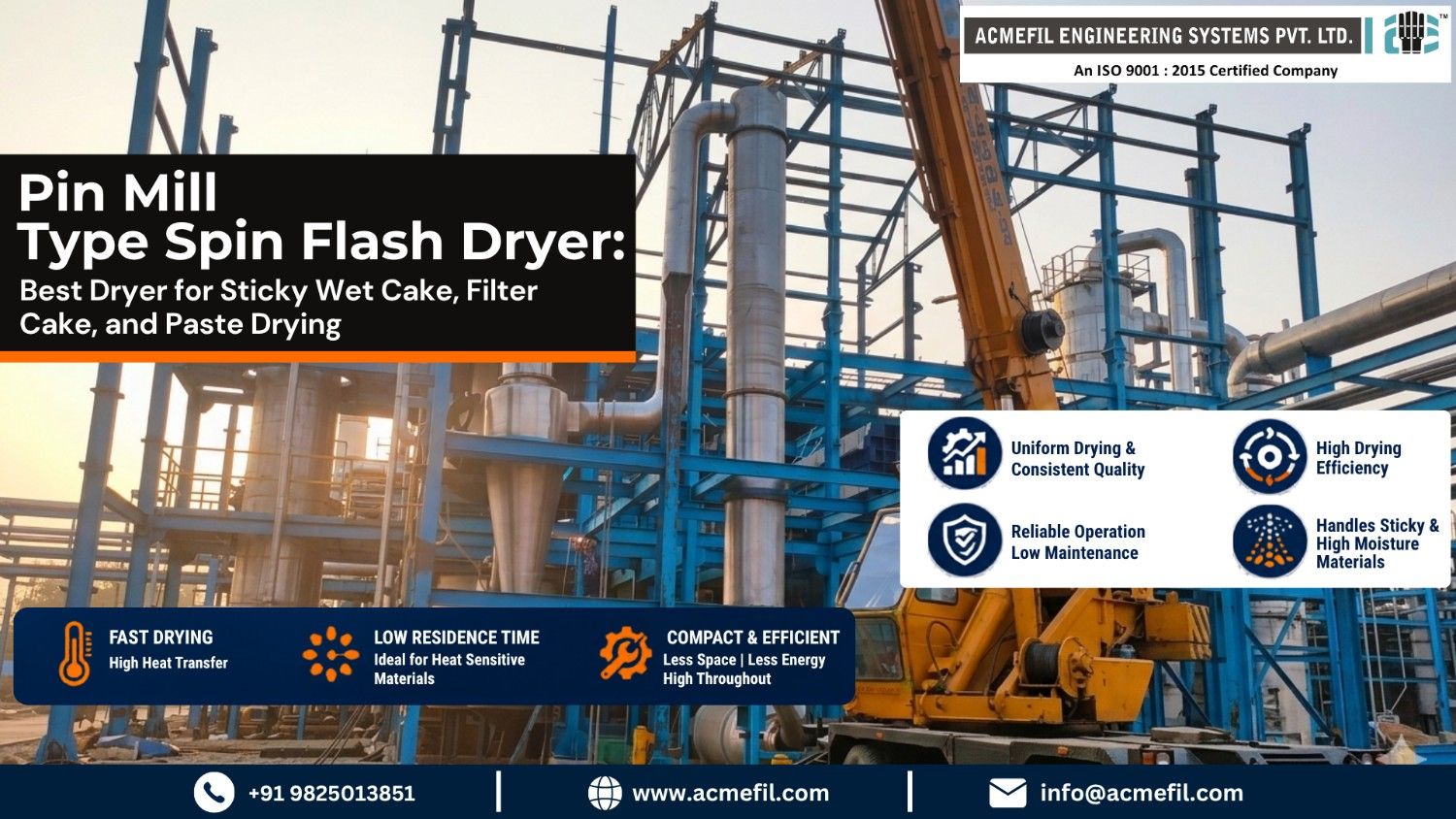
Pin Mill Type Spin Flash Dryer
A pin mill type spin flash dryer is used when wet cake, sticky paste, gelatinous material, or high-viscosity sludge cannot be dispersed properly in a standard flash dryer. The pin mill disintegrator breaks the incoming lumps at the feed zone so hot air can contact more surface area quickly. This helps convert difficult wet cake into a dry, conveyable powder in a short residence time.
In my experience, this is not only a drying problem. It is a feed dispersion problem. If the material enters the dryer as large sticky lumps, no amount of hot air will give stable drying.
For difficult wet cakes from dyes, pigments, agrochemicals, and chemical intermediates, the pin mill type arrangement can be the difference between continuous operation and repeated choking.
What Is a Pin Mill Type Spin Flash Dryer?
A pin mill type spin flash dryer is a spin flash drying system fitted with a pin mill style disintegrator near the feed entry. The system combines three actions in one continuous operation:
- Controlled feeding of wet cake or paste
- Mechanical disintegration of sticky lumps by the pin mill zone
- Rapid drying by hot air contact and pneumatic conveying
The objective is not simply to heat the product. The objective is to break the wet feed into smaller fragments before and during drying so that moisture can leave the material quickly and uniformly.
A normal flash dryer works well for free-flowing powders or centrifuged cakes. But many filter press cakes do not behave like free-flowing powder. They arrive as lumps, paste, sticky slabs, or slimy mass. A pin mill type spin flash dryer is designed for this more difficult feed behavior.
For a broader understanding of the system, you can also read the detailed guide on spin flash dryer working principle.
Why Standard Flash Dryers Fail with Sticky Wet Cake
A standard flash dryer depends on instant dispersion of feed into a high velocity hot air stream. This works only when the material can separate easily.
Sticky wet cake creates different problems:
| Problem in Standard Flash Dryer | What Happens in Operation |
|---|---|
| Wet cake enters as lumps | Hot air contacts only the outer surface |
| Paste does not disperse | Moisture remains trapped inside |
| Feed sticks near entry point | Choking and unstable operation increase |
| Oversized wet particles travel upward | Final moisture becomes inconsistent |
| Operators increase temperature blindly | Product quality risk increases without solving feed dispersion |
This is why the disintegrator matters. In a pin mill type spin flash dryer, the feed is mechanically opened up before it travels through the drying column. The dryer is not only moving air. It is actively preparing the material for drying.
How a Pin Mill Type Spin Flash Dryer Works
The working sequence is simple, but every stage must be correctly designed.
Wet Cake Feeding
The wet cake normally comes from a filter press, centrifuge, or upstream process. A variable speed screw feeder controls the feed rate into the dryer. This control is important because sticky materials do not flow consistently on their own.
If the feed screw overloads the dryer, wet material accumulates. If it underfeeds, the dryer runs inefficiently and product quality fluctuates.
Pin Mill Disintegration
At the feed zone, the pin mill disintegrator subjects the incoming material to high-speed impact and shear. The wet lumps break into smaller fragments.
This is the most important part of the system for sticky material. The pin mill helps expose fresh surface area so moisture can evaporate faster when hot air contacts the material.
Hot Air Contact
Hot air enters the drying chamber and immediately contacts the dispersed material. Because the material has already been broken into smaller particles, drying happens rapidly.
The residence time is short compared with many conventional dryers. This is useful for many heat-sensitive chemical products because the material is exposed to heat for a limited time.
Particle Classification and Drying Column Movement
Lighter dry particles are carried upward by the air stream. Heavier or wetter particles remain longer near the lower section until they become light enough to move with the air.
This natural classification helps reduce the chance of wet lumps passing directly to final collection.
Cyclone and Bag Filter Separation
After drying, the powder is separated from the air stream through a cyclone and, where required, a bag filter or pulse jet bag filter system. The collected powder is discharged through an air lock rotary valve.
For dust-heavy applications, the dust collection system is not optional. It directly affects product recovery, housekeeping, emissions control, and plant cleanliness.
For related dust collection understanding, see Acmefil’s support page on bag filter systems.
Where Pin Mill Type Spin Flash Dryer Is Most Useful
A pin mill type spin flash dryer is generally considered when the feed has one or more of these characteristics:
| Feed Condition | Why Pin Mill Type Helps |
|---|---|
| Sticky wet cake | Breaks lumps before drying |
| Filter press discharge | Handles uneven cake pieces better than simple flash drying |
| Gelatinous paste | Helps open up the mass for hot air contact |
| High viscosity sludge | Reduces feed choking risk through mechanical disintegration |
| Pigment cake | Supports faster drying and powder formation |
| Dye intermediate cake | Useful where filter cake is difficult to disperse |
| Agrochemical intermediate | Helps convert wet cake into dry powder continuously |
Acmefil’s verified application areas for spin flash dryers include filter cakes, dye intermediates, reactive dyes, J-Acid, N-Methyl J-Acid, Acetanilide, Sulfotobias Acid, pastes, high viscous sludge, pigments, and agrochemicals.
Pin Mill Type vs Cage Mill Type Spin Flash Dryer
Both pin mill and cage mill type disintegrators are used in spin flash dryers. The right choice depends on feed behavior, lump strength, moisture, abrasiveness, temperature sensitivity, and final powder requirement.
| Selection Point | Pin Mill Type Spin Flash Dryer | Cage Mill Type Spin Flash Dryer |
|---|---|---|
| Main action | High intensity impact and de-lumping near feed zone | Strong mechanical breaking and dispersion |
| Best suited for | Sticky wet cake, paste-like material, smaller lump breaking requirement | Tougher wet lumps, heavier cake pieces, stronger mechanical deagglomeration need |
| Feed control need | High, because overfeeding can choke the disintegrator zone | High, especially for heavy cake feeding |
| Trial importance | Very important for sticky and heat-sensitive feeds | Very important for hard or irregular cake lumps |
| Final selection basis | Product trial, feed rheology, moisture, lump behavior, powder target | Product trial, lump strength, drying load, power and wear behavior |
There is no universal answer that pin mill is always better than cage mill. I would not finalize this selection only from a datasheet. A wet cake trial gives much better evidence because two materials with the same moisture percentage can behave completely differently inside the feed zone.
For selection logic, refer to the guide on how to choose a spin flash dryer.
Key Components in a Pin Mill Type Spin Flash Dryer System
A complete system normally includes more than the dryer body. For stable plant operation, each supporting component matters.
| Component | Function |
|---|---|
| Feed hopper | Receives wet cake or paste |
| Variable speed screw feeder | Controls feed rate into dryer |
| Lump breaker or pre-breaker | Reduces large wet masses before the main disintegrator |
| Pin mill disintegrator | Breaks sticky feed at the dryer entry zone |
| Hot air generator | Supplies drying air, direct or indirect depending on product requirement |
| Drying chamber | Provides space for hot air contact and particle movement |
| Cyclone separator | Recovers dried powder from air stream |
| Bag filter | Captures fine dust and improves product recovery |
| ID fan / system fan | Maintains air movement and pressure balance |
| Air lock rotary valve | Discharges product while reducing air leakage |
| Control panel | Controls temperature, feed rate, airflow, and operating sequence |
A spin flash dryer should not be purchased as only a vessel with a motor. The feeding system, hot air system, separation system, fan sizing, and discharge arrangement decide how the dryer performs in real production.
Industries That Use Pin Mill Type Spin Flash Dryers
Dye and Dye Intermediate Industry
Dye intermediate wet cakes are often sticky, colored, and difficult to dry uniformly. Products such as reactive dyes, J-Acid, N-Methyl J-Acid, and Sulfotobias Acid may require controlled disintegration before drying.
A pin mill type spin flash dryer helps by breaking the cake at the feed zone and reducing the dependence on slow tray drying or manual handling.
Pigment Industry
Pigment cakes can form dense wet lumps after filtration. If these lumps are not broken properly, the outer layer dries while the inner portion remains wet.
Pin mill type spin flash drying helps expose more surface area and supports more uniform drying.
Agrochemical Industry
Many agrochemical intermediates are processed as wet cakes or pastes. Drying selection must consider thermal sensitivity, dusting behavior, particle size requirement, and safe material handling.
The pin mill type configuration can be evaluated when the feed is cohesive and difficult to disperse.
Chemical Wet Cake Drying
Chemical filter cakes vary widely. One product may be granular and easy to flash dry. Another may be sticky, gelatinous, or high viscosity. For the second type, a pin mill type spin flash dryer may be more practical than a standard flash dryer.
Practical Benefits of Pin Mill Type Spin Flash Drying
When correctly selected, the pin mill type spin flash dryer can offer important practical benefits:
- Direct drying of wet cake or paste from filtration process
- Reduced manual handling compared with conventional open drying methods
- Faster drying due to disintegration and hot air contact
- Cleaner operating environment when paired with cyclone and bag filter separation
- Lower heat exposure time compared with long residence time drying systems
- Continuous operation potential for chemical and pigment production
- Better feed control with variable speed screw feeding
- Reduced clogging risk when lump breaker and feed system are properly designed
These benefits depend on correct sizing, feed characterization, and trial validation. They should not be assumed only from equipment name.
What Data Is Needed Before Sizing the Dryer?
Before selecting a pin mill type spin flash dryer, the manufacturer should ask for process data. If this data is missing, the quotation becomes guesswork.
| Data Required | Why It Matters |
|---|---|
| Feed moisture | Decides evaporation load |
| Final moisture target | Defines drying duty and outlet condition |
| Feed form | Cake, paste, sludge, gelatinous mass, or powder |
| Bulk density | Affects feeding and collection design |
| Stickiness behavior | Decides disintegrator and feed system design |
| Lump size | Helps select pre-breaker and pin mill configuration |
| Heat sensitivity | Controls inlet and outlet temperature approach |
| Material of construction requirement | Depends on corrosion, hygiene, and product chemistry |
| Capacity requirement | Determines dryer size, air volume, thermal load, and separation system |
| Dust explosibility or solvent presence | May require special safety review and non-standard system design |
A good RFQ should include a sample or trial request wherever possible. For difficult wet cakes, pilot testing is often more reliable than assumptions.
Acmefil has an in-house pilot plant facility, and the spin flash dryer pilot capacity is verified at 10 kg/hr water evaporation. For uncertain products, this trial can help validate whether pin mill type drying is suitable before moving to full-scale equipment.
Common Mistakes Buyers Should Avoid
Choosing Dryer Type Only by Moisture Percentage
Moisture percentage alone does not tell you whether the material will dry well. A 35% moisture cake that breaks easily may dry better than a 25% moisture gelatinous paste.
Feed behavior matters more than only moisture.
Ignoring Feed System Design
Many spin flash dryer problems start before drying begins. If the wet cake bridges in the hopper or overloads the screw feeder, the dryer cannot perform consistently.
Selecting Pin Mill or Cage Mill Without Trial
A pin mill type system may suit one product. A cage mill type may suit another. Without trial data, selection risk increases.
Underestimating Dust Collection
Fine powders from pigments, dyes, and chemicals can load the separation system heavily. Cyclone and bag filter design must match the powder behavior and air volume.
Asking Only for Price
Price matters, but it should not be the first selection criterion. For wet cake drying, a cheaper dryer that chokes or gives inconsistent moisture becomes expensive after installation.
For a broader technology comparison, read spin flash dryer vs other dryers.
When Should You Choose a Pin Mill Type Spin Flash Dryer?
You should evaluate a pin mill type spin flash dryer when:
- Your feed is wet cake, paste, or sticky sludge
- A normal flash dryer cannot disperse the material
- The product forms lumps after filter press discharge
- You need continuous drying instead of open tray drying
- The product requires short residence time drying
- You want to reduce manual wet cake handling
- Final powder consistency is affected by poor lump breaking
- Pilot testing confirms that pin mill disintegration gives stable drying
You should not select it blindly for every wet material. Very hard lumps, abrasive feed, solvent-loaded products, or special safety-sensitive materials need detailed engineering review.
Conclusion
A pin mill type spin flash dryer is a practical solution for sticky wet cake, filter cake, paste, gelatinous material, high viscosity sludge, pigments, dyes, and agrochemical intermediates where standard flash drying fails because the material does not disperse.
The core advantage is the disintegrator action at the feed zone. The pin mill breaks wet lumps, exposes more surface area, and allows hot air to dry the material quickly in suspension. But the final success depends on proper feed testing, screw feeder design, hot air sizing, cyclone and bag filter selection, and product-specific trial validation.
For difficult wet cake drying, do not finalize the dryer only from catalogue capacity. Share the feed sample, moisture data, final powder requirement, and operating constraints. A pilot trial can confirm whether pin mill type spin flash drying is the right route before full-scale investment.
To discuss a wet cake, paste, sludge, pigment, dye, or agrochemical drying application, connect through the SpinFlashDrying.com contact page or review Acmefil’s spin flash dryer manufacturing page.
FAQs
What is a pin mill type spin flash dryer?
A pin mill type spin flash dryer is a spin flash dryer fitted with a pin mill style disintegrator at the feed zone. It breaks sticky wet cake, paste, or sludge into smaller particles so hot air can dry the material quickly and carry it to the cyclone and bag filter system.
What materials can be dried in a pin mill type spin flash dryer?
It can be evaluated for filter cakes, dye intermediates, reactive dyes, J-Acid, N-Methyl J-Acid, Acetanilide, Sulfotobias Acid, pigments, agrochemical intermediates, pastes, and high viscosity sludge. Final suitability should be confirmed through feed data and trial testing.
How is a pin mill type spin flash dryer different from a normal flash dryer?
A normal flash dryer depends mainly on hot air and pneumatic conveying. A pin mill type spin flash dryer adds mechanical disintegration at the feed entry, which helps break sticky wet cake or paste before drying. This makes it more suitable for difficult feeds that do not disperse naturally.
Is pin mill type better than cage mill type?
Not always. Pin mill type and cage mill type disintegrators solve similar but not identical feed problems. Selection depends on lump strength, stickiness, moisture, abrasiveness, final powder requirement, and pilot trial results.
Why is pilot testing important for pin mill type spin flash dryers?
Pilot testing shows how the actual wet cake behaves inside the feed and disintegration zone. It helps confirm feed rate, drying temperature approach, clogging tendency, powder recovery, final moisture, and whether pin mill type disintegration is suitable before full-scale plant purchase.

Siddharth Nair is the Technical Director at Acmefil Engineering Systems Pvt. Ltd., an ISO 9001:2015 certified manufacturer of industrial drying and evaporation systems headquartered in Ahmedabad, Gujarat, he has led technical evaluation, application engineering and customer solution design for spray dryers, multi-effect evaporators, agitated thin film dryers, spin flash dryers and zero liquid discharge systems.