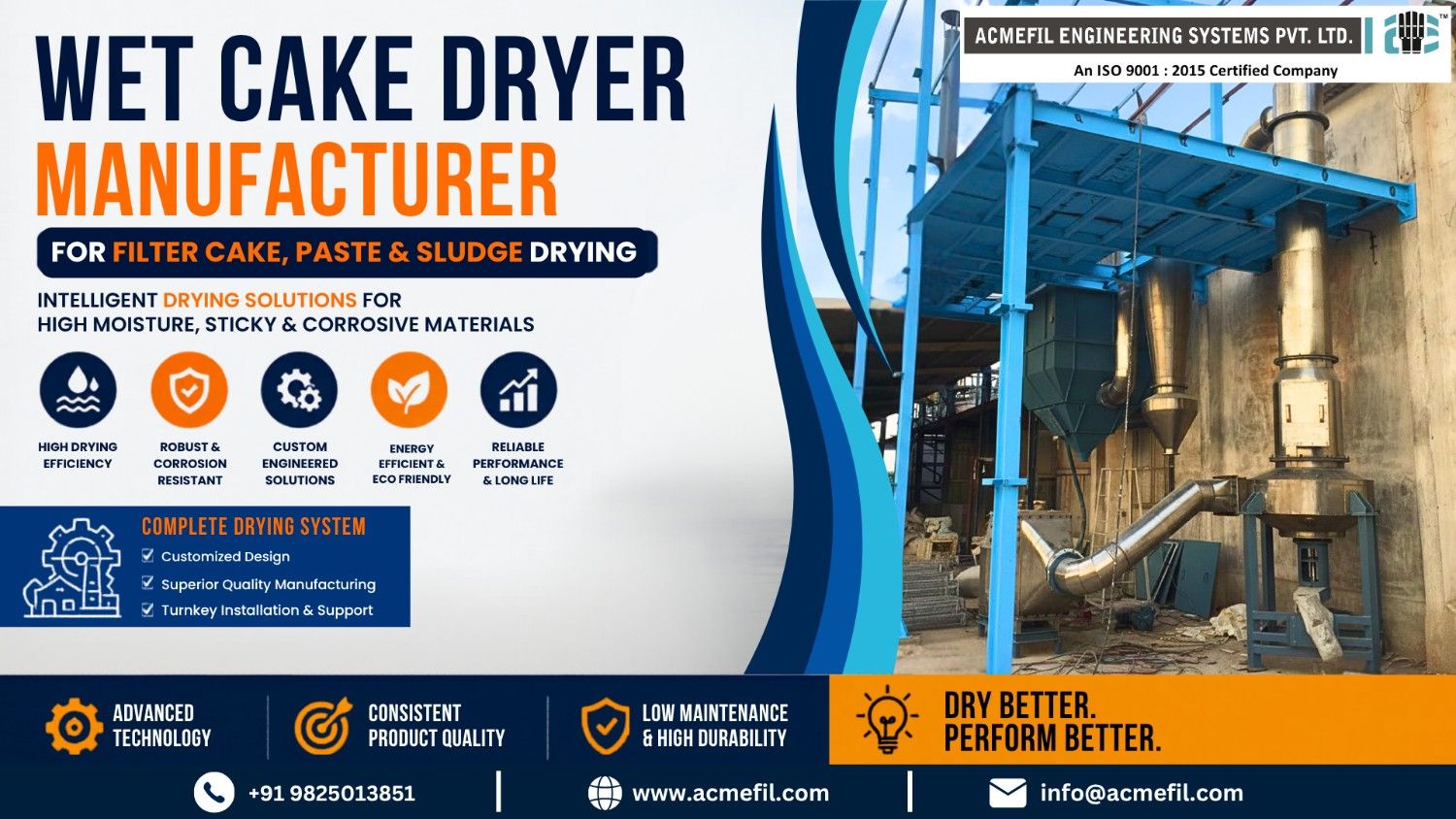
A wet cake dryer manufacturer should not recommend equipment only from moisture percentage or hourly capacity. Wet cake, filter cake, sticky paste, gelatinous material and high-viscosity sludge behave differently inside a dryer. For many chemical, dye, pigment and agrochemical applications, a spin flash dryer is selected because it breaks the wet cake at the feed point and dries the smaller particles rapidly in a hot air stream.
In my experience, most wet cake drying problems start before evaporation begins. The real problem is feed behavior.
If the wet cake forms lumps, smears near the inlet, blocks the feed zone or refuses to disperse, even a correctly sized heating system will not give stable drying.
What Is a Wet Cake Dryer?
A wet cake dryer is industrial drying equipment used to remove residual moisture from semi-solid material discharged from a filter press, centrifuge, vacuum filter or similar solid-liquid separation system.
The feed is usually called wet cake or filter cake because it has already been mechanically dewatered. But it still contains enough bound or surface moisture to make handling, storage, packing or further processing difficult.
Wet cake dryers are commonly used for:
- Dye intermediates
- Reactive dyes
- Pigments
- Agro chemicals
- Chemical filter cakes
- Paste-like products
- Gelatinous materials
- High-viscosity sludge
- Filter press discharge
- Centrifuged cake
For buyers comparing drying systems, the important question is not only “how much moisture is present?” The better question is, “will this material disperse properly when it enters the dryer?”
Wet Cake Dryer vs Filter Cake Dryer
In most industrial conversations, wet cake dryer and filter cake dryer are used for the same broad equipment category. The difference is mainly in how the feed is described.
| Term | What It Usually Means | Typical Source | Dryer Selection Concern |
|---|---|---|---|
| Wet cake dryer | Dryer for semi-solid wet material after dewatering | Filter press, centrifuge, belt press | Stickiness, lump formation, moisture load |
| Filter cake dryer | Dryer specifically for cake discharged from filtration equipment | Filter press, vacuum filter, Nutsche filter | Cake structure, breakability, feed consistency |
| Wet filter cake dryer | Dryer for filter cake that still carries high residual moisture | Filter press discharge | Feeding, disintegration, drying uniformity |
| Wet cake to powder dryer | Dryer intended to convert cake or paste into dry powder | Chemical and pigment process lines | Particle formation, powder collection, dust control |
A good filter cake dryer manufacturer should evaluate cake behavior before finalizing dryer type, hot air system, disintegrator design, material of construction and dust collection.
Why Standard Flash Dryers Often Fail on Wet Cake
A standard flash dryer works well when the material is already free-flowing, easily dispersible or only carrying surface moisture. It is not the best first choice when the feed is slimy, sticky, pasty or gelatinous.
When difficult wet cake enters a normal flash dryer, the plant may face:
- Feed choking near the inlet
- Wet lumps travelling through the drying duct
- Uneven final moisture
- Product build-up inside the chamber
- Unstable discharge from cyclone or bag filter
- Frequent cleaning shutdowns
- Higher operator attention
- Inconsistent powder quality
This is why a spin flash dryer is often preferred for wet cake and filter cake drying where mechanical break-up is required before the material can dry properly.
Why Spin Flash Drying Is Suitable for Wet Cake and Filter Cake
A spin flash dryer combines mechanical disintegration and hot air drying in one continuous system.
The wet cake enters through a controlled feed system. At the feed point, a disintegrator breaks the incoming wet cake, paste or sludge into smaller fragments. These smaller particles expose more surface area to the hot air stream, dry rapidly in suspension and move toward downstream separation equipment such as a cyclone and bag filter.
This is useful when the feed is:
- Sticky
- Lumpy
- Pasty
- Slimy
- Gelatinous
- High in viscosity
- Difficult to disperse
- Coming directly from a filter press
ACMEFIL’s spin flash dryer range includes cage mill type and pin mill type disintegrator arrangements. The right choice depends on material stickiness, lump strength, particle behavior, heat sensitivity and final powder requirement.
For a deeper technical explanation, read this guide on the spin flash dryer working principle.
How a Wet Cake Spin Flash Dryer Works
The working sequence is simple, but each stage must be engineered correctly.
- Wet cake or filter cake is fed into the dryer through a controlled feeding arrangement.
- A variable speed feed screw helps regulate feed flow.
- A lump breaker or disintegrator breaks the wet material near the feed point.
- Hot drying air contacts the broken particles.
- Moisture evaporates quickly because the surface area has increased.
- Dried powder travels with the air stream.
- Cyclone and bag filter systems separate the product from the drying air.
- The dry product is discharged for collection, packing or downstream handling.
The feed zone is the most critical area. If the material is not broken correctly at this stage, the dryer may show choking, poor dispersion and unstable final moisture.
Which Wet Cake Dryer Type Should You Select?
There is no single dryer that fits every wet cake. Selection depends on material form, moisture level, heat sensitivity, stickiness, final product requirement and whether powder formation is required.
| Dryer Type | Best Suited For | Not Ideal When |
|---|---|---|
| Spin flash dryer | Wet cake, filter cake, sticky paste, gelatinous material, high-viscosity sludge | Product cannot tolerate mechanical disintegration |
| Flash dryer | Free-flowing centrifuged cake or powder with surface moisture | Feed is sticky, slimy or highly pasty |
| Fluid bed dryer | Granules or powders needing uniform drying | Feed does not fluidize or enters as sticky cake |
| Sludge dryer | Sludge volume reduction and slower drying duties | Fast wet cake to powder conversion is required |
| Spray dryer | Liquid slurry or solution drying into powder | Feed is already a dewatered cake |
For sticky wet cake drying, I usually recommend beginning with feed behavior testing, not only a capacity discussion. Two cakes with the same moisture percentage can behave very differently inside a dryer.
You can also compare dryer selection logic in this article on how to choose a spin flash dryer.
Key Design Factors for a Wet Cake Dryer Manufacturer
Before finalizing a wet cake dryer, the manufacturer should evaluate these inputs.
| Selection Factor | Why It Matters |
|---|---|
| Feed source | Filter press, centrifuge and vacuum filter cakes behave differently |
| Initial moisture | Decides evaporation load and heating requirement |
| Final moisture target | Defines drying duty and product specification |
| Stickiness | Impacts feed screw, lump breaker and disintegrator design |
| Cake hardness | Decides whether cage mill or pin mill type action is suitable |
| Heat sensitivity | Controls inlet and outlet temperature approach |
| Particle size requirement | Affects powder quality and downstream handling |
| Dusting tendency | Decides cyclone, bag filter and air pollution control requirement |
| Corrosiveness | Influences material of construction |
| Feed variability | Batch-to-batch variation can affect dryer stability |
| Trial requirement | Difficult products should be tested before full-scale design |
A serious wet cake dryer manufacturer in India should ask for this data before giving a final technical recommendation.
Cage Mill Type or Pin Mill Type for Filter Cake Drying?
For wet cake and filter cake drying, the disintegrator is not a small accessory. It decides whether the feed disperses properly.
Cage Mill Type
A cage mill type arrangement is generally considered when stronger disintegration is required. It is useful for wet cake that forms lumps, resists break-up or needs aggressive size reduction before hot air contact.
Pin Mill Type
A pin mill type arrangement is generally considered where controlled break-up and particle handling are important. It can be suitable where the feed needs dispersion without unnecessarily damaging the desired powder characteristics.
Final selection should be made after reviewing the actual material. For uncertain feeds, pilot testing is safer than deciding only from a catalogue.
Where Filter Cake Dryers Are Used
Wet cake and filter cake dryers are widely used in industries where mechanical dewatering happens before final drying.
Common application areas include:
- Dyestuff manufacturing
- Dye intermediates
- Pigment production
- Agrochemical processing
- Chemical intermediates
- Inorganic chemicals
- Filter press cake drying
- High-viscosity sludge drying
- Paste drying
- Wet cake to powder conversion
In dye and chemical plants, many products leave filtration as wet cake, not as powder. If this cake is fed into the wrong dryer, the plant may face unstable output, low recovery, cleaning issues and repeated operator intervention.
For sludge-heavy applications, this related page on spin flash dryer for sludge drying may also help.
Why Pilot Testing Matters Before Buying a Wet Cake Dryer
Pilot testing is useful when the material is sticky, expensive, heat-sensitive, variable or new to the plant.
ACMEFIL has an in-house R&D pilot plant facility where spin flash dryer trials can be conducted at 10 kg/hr water evaporation capacity. This helps evaluate whether the feed can be disintegrated, dried and collected properly before committing to full-scale equipment.
A pilot trial can help answer:
- Will the cake feed smoothly?
- Does the cake need cage mill or pin mill type disintegration?
- Does the material smear or build up near the inlet?
- What outlet moisture is realistic?
- Does the product remain stable at the selected temperature?
- What powder behavior should be expected after drying?
- What separation system is needed after the dryer?
For difficult wet cake drying, a trial can prevent expensive equipment mismatch.
What to Share Before Asking for a Filter Cake Dryer Quote
Do not begin only with “send price for 500 kg/hr dryer.” A dryer quote without feed data is usually a rough commercial estimate, not a reliable process selection.
Share the following details:
- Product name and industry
- Feed source, such as filter press or centrifuge
- Feed form, such as cake, paste, sludge or gelatinous mass
- Initial moisture percentage
- Required final moisture percentage
- Feed rate or water evaporation load
- Bulk density, if available
- Heat sensitivity
- Stickiness or lump formation behavior
- Required final powder size or form
- Material of construction requirement
- Dust collection requirement
- Existing plant layout limitations
- Whether pilot testing is possible
This information helps the manufacturer select the right dryer type, feed system, disintegrator, hot air generator, cyclone, bag filter and control approach.
Why Choose ACMEFIL for Wet Cake and Filter Cake Drying Applications?
ACMEFIL Engineering Systems Pvt. Ltd. manufactures industrial drying and concentrating equipment from Ahmedabad, Gujarat. The company is incorporated in 2000 and operates with an ISO 9001:2015 certified manufacturing system.
For wet cake and filter cake drying applications, ACMEFIL’s relevant strengths include:
- Spin flash dryers for wet cake, paste, gelatinous material and high-viscosity sludge
- Cage mill type and pin mill type disintegrator options
- Flash dryers for suitable free-flowing cakes and powders
- Hot air generators, cyclone, bag filter and rotary valve support equipment
- In-house pilot plant facility for process development
- Engineering support from equipment selection to installation and commissioning
- Experience across dyes, pigments, chemicals, agrochemicals and related process industries
The practical advantage is not only equipment fabrication. It is process selection. A wet cake dryer must match the feed behavior, moisture target, temperature limit, dust handling requirement and final powder expectation.
For complete system support, ACMEFIL also provides spin flash dryers, flash dryers, bag filters, indirect fired hot air generators and design and engineering support.
Common Mistakes When Selecting a Wet Cake Dryer
Selecting only by capacity
Capacity matters, but feed behavior decides whether the dryer will run smoothly. A 500 kg/hr easy cake and a 500 kg/hr sticky cake are not the same drying problem.
Ignoring stickiness
Sticky feed can block the inlet, overload the feed screw, form lumps and create unstable drying. Stickiness must be checked before dryer selection.
Treating dust collection as optional
Powder recovery and air handling directly affect yield, cleanliness and compliance. Cyclone and bag filter design should be considered from the beginning.
Not checking heat sensitivity
Some products may tolerate high inlet air temperature because residence time is short. Others may degrade if the outlet temperature is not controlled. This must be evaluated product by product.
Buying without trial for difficult materials
For gelatinous, slimy, high-viscosity or unknown material, pilot testing is often more valuable than comparing only price.
FAQs
What is a wet cake dryer?
A wet cake dryer is industrial equipment used to remove moisture from semi-solid cake discharged from filtration or centrifuging equipment. It is used when wet cake must be converted into a drier solid or powder for packing, storage, reuse or disposal.
What is the best dryer for filter cake?
For sticky, pasty, gelatinous or high-viscosity filter cake, a spin flash dryer is often suitable because it breaks the cake at the feed point and dries the smaller particles rapidly in hot air. For free-flowing cake, a flash dryer may be enough. For other sludge or slow drying duties, another dryer type may be better.
Is wet cake dryer the same as filter cake dryer?
The terms are closely related. Filter cake usually means wet cake discharged from a filter press, vacuum filter or similar filtration system. Wet cake is the broader term for dewatered semi-solid material that still needs thermal drying.
Can a spin flash dryer dry sticky filter cake?
Yes, a spin flash dryer can dry many sticky filter cakes when the feed can be mechanically disintegrated and safely dried in a hot air stream. The feed behavior, stickiness, moisture content, heat sensitivity and final powder requirement should be reviewed before selection.
What information is needed for a wet cake dryer quotation?
A proper quotation needs product name, feed form, initial moisture, final moisture target, feed rate, heat sensitivity, stickiness, bulk density, material of construction requirement, dust collection requirement and whether pilot testing is needed.
Conclusion
A wet cake dryer manufacturer should be selected for process understanding, not only fabrication capacity. Wet cake and filter cake drying depend on feed behavior, stickiness, moisture load, temperature limit, disintegration requirement and powder collection.
For many dye, pigment, chemical and agrochemical filter cakes, spin flash drying is a strong option because it combines wet cake disintegration and rapid hot air drying in one continuous system.
If your material is wet cake, filter cake, sticky paste, gelatinous feed or high-viscosity sludge, share your feed details before finalizing the dryer. ACMEFIL can evaluate whether a spin flash dryer, flash dryer or another drying route is the right technical fit for your process. You can contact the team here with your material data and drying requirement.

Siddharth Nair is the Technical Director at Acmefil Engineering Systems Pvt. Ltd., an ISO 9001:2015 certified manufacturer of industrial drying and evaporation systems headquartered in Ahmedabad, Gujarat, he has led technical evaluation, application engineering and customer solution design for spray dryers, multi-effect evaporators, agitated thin film dryers, spin flash dryers and zero liquid discharge systems.