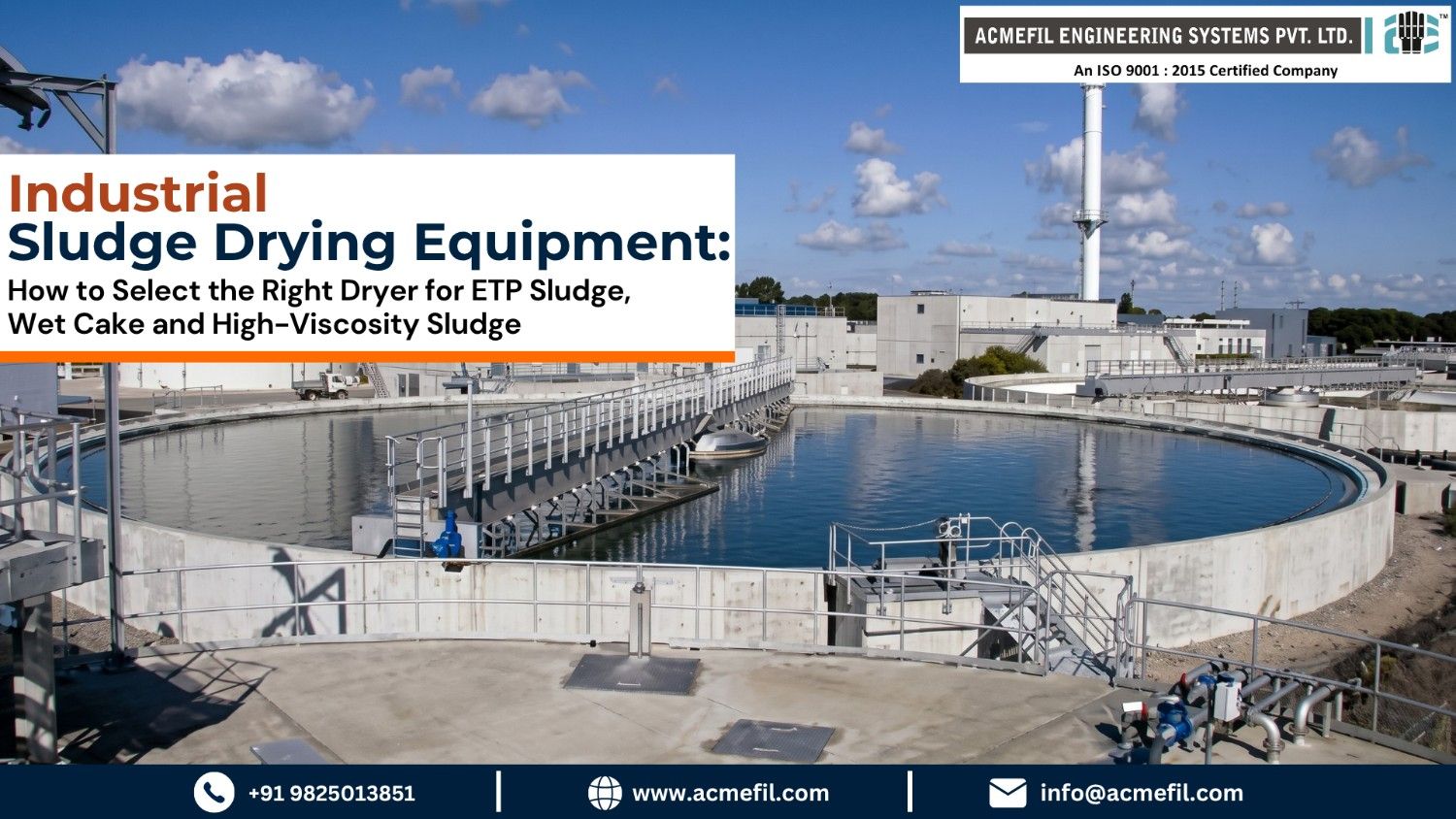
Industrial sludge drying equipment is used to reduce moisture from dewatered sludge, wet cake, filter cake or paste so the final solids become easier to handle, store, transport or dispose. The correct dryer is not selected only by capacity. It depends on sludge stickiness, feed moisture, particle behavior, heat sensitivity, odor risk, dust load, available utilities and the final moisture required.
In my experience, most sludge dryer mistakes start before the quotation stage. The buyer asks for a “sludge dryer machine,” but the supplier does not receive enough information about the actual sludge behavior.
A municipal sludge, chemical ETP sludge, pigment cake, dye intermediate cake and high-viscosity sludge do not behave the same inside a dryer.
What Is Industrial Sludge Drying Equipment?
Industrial sludge drying equipment is a thermal drying system designed to evaporate water from mechanically dewatered sludge or wet process solids.
A complete industrial sludge drying system may include:
- Sludge feed hopper
- Lump breaker or agitator
- Variable speed feed screw
- Dryer body
- Hot air generator or heating system
- Cyclone separator
- Bag filter or dust collection system
- Rotary airlock valve
- Scrubber or odor control system, where required
- Control panel and safety interlocks
For sticky sludge and wet cake, the feeding and disintegration section is as important as the dryer itself. If the feed does not enter the drying zone consistently, even a well-sized dryer will struggle.
Why Sludge Drying Is Different from Powder Drying
A free-flowing powder can disperse quickly in hot air. Sludge cannot.
Industrial sludge may contain:
- Bound moisture
- Fine suspended solids
- Sticky organic matter
- Salts
- Pigments or dye residues
- Oil and grease
- Fibrous matter
- Biological solids
- Chemical precipitates
This is why a standard flash dryer may fail with slimy or gelatinous sludge. The material can form lumps, stick near the feed point, block the inlet, or dry unevenly.
For sludge that enters the system as wet cake, paste or high-viscosity mass, a spin flash dryer for sludge drying is often evaluated because it combines mechanical disintegration with hot air drying.
Main Types of Industrial Sludge Drying Equipment
| Dryer type | Best suited for | Main advantage | Check carefully before selection |
|---|---|---|---|
| Spin flash dryer | Wet cake, filter cake, paste, high-viscosity sludge, pigment cake, dye sludge | Breaks lumps and dries in a short residence time | Feed must be suitable for disintegration and pneumatic drying |
| Paddle dryer | Sticky sludge, high-solids sludge, slow indirect drying duties | Indirect heating and controlled residence time | Footprint, torque, vapor handling and discharge behavior |
| Belt dryer | Large-volume sludge with lower-temperature drying requirement | Continuous thin-layer drying | Space requirement, odor control and feed spreading |
| Flash dryer | Centrifuged cake or powdery material with surface moisture | Fast drying and pneumatic conveying | Not suitable for slimy, pasty or highly sticky feed |
| Fluid bed dryer | Granular or fluidizable wet solids | Uniform drying with good air-solid contact | Feed must fluidize properly |
| ATFD / thin film dryer | Concentrated viscous liquid or slurry from evaporation systems | Handles viscous concentrate in ZLD sequence | Not the same duty as dewatered sludge cake drying |
The correct answer is not “which dryer is best?” The correct question is, “Which dryer matches this sludge behavior and final disposal route?”
When a Spin Flash Dryer Fits Industrial Sludge Drying
A spin flash dryer is useful when the sludge behaves more like wet cake, paste, filter cake or high-viscosity material rather than a pumpable liquid.
The key mechanism is the disintegrator at the feed point. As sludge enters the drying chamber, the rotating disintegrator breaks the wet mass into smaller fragments. Hot air contacts the fragmented particles, moisture evaporates quickly, and the dried material is carried to cyclone and bag filter separation.
This makes spin flash drying relevant for:
- ETP sludge from chemical plants
- Dye and dye intermediate filter cake
- Pigment cake
- Agrochemical wet cake
- High-viscosity sludge
- Sticky process residues
- Filter press discharge
- Wet cake that must be converted into powder or dry granular solids
For a deeper equipment-level explanation, read this guide on the spin flash dryer working principle.
When Spin Flash Drying May Not Be the Right Choice
A spin flash dryer is not suitable for every sludge.
It may not be the first choice when:
- The feed is too wet and pumpable, with very low solids
- The sludge cannot tolerate mechanical disintegration
- The material requires long residence time for safe drying
- Odor control requires a fully different closed vapor handling strategy
- The final product must remain in a specific pellet or granule form
- The sludge contains oversized foreign matter that can damage the feed system
- The feed varies too much without upstream conditioning
This is where pilot testing becomes important. A lab report can give moisture, ash and volatile solids. It cannot fully show how the sludge behaves at the feed screw, disintegrator and hot air contact zone.
What Data Is Needed Before Selecting a Sludge Dryer?
Before selecting industrial sludge drying equipment, prepare these details.
| Data required | Why it matters |
|---|---|
| Sludge source | ETP, CETP, chemical, pharma, food, pigment or dye sludge behaves differently |
| Feed moisture | Determines evaporation load and dryer sizing |
| Total solids | Helps estimate feed rate and dry output |
| Stickiness | Decides whether disintegration, scraping or indirect drying is required |
| Particle size or cake texture | Impacts feeding, lump breaking and drying uniformity |
| pH and corrosivity | Affects material of construction |
| Salt and ash content | Influences scaling, fouling and final disposal |
| Oil and grease | Can create sticking, odor or safety issues |
| Required final moisture | Changes dryer duty and energy demand |
| Disposal or reuse route | The dryer must match the final handling requirement |
| Available utilities | Hot air, steam, thermic fluid, electricity and fuel availability affect dryer choice |
| Pollution control requirement | Vapors, dust and odor may require bag filter, scrubber or other controls |
A serious vendor should ask for this information before giving a final technical recommendation.
Industrial Sludge Drying Process Flow
A typical sludge drying process follows this sequence:
- Sludge is mechanically dewatered through a filter press, centrifuge or similar system.
- Wet cake enters a feed hopper.
- A screw feeder or dosing system controls feed rate.
- Lumps are broken before or during entry into the drying zone.
- Heat is introduced through hot air or indirect heating, depending on dryer type.
- Moisture evaporates from the sludge.
- Dry solids are separated, discharged and collected.
- Exhaust air or vapor is treated through dust collection, odor control or scrubbing where required.
In a spin flash dryer, the disintegration and drying happen in one continuous flow path. This is why it is used for difficult wet cake applications where simple pneumatic drying is not enough.
You can compare this further with our guide on spin flash dryer vs other drying technologies.
Key Components of a Sludge Drying System
Feed Hopper and Screw Feeder
The feed section controls how sludge enters the dryer. For sticky sludge, inconsistent feeding causes surging, choking and uneven final moisture.
A variable speed screw feeder helps control the feed rate. For wet cake, a lump breaker or agitator may be required before the material reaches the drying zone.
Disintegrator or Lump Breaker
For spin flash drying, this is one of the most critical sections.
The disintegrator breaks sludge lumps into smaller particles. Better dispersion means better hot air contact and more uniform drying.
Cage mill and pin mill type disintegrators are commonly evaluated for wet cake, gelatinous paste and high-viscosity sludge duties.
Hot Air System
The hot air system supplies the thermal energy needed to evaporate moisture. The heating source may be direct fired or indirect fired depending on product sensitivity, contamination risk, plant utility availability and safety requirements.
Drying Chamber
The drying chamber must provide enough contact between sludge particles and hot air. In spin flash drying, short residence time helps reduce heat exposure compared with slower thermal drying methods, but the feed must disperse properly.
Cyclone Separator and Bag Filter
After drying, the air carries dried solids and fines toward separation equipment. A cyclone separates heavier particles. A bag filter captures finer dust and helps maintain a cleaner exhaust stream.
For more detail on dust handling, refer to this guide on bag filter for spin flash dryer once the page is added, or use the available support link listed below until that post is published.
Selection Guide: Which Sludge Dryer Should You Choose?
Choose a Spin Flash Dryer When
- Sludge comes as wet cake, paste or filter cake
- The material needs lump breaking before drying
- The target output is powdery or fine dry solids
- Short residence time is preferred
- The feed is from dyes, pigments, chemicals or agrochemical processes
- A standard flash dryer is choking or giving uneven drying
- Pilot testing confirms that the feed can be dispersed
Choose a Paddle Dryer When
- Indirect drying is preferred
- Sludge is sticky and requires slower residence time
- Vapor handling must be controlled separately
- The plant has steam or thermic fluid available
- The dried output does not need pneumatic conveying
Choose a Belt Dryer When
- The sludge volume is high
- Low-temperature drying is preferred
- Space is available
- Feed can be spread in a uniform layer
- Odor control is properly designed
Choose a Flash Dryer When
- The feed is already powdery or granular
- Only surface moisture needs to be removed
- The material is not slimy or gelatinous
- Pneumatic conveying and fast drying are suitable
A good dryer selection should not be based only on the lowest machine price. It should be based on drying behavior, operating cost, maintenance risk, pollution control and final disposal requirements.
Common Mistakes Buyers Make
Asking for Capacity Without Moisture Load
A dryer is not sized only by kg/hr of wet sludge. It is sized by water evaporation load.
For example, 1,000 kg/hr of sludge at 70% moisture is a very different duty from 1,000 kg/hr of sludge at 45% moisture.
Ignoring Stickiness
Stickiness decides whether the feed will move, break, disperse or block. If the supplier does not ask about stickiness, the proposal is incomplete.
Not Checking Final Disposal Requirement
Some plants only need volume reduction. Some need dry powder. Some need solids suitable for further handling. The dryer must be selected around the final destination of the dried sludge.
Treating ETP Sludge as One Material
ETP sludge from a dyestuff plant is not the same as biological sludge from a food plant. Even within chemical plants, sludge composition changes based on process chemistry and effluent treatment method.
Skipping Pilot Trials
For difficult sludge, pilot trials reduce risk. At Acmefil, pilot plant testing is used to check whether the feed can be dried, dispersed and collected before committing to a full-scale system.
Practical RFQ Checklist for Industrial Sludge Drying Equipment
Before sending an inquiry, prepare this checklist:
- Sludge source and process origin
- Wet feed quantity in kg/hr or kg/day
- Feed moisture percentage
- Required final moisture percentage
- Bulk density, if available
- pH and corrosive nature
- Sticky, pasty, fibrous, granular or powdery behavior
- Current dewatering method
- Filter press or centrifuge discharge condition
- Available fuel or utility
- Required material of construction
- Site space limitation
- Pollution control requirement
- Final disposal or reuse plan
- Sample availability for trial
This information helps the manufacturer evaluate whether a spin flash dryer, paddle dryer, flash dryer, fluid bed dryer or another system is more suitable.
Why Pilot Testing Matters for Sludge Drying
Sludge drying has too many variables to depend only on assumptions.
A pilot trial can show:
- Whether sludge feeds consistently
- Whether it sticks near the inlet
- Whether the disintegrator can break the wet cake
- Whether the dried material becomes powder, granules or sticky residue
- Whether the cyclone and bag filter can collect the dry product properly
- Whether the final moisture target is realistic
- Whether odor, dust or vapor load needs additional control
This is especially important for high-viscosity sludge and filter cake from chemical, pigment, dye and agrochemical plants.
For related selection logic, read this guide on how to choose a spin flash dryer.
Industrial Sludge Drying Equipment for Chemical and ETP Plants
Chemical and ETP sludge applications need careful review because the feed may contain salts, fines, corrosive components, pigments, dye residues or organic matter.
A spin flash dryer can be useful when the sludge is already dewatered and behaves like wet cake or paste. The disintegrator helps break the material at the feed point so hot air can contact the wet surface more effectively.
For ZLD projects, sludge drying may also connect with evaporation and final solids handling. The dryer should be evaluated as part of the full plant flow, not as a standalone machine.
ACMEFIL’s support ecosystem includes zero liquid discharge systems, spin flash dryers, flash dryers and bag filters for related industrial drying and pollution-control duties.
Conclusion
Industrial sludge drying equipment should be selected from the sludge behavior first, not from a generic dryer name.
For wet cake, filter cake, paste and high-viscosity sludge, the main challenge is not only evaporation. The main challenge is feeding, lump breaking, dispersion, hot air contact, dust separation and stable final moisture.
A spin flash dryer becomes a strong option when the sludge can be mechanically disintegrated and dried quickly in a hot air stream. Paddle dryers, belt dryers, flash dryers, fluid bed dryers and ATFD systems may be better in other cases.
The safest approach is to share real sludge data, provide a sample for testing and validate the drying route before finalizing the full-scale system.
For sludge drying evaluation, process trials or equipment selection support, contact the technical team through the SpinFlashDrying.com contact page.
FAQs
What is industrial sludge drying equipment?
Industrial sludge drying equipment is a drying system used to remove moisture from dewatered sludge, wet cake, filter cake or paste. It reduces sludge volume and improves handling, storage, transport or disposal.
Which dryer is best for high-viscosity sludge?
For high-viscosity sludge that behaves like wet cake or paste, a spin flash dryer or paddle dryer is commonly evaluated. A spin flash dryer is suitable when the feed can be broken by a disintegrator and dried in hot air. A paddle dryer may be preferred when indirect, slower drying is required.
Can a standard flash dryer dry sludge?
A standard flash dryer can handle some centrifuged cakes or powdery materials, but it is usually not suitable for slimy, gelatinous or highly sticky sludge. Such feed may block or dry unevenly unless it is properly disintegrated before drying.
Why is sludge sample testing important?
Sludge sample testing shows how the material behaves during feeding, lump breaking, hot air contact, drying and collection. It helps avoid wrong dryer selection and gives better confidence before full-scale investment.
What information should I give to a sludge dryer manufacturer?
Share sludge source, feed moisture, required final moisture, feed rate, stickiness, pH, corrosivity, oil and grease content, ash or salt content, disposal route, available utilities and sample availability for trial.

Siddharth Nair is the Technical Director at Acmefil Engineering Systems Pvt. Ltd., an ISO 9001:2015 certified manufacturer of industrial drying and evaporation systems headquartered in Ahmedabad, Gujarat, he has led technical evaluation, application engineering and customer solution design for spray dryers, multi-effect evaporators, agitated thin film dryers, spin flash dryers and zero liquid discharge systems.