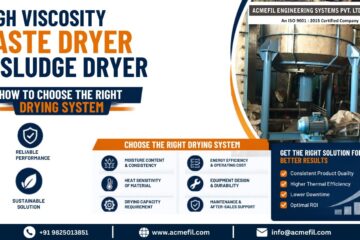
A cage mill type spin flash dryer is used when wet cake, sticky paste, filter cake or high-viscosity sludge cannot be dried properly in a standard flash dryer. The cage mill disintegrator breaks lumps at the feed point, exposes more wet surface area to hot air and helps convert difficult cake-type material into dry powder in a short residence time.
In my experience, this dryer is not selected only because the product is wet. It is selected because the product is wet, cohesive, lumpy, sticky or difficult to disperse. That difference matters.
A standard flash dryer works well when material is already loose, granular or powdery. A cage mill type spin flash dryer is required when the feed comes from a filter press, centrifuge, reactor discharge or sludge handling line and enters the dryer as cake, paste or lumps.
For a broader foundation, you can also read the spin flash dryer working principle and the complete guide on how to choose a spin flash dryer.
What Is a Cage Mill Type Spin Flash Dryer?
A cage mill type spin flash dryer is a continuous drying system where a cage mill disintegrator is installed near the wet feed entry zone. The wet cake enters the dryer through a controlled feed system. The cage mill breaks the lumps into smaller particles while hot air simultaneously contacts the exposed wet surface.
The dried particles are carried upward by the air stream and separated in a cyclone, bag filter or a combined dust collection system.
In simple terms:
The cage mill breaks the wet mass.
The hot air evaporates moisture quickly.
The air stream carries the dried powder forward.
The cyclone and bag filter separate dry product from exhaust air.
This is why cage mill type systems are useful for materials that form lumps, smear on surfaces or choke normal flash dryer feed zones.
Why Standard Flash Dryers Fail With Sticky Wet Cake
A standard flash dryer depends heavily on feed dispersion. If the feed enters as loose particles, drying is fast. If the feed enters as sticky cake, the system struggles.
Common problems include:
- Wet cake clumps instead of dispersing
- Feed sticks near the inlet
- Large lumps remain wet inside
- Dryer duct or feed zone starts choking
- Product moisture becomes inconsistent
- Operators increase temperature to compensate, which can damage heat-sensitive material
- Powder recovery becomes unstable because some particles remain too wet and heavy
This is where a spin flash dryer becomes a better fit. The dryer is designed around mechanical disintegration at the feed point, not only pneumatic conveying.
A cage mill type spin flash dryer gives stronger lump-breaking action compared with simple feed scattering. That is useful when the feed is sticky, dense, fibrous, gelatinous or difficult to open up.
How a Cage Mill Type Spin Flash Dryer Works
The process is simple in concept, but the design must be correct.
Wet Cake Feeding
Wet material is usually fed through a screw feeder or controlled feeding arrangement. In many plants, the feed comes from a filter press, centrifuge or sludge dewatering system.
The feeding rate must be stable. If the feed comes in surges, even a good cage mill dryer will show unstable outlet moisture.
Lump Breaking by Cage Mill Disintegrator
The wet cake reaches the cage mill zone. The rotating cage mill applies impact and shearing action. This breaks the cake into smaller fragments and exposes fresh wet surfaces.
This step is the main reason the dryer can handle materials that a normal flash dryer cannot.
Hot Air Contact and Rapid Drying
Hot air enters the system and contacts the disintegrated particles. Because the cage mill has already opened the wet cake, moisture removal becomes faster and more uniform.
The actual inlet and outlet temperature must be selected based on product behavior, moisture content, heat sensitivity and final powder requirement. These values should not be guessed from generic dryer charts.
Particle Transport
The air stream carries the dried particles through the drying path. Lighter, properly dried particles move forward. Heavier or insufficiently dried particles remain exposed longer depending on the system design.
Product Separation
The dried powder is separated using a cyclone, a bag filter for spin flash dryer or a combined arrangement depending on product fineness and dust load.
For dust-heavy chemical, pigment and dye applications, the bag filter selection is not a small accessory decision. It affects powder recovery, clean working conditions and plant housekeeping.
Cage Mill Type vs Pin Mill Type Spin Flash Dryer
Both cage mill and pin mill disintegrators are used in spin flash drying. The right choice depends on feed behavior.
| Selection Point | Cage Mill Type Spin Flash Dryer | Pin Mill Type Spin Flash Dryer |
|---|---|---|
| Best suited for | Lumpy, sticky, dense or cohesive wet cake | Softer cake, paste or material needing finer disintegration |
| Main action | Strong impact and lump breaking | Impact and particle size reduction with finer dispersion |
| Feed behavior | Better where lumps are stronger or cake is harder to open | Better where material can be dispersed without heavy lump-breaking load |
| Risk area | Wear may increase with abrasive material | Pin wear and product buildup need attention |
| Typical use | Filter cake, pigments, dye intermediates, agrochemical cake, sludge-type feeds | Softer pastes, chemical cakes and applications needing controlled fine breakup |
| Selection basis | Lump strength, stickiness, abrasiveness, moisture and final powder quality | Feed softness, desired particle size and thermal sensitivity |
I would not select cage mill or pin mill based only on keyword preference. I would first check how the wet cake behaves in hand, how it breaks under pressure, how sticky it is, and whether it smears, crumbles or rebounds.
That is why pilot testing is useful before final equipment sizing.
Where Cage Mill Type Spin Flash Dryers Are Used
A cage mill type spin flash dryer is suitable for industrial drying applications where the feed is wet, sticky or cake-like.
Common applications include:
- Dye intermediates
- Reactive dyes
- Pigment cakes
- Filter press cake
- Agrochemical intermediates
- Chemical wet cake
- High-viscosity sludge
- Slimy or gelatinous paste
- Acetanilide
- J-Acid
- N-Methyl J-Acid
- Sulfotobias Acid
For application-level reading, see applications of spin flash dryers across industries and spin flash dryer for sludge drying.
ACMEFIL also provides a dedicated spin flash dryer manufacturer page for buyers who want the equipment-side overview.
When Cage Mill Type Is the Better Choice
A cage mill type spin flash dryer is usually a strong option when the feed has one or more of these conditions:
- Wet cake comes in lumps from a filter press
- Cake is sticky and does not disperse easily
- Material forms balls inside standard flash dryer feed zones
- Feed has high moisture with poor flowability
- Product needs rapid drying without long exposure time
- Manual tray drying is too slow or labour-heavy
- Plant needs a continuous drying system after filtration
- Dust collection and clean operation are important
- The material cannot be handled as a free-flowing powder at the inlet
This is common in dye, pigment, chemical, agrochemical and sludge drying lines.
When a Cage Mill Type Spin Flash Dryer May Not Be the Right Fit
No dryer is correct for every product.
A cage mill type spin flash dryer may need deeper evaluation when:
- The product is extremely abrasive
- The product is highly heat-sensitive and cannot tolerate the required air temperature
- The feed is pumpable liquid rather than wet cake or paste
- The final product must have a very narrow particle size distribution
- The material is explosive, solvent-based or requires special inert atmosphere design
- The feed has large foreign particles or hard contaminants
- The moisture is not surface or near-surface moisture but strongly bound moisture requiring longer residence time
In such cases, compare alternatives such as a standard flash dryer, fluid bed dryer, paddle dryer or agitated thin film dryer depending on the product and process objective.
You can also use this comparison guide: spin flash dryer vs other drying technologies.
Main Components of a Cage Mill Type Spin Flash Dryer
A cage mill type spin flash dryer is not only a drying chamber. It is a complete system.
Typical sections include:
| Component | Function |
|---|---|
| Feed hopper or feed screw | Controls wet cake feed rate into the dryer |
| Lump breaker or pre-breaker | Reduces oversized cake before main disintegration |
| Cage mill disintegrator | Breaks wet lumps and exposes surface area for drying |
| Hot air generator | Supplies controlled hot air for evaporation |
| Drying chamber | Provides contact zone for hot air and wet particles |
| Cyclone separator | Recovers major dry powder fraction |
| Pulse jet bag filter | Captures fine powder and controls dust carryover |
| Rotary airlock valve | Discharges powder while reducing air leakage |
| ID fan or system fan | Maintains airflow and conveying velocity |
| Control panel | Controls temperature, feed rate, airflow and operating sequence |
For deeper equipment anatomy, read spin flash dryer components.
For dust collection support, ACMEFIL’s bag filter page is also relevant because fine powders from dyes, pigments and chemicals often need reliable filtration.
Why Feed Control Matters More Than Buyers Expect
Many dryer problems start before the drying chamber.
If the wet cake feed rate fluctuates, the dryer sees alternating overload and underload. During overload, the system may produce wet powder or choking. During underload, outlet temperature may rise and product quality can become unstable.
For cage mill type spin flash dryers, feed control should consider:
- Cake moisture percentage
- Bulk density
- Lump size
- Stickiness
- Screw feeder speed
- Hopper bridging tendency
- Whether the feed smears or crumbles
- Whether pre-breaking is required before the cage mill
A variable speed feed screw is useful because it allows the operator to adjust feed rate based on outlet moisture, exhaust temperature and system load.
Cage Mill Dryer for Pigment and Dye Intermediate Cake
Pigments and dye intermediates are common candidates for cage mill type spin flash drying because they often come as wet filter cake.
The drying challenge is not only evaporation. The challenge is opening the cake structure so the wet mass does not stay as large lumps. If the inner core remains wet, the final powder will fail moisture specification even when the surface looks dry.
For dye and pigment drying, the dryer design must pay attention to:
- Cake stickiness
- Colour contamination risk
- Dust collection efficiency
- Contact parts material of construction
- Cleaning access
- Exhaust air filtration
- Product recovery
- Heat sensitivity
- Final powder fineness requirement
This is also why generic dryer selection can go wrong. A pigment cake dryer and a free-flowing powder dryer are not the same engineering problem.
Cage Mill Dryer for High-Viscosity Sludge
High-viscosity sludge can behave differently from chemical filter cake. Some sludge crumbles after dewatering. Some sludge smears and forms sticky layers. Some sludge contains salts, fibres or variable solids.
A cage mill type spin flash dryer may be useful when the sludge is dewatered enough to feed as cake or paste and can be mechanically disintegrated. If the sludge is too wet, too fluid or too inconsistent, upstream dewatering or feed conditioning may be required.
For sludge drying, evaluate:
- Feed solids percentage
- Organic or inorganic composition
- Chloride or corrosive content
- Odour handling requirement
- Dust handling requirement
- Final disposal or reuse target
- Required final moisture
- Fuel and hot air source
- Bag filter and emission control requirement
For this topic, the dedicated guide on spin flash dryer for sludge drying will help.
Design Questions Before Buying a Cage Mill Type Spin Flash Dryer
Before asking for price, prepare process data. Without this data, the quotation will be weak and the dryer may be undersized or oversized.
| Data Required | Why It Matters |
|---|---|
| Feed material name | Determines product behavior and metallurgy |
| Feed moisture | Defines evaporation load |
| Required final moisture | Defines drying duty and outlet condition |
| Feed rate | Defines dryer capacity |
| Lump size | Defines cage mill and feed system design |
| Stickiness | Determines choking risk |
| Bulk density | Affects feeding and conveying |
| Heat sensitivity | Affects inlet and outlet temperature selection |
| Abrasiveness | Affects wear parts and material of construction |
| Corrosiveness | Affects contact part selection |
| Dust fineness | Affects cyclone and bag filter design |
| Required powder quality | Affects residence time and disintegration intensity |
| Available fuel | Affects hot air generator selection |
| Site space | Affects layout and duct routing |
| Emission requirement | Affects dust collection and filtration design |
This is the practical difference between buying a dryer and engineering a drying system.
Pilot Trial: The Safest Way to Confirm Dryer Selection
For difficult wet cake and sticky paste, pilot testing is more reliable than assumptions.
A small trial can answer questions such as:
- Will the cake disperse properly in a cage mill?
- Does the product stick inside the feed zone?
- What outlet moisture is achievable?
- Does the product degrade at selected temperature?
- Does the powder flow after drying?
- How much dust is generated?
- Does the final powder need further classification?
- Is cage mill or pin mill more suitable?
ACMEFIL has in-house pilot plant capability for spin flash dryer trials with 10 kg/hr water evaporation capacity. For buyers, this is useful because product behaviour can be checked before committing to a full-scale system.
For next step discussion, use the SpinFlashDrying.com contact page or ACMEFIL’s contact page.
Common Mistakes in Cage Mill Type Spin Flash Dryer Selection
Selecting Only by Evaporation Capacity
Evaporation capacity is important, but it is not enough. Two products with the same water evaporation requirement can behave completely differently inside the dryer.
Ignoring Lump Size
Large, hard lumps may overload the feed zone. A pre-breaker or better feeding arrangement may be required.
Treating Sticky Cake Like Free-Flowing Powder
A standard flash dryer may work for powders, but sticky cake needs disintegration before drying.
Underestimating Bag Filter Load
Fine powders from dyes and pigments can create high dust load. The cyclone and bag filter must be designed as part of the system.
Skipping Pilot Trials
For difficult materials, trial data is often more useful than theoretical assumptions.
Asking for Lowest Price Before Defining Scope
A dryer without proper feed system, dust collection, airlock, controls and hot air system may look cheaper, but it may not solve the actual plant problem.
Maintenance Points for Cage Mill Type Spin Flash Dryers
Maintenance should focus on the parts exposed to impact, dust, heat and abrasion.
Key areas to inspect include:
- Cage mill wear parts
- Feed screw and hopper
- Lump breaker blades
- Rotary airlock valve
- Cyclone cone and discharge
- Bag filter differential pressure
- Ducting bends
- Temperature sensors
- Fan vibration
- Product buildup near feed entry
- Seal points and air leakage
A good maintenance plan prevents choking, uneven drying and unexpected downtime. For more detail, read spin flash dryer maintenance and cost analysis and spin flash drying best practices for operation.
Cage Mill Type Spin Flash Dryer RFQ Checklist
Use this checklist before sending an inquiry:
- Material name and industry
- Feed source, such as filter press, centrifuge or reactor
- Feed moisture percentage
- Required final moisture percentage
- Feed rate in kg/hr
- Water evaporation load
- Lump size and cake hardness
- Sticky, slimy or gelatinous behaviour
- Heat sensitivity
- Abrasive or corrosive nature
- Current drying method
- Current pain point, such as choking, high labour or high drying time
- Required material of construction
- Fuel available for hot air generation
- Dust collection requirement
- Site location and available space
- Whether pilot trial is required
This data helps the equipment manufacturer size the system responsibly instead of giving a generic quote.
Conclusion
A cage mill type spin flash dryer is a strong choice when the feed is wet, sticky, lumpy or difficult to disperse. Its main advantage is the cage mill disintegrator at the feed point. This mechanism breaks wet cake into smaller particles so hot air can dry the material quickly and more uniformly.
For filter cake, pigment cake, dye intermediates, agrochemical cake and high-viscosity sludge, this can be the difference between a dryer that frequently chokes and a system that runs continuously.
The final selection should still be based on feed behaviour, moisture load, heat sensitivity, abrasiveness, dust load and pilot trial results. If the material is difficult, do not finalize the dryer only from a catalogue. Test the feed, study the cake and then decide between cage mill type, pin mill type or another drying technology.
FAQs
What is a cage mill type spin flash dryer?
A cage mill type spin flash dryer is a continuous dryer that uses a cage mill disintegrator to break wet cake or sticky paste at the feed point. The broken particles are dried rapidly by hot air and separated as powder through cyclone and bag filter systems.
What materials can be dried in a cage mill type spin flash dryer?
It can be used for wet filter cake, sticky paste, dye intermediates, reactive dyes, pigments, agrochemical cake, chemical wet cake and high-viscosity sludge, provided the material can be mechanically disintegrated and thermally dried.
What is the difference between cage mill and pin mill type spin flash dryer?
A cage mill type is generally preferred for stronger lump breaking and difficult wet cake dispersion. A pin mill type is generally preferred where finer disintegration or softer cake handling is required. Final selection should be based on product trial and feed behaviour.
Can a cage mill flash dryer handle sludge?
Yes, it can handle some high-viscosity sludge applications when the sludge is dewatered enough to feed as cake or paste. If the sludge is too fluid or inconsistent, upstream dewatering or feed conditioning may be required.
Why is pilot testing important for cage mill type spin flash dryer selection?
Pilot testing confirms whether the wet cake breaks properly, whether the product sticks inside the system, what final moisture is achievable and whether the product tolerates selected drying temperatures. It reduces the risk of wrong dryer selection.

Siddharth Nair is the Technical Director at Acmefil Engineering Systems Pvt. Ltd., an ISO 9001:2015 certified manufacturer of industrial drying and evaporation systems headquartered in Ahmedabad, Gujarat, he has led technical evaluation, application engineering and customer solution design for spray dryers, multi-effect evaporators, agitated thin film dryers, spin flash dryers and zero liquid discharge systems.