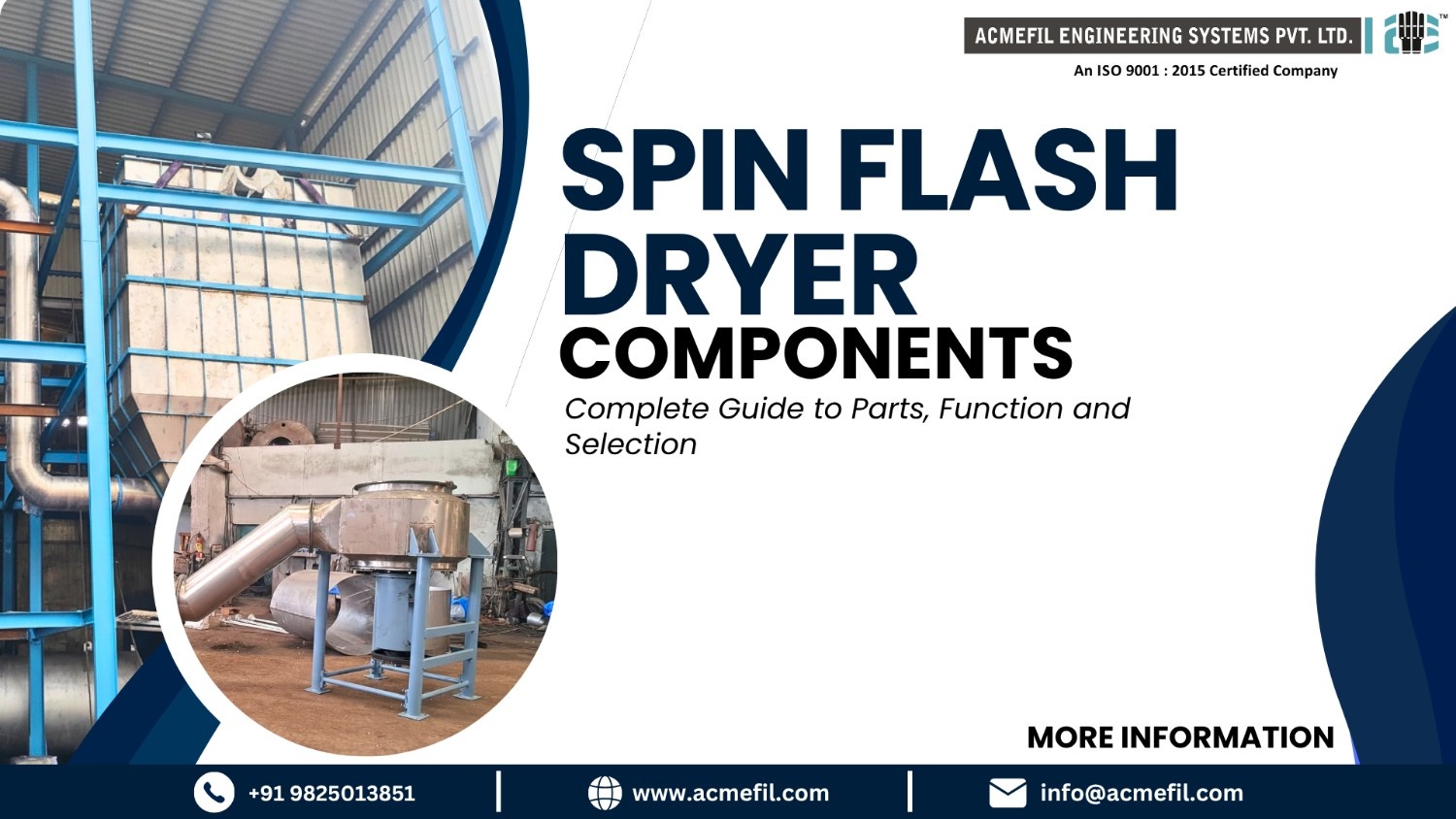
Spin flash dryer components work together to convert wet cake, filter cake, sticky paste, gelatinous material or high-viscosity sludge into dry powder. The main parts include the feed system, lump breaker, disintegrator, hot air generator, drying chamber, cyclone separator, bag filter, discharge valve and control system. The most important component is the disintegrator because it breaks wet lumps at the feed point before hot air can dry them in suspension.
A spin flash dryer is not just a hot air pipe. If the feed is sticky, slimy or uneven, component design decides whether the dryer runs continuously or blocks every few hours.
What Are the Main Components of a Spin Flash Dryer?
A typical spin flash dryer system includes:
| Component | Main Function | Why It Matters |
|---|---|---|
| Feed hopper | Receives wet cake or paste before drying | Prevents irregular feeding into the dryer |
| Variable speed feed screw | Controls material feed rate | Helps match feed quantity with drying capacity |
| Lump breaker | Breaks large lumps before disintegration | Reduces clogging and improves drying uniformity |
| Disintegrator | Breaks wet cake into small particles at the feed point | The key part that separates spin flash drying from standard flash drying |
| Hot air generator | Produces the required hot drying air | Supplies heat for moisture evaporation |
| Hot air inlet | Introduces hot air into the drying zone | Helps create fast contact between wet particles and hot air |
| Drying chamber | Main contact zone for wet particles and hot air | Controls residence time, dispersion and drying path |
| Cyclone separator | Separates dried powder from air stream | Recovers product after drying |
| Bag filter | Captures fine powder and dust | Keeps product loss and dust emission under control |
| Air lock rotary valve | Discharges powder while limiting air leakage | Maintains stable system air balance |
| Exhaust and fan system | Moves air through the dryer and filtration line | Supports pneumatic conveying and separation |
| Control panel and instrumentation | Controls temperature, feed rate and system operation | Helps operators maintain stable drying conditions |
For a broader process overview, you can also read the detailed guide on spin flash dryer working principle.
Why Components Matter More in Spin Flash Drying Than in Standard Flash Drying
A standard flash dryer works well when the feed is already powdery, granular or easy to disperse. It becomes weak when the material is wet cake, filter press cake, sticky sludge or gelatinous paste.
The reason is simple. Hot air cannot dry a lump properly if the lump remains intact.
In a spin flash dryer, the feed does not simply fall into the air stream. It enters near a high-speed mechanical disintegration zone. The disintegrator breaks the wet feed into smaller fragments while hot air begins removing moisture. This simultaneous breaking and drying is what makes the system suitable for difficult materials such as dye intermediates, pigments, agrochemical cakes and high-viscosity sludge.
I usually advise buyers to study the feed zone first before comparing motor size, chamber height or price. Most spin flash dryer failures start at feeding and disintegration, not at the cyclone.
Feed Hopper
The feed hopper receives wet material from upstream equipment such as a filter press, centrifuge or holding bin. In many chemical and dyestuff plants, the feed may not be free-flowing. It may bridge, stick to the hopper wall or fall in uneven chunks.
A good hopper design should support controlled feeding, not just storage. For sticky wet cakes, the hopper angle, internal surface finish and discharge opening need attention. If the hopper does not release material consistently, even the best disintegrator will receive uneven load.
Common feed hopper problems include:
- Material bridging inside the hopper
- Sudden feed surges
- Manual poking requirement
- Feed screw starvation
- Inconsistent outlet moisture due to irregular feed rate
For wet cake and filter press discharge applications, the hopper must be selected based on actual feed behavior, not only bulk density.
Variable Speed Feed Screw
The variable speed feed screw controls how much wet material enters the drying chamber. This is one of the most practical spin flash dryer components because it directly affects drying stability.
If feed rate is too high, the dryer may show:
- Wet powder at discharge
- High outlet moisture
- Heavy motor load
- Disintegrator choking
- Product build-up near the feed point
If feed rate is too low, the plant may lose capacity and run below the expected evaporation load.
The feed screw should be designed for the feed’s stickiness, moisture level, lump size and abrasiveness. In many plants, the feed screw is also used as an operating control. When inlet air temperature, outlet air temperature and product moisture are monitored together, feed screw speed becomes a useful adjustment point.
For selection-level understanding, see how to choose a spin flash dryer.
Lump Breaker
A lump breaker reduces large wet lumps before they reach the main disintegration zone. This is especially important when material is discharged from a filter press in cake form.
Without proper lump breaking, large chunks can enter the dryer and create three problems:
- Uneven surface drying
- Mechanical load on the disintegrator
- Blockage at the feed point
A lump breaker does not replace the disintegrator. It prepares the feed so that the disintegrator can work more consistently. For materials like pigment cake, reactive dye cake or agrochemical paste, this step can make a major difference in continuous operation.
Disintegrator
The disintegrator is the heart of a spin flash dryer.
Its job is to break wet cake, paste or sludge into smaller particles as the material enters the hot air stream. This exposes more surface area to hot air and prevents large lumps from travelling through the system.
Spin flash dryers commonly use two disintegrator types:
| Disintegrator Type | Suitable Feed Behavior | Practical Use |
|---|---|---|
| Cage mill type | Wet cake, soft lumps, sticky materials requiring aggressive breakup | Useful when feed has uneven lump structure |
| Pin mill type | Pastes, softer cakes, materials needing finer breakup | Useful when particle dispersion needs closer control |
The correct disintegrator depends on feed texture. A material that looks dry on the surface may still be wet and sticky inside. This is why pilot trials are valuable before full-scale dryer sizing.
A wrong disintegrator choice can cause:
- Feed point choking
- High maintenance load
- Poor powder uniformity
- Excessive fines
- Undried particles in final product
For more engineering detail, refer to design and operation inside spin flash dryers.
Hot Air Generator
The hot air generator supplies the heat required for moisture evaporation. In spin flash drying, hot air does two jobs at the same time:
- It dries the wet particles.
- It pneumatically carries the dried product through the system.
Hot air generator selection depends on product sensitivity, contamination risk, fuel availability and operating temperature requirement. Direct fired and indirect fired arrangements are both used in industrial drying, depending on whether combustion gases can contact the product or must remain separated.
For chemical, pigment, dye and agrochemical materials, this decision should not be made casually. If product purity or contamination risk is important, the heating arrangement must be reviewed before finalizing the plant layout.
ACMEFIL also manufactures direct fired hot air generators and indirect fired hot air generators for process drying systems.
Hot Air Inlet and Air Distribution
The hot air inlet introduces heated air into the drying zone. Its design affects turbulence, particle suspension and drying uniformity.
If air distribution is poor, the dryer may show:
- Product sticking near the feed zone
- Uneven drying
- Local overheating
- Poor powder movement
- High dust carryover
In spin flash drying, the hot air must meet freshly disintegrated wet particles quickly. This contact is what allows short residence time drying. The inlet arrangement should support rapid heat and mass transfer without allowing material to settle or build up.
Drying Chamber
The drying chamber is where hot air and disintegrated wet particles remain in contact long enough for moisture removal.
The chamber design affects:
- Residence time
- Particle suspension
- Drying path
- Product carryover
- Outlet moisture
- Material build-up risk
For heat-sensitive materials, short residence time is a major advantage when the dryer is correctly designed. The product is exposed to hot air for a limited time, and moisture evaporation absorbs heat quickly. Still, this does not mean every heat-sensitive feed is automatically suitable. Product trials should be done where degradation, melting, stickiness or colour change is a concern.
If you are comparing dryer technologies for a difficult feed, this guide on spin flash dryers vs other drying technologies will help.
Cyclone Separator
The cyclone separator separates dried powder from the air stream after drying.
In a spin flash dryer, the dried material travels pneumatically with hot air. The cyclone uses centrifugal action to separate heavier powder particles from the conveying air. The separated powder then moves toward the discharge system.
Cyclone performance matters because poor separation can increase product loss and overload downstream filtration. If the powder is very fine, light or dusty, the bag filter becomes even more important.
ACMEFIL has also published a useful support article on cyclone separators for readers who want to understand separation equipment in more detail.
Bag Filter
The bag filter captures fine powder and dust that passes beyond the cyclone separator. In many chemical and pigment drying applications, this is not optional. Fine particle control is part of product recovery, housekeeping and environmental control.
A properly selected bag filter helps with:
- Fine powder recovery
- Lower dust escape
- Cleaner operating area
- Better product yield
- Reduced load on downstream exhaust handling
Bag filter selection should consider dust load, particle size, temperature, moisture carryover, cleaning arrangement and material compatibility. For many plants, a pulse jet bag filter is preferred because it supports continuous operation with controlled cleaning of filter bags.
You can also refer to ACMEFIL’s bag filter selection and maintenance guide for deeper filtration understanding.
Air Lock Rotary Valve
The air lock rotary valve discharges dried powder from the cyclone or bag filter while limiting air leakage. This small component has a large effect on system stability.
If air leaks through the discharge point, the dryer can lose air balance. That may reduce drying performance, affect powder discharge and disturb the separation system.
A rotary air lock valve is especially important when the dryer operates under controlled airflow and pneumatic conveying conditions. For abrasive, sticky or fine powders, valve material and clearance should be selected carefully.
ACMEFIL’s air lock rotary valve page is a useful support reference for this component.
Exhaust System and Fan
The exhaust system moves air through the drying chamber, cyclone, bag filter and discharge path. In practical operation, airflow is as important as temperature.
Poor airflow can cause:
- Product settling
- Dryer choking
- Incomplete drying
- Excessive pressure drop
- Dust leakage
- Unstable outlet temperature
When engineers discuss spin flash dryer capacity, they should not only ask about water evaporation. They should also ask about air volume, pressure drop, fan selection, duct routing and filtration load.
Control Panel and Instrumentation
The control system helps operators maintain stable drying conditions. At minimum, a spin flash dryer needs controlled monitoring of feed rate, air temperature, drive loads and system operation.
Important control points usually include:
- Feed screw speed
- Inlet air temperature
- Outlet air temperature
- Disintegrator drive load
- Fan and blower operation
- Bag filter cleaning cycle
- Emergency stops and safety interlocks
Automation does not correct a wrong dryer design. But once the mechanical design is correct, good controls help the operator keep the system stable over long shifts.
Component-Wise Failure Symptoms in a Spin Flash Dryer
| Symptom Seen in Plant | Likely Component Area to Check | Possible Cause |
|---|---|---|
| Wet powder at discharge | Feed screw, hot air generator, drying chamber | Feed rate too high, insufficient heat or short effective drying time |
| Feed point choking | Hopper, lump breaker, disintegrator | Sticky feed, large lumps or poor breakup |
| High dust loss | Cyclone, bag filter, air lock valve | Poor separation, damaged filter bags or air leakage |
| Product sticking inside dryer | Feed system, hot air inlet, chamber design | Poor dispersion or unsuitable feed behavior |
| High motor load | Feed screw, disintegrator | Excessive feed rate or large wet lumps |
| Unstable outlet moisture | Feed screw, controls, hot air system | Irregular feeding or temperature fluctuation |
| Dust in plant area | Bag filter, ducting, seals | Leakage or filtration issue |
| Low plant capacity | Hot air system, feed control, airflow path | Insufficient evaporation load or pressure drop issue |
This is why I prefer checking a dryer as a system, not as separate equipment pieces. A good disintegrator cannot compensate for a poor feed screw. A good bag filter cannot fix wrong cyclone sizing. A high-temperature hot air generator cannot solve poor material dispersion.
Which Components Should Buyers Check Before Ordering a Spin Flash Dryer?
Before finalizing a spin flash dryer, ask the manufacturer these questions:
- What type of disintegrator is suitable for my feed, cage mill or pin mill?
- Can the feed screw handle my wet cake without bridging or choking?
- Is a lump breaker required before the disintegrator?
- What feed moisture and final moisture are assumed in sizing?
- What hot air generator type is proposed, direct fired or indirect fired?
- How will fine powder be recovered, cyclone only or cyclone plus bag filter?
- What discharge valve is used below the cyclone and bag filter?
- What control points are included in the panel?
- Can the material be tested before full-scale design?
- What cleaning and maintenance access is provided?
If a supplier gives a proposal without asking for feed moisture, material behavior, bulk density, temperature sensitivity and target final moisture, the design is not ready for purchase.
Spin Flash Dryer Components for Sticky Wet Cake and Sludge
Sticky wet cake and sludge need special attention because they do not behave like powder. They can bridge, smear, form lumps and stick to metal surfaces.
For these feeds, the most critical components are:
- Feed hopper
- Variable speed feed screw
- Lump breaker
- Disintegrator
- Hot air inlet
- Drying chamber
- Bag filter
The disintegrator must break the material before it forms a wet mass inside the chamber. The feed screw must prevent sudden overfeeding. The hot air system must supply enough thermal energy without damaging the product.
For sludge-specific applications, see spin flash dryer for sludge drying.
Why Pilot Testing Helps Component Selection
A drawing can show the component layout. It cannot fully show how a wet cake behaves inside the dryer.
Pilot testing helps answer practical questions:
- Does the material break cleanly in the disintegrator?
- Does it smear or stick near the feed point?
- What outlet moisture is achievable?
- Does the product change colour or degrade?
- Is cyclone and bag filter recovery suitable?
- Does the dried powder flow properly through the discharge valve?
ACMEFIL’s in-house pilot facility includes spin flash dryer trial capability with 10 kg/hr water evaporation capacity. For difficult materials, this trial can reduce the risk of selecting the wrong feed system, disintegrator or drying arrangement.
To discuss equipment selection and trials, use the SpinFlashDrying.com contact page or review ACMEFIL’s spin flash dryer manufacturer page.
FAQs
What are the main components of a spin flash dryer?
The main spin flash dryer components are the feed hopper, variable speed feed screw, lump breaker, disintegrator, hot air generator, hot air inlet, drying chamber, cyclone separator, bag filter, air lock rotary valve, exhaust system and control panel.
Which is the most important component in a spin flash dryer?
The disintegrator is the most important component because it breaks wet cake, paste or sludge at the feed point. Without proper disintegration, the material can form lumps, block the dryer and dry unevenly.
What is the role of a cyclone separator in a spin flash dryer?
The cyclone separator recovers dried powder from the air stream after drying. It separates heavier product particles from conveying air before the remaining fines move toward the bag filter.
Why is a variable speed feed screw used in a spin flash dryer?
A variable speed feed screw controls the wet material feed rate. It helps operators match feed input with drying capacity, maintain outlet moisture and avoid overloading the disintegrator.
Can a spin flash dryer handle wet filter cake directly?
Yes, a spin flash dryer can handle many wet filter cakes directly when the feed system, lump breaker and disintegrator are correctly selected. Pilot testing is recommended for sticky, gelatinous, heat-sensitive or high-viscosity materials.
Conclusion
Spin flash dryer components must be selected as one integrated drying system. The feed hopper, screw feeder, lump breaker and disintegrator decide whether wet cake enters the dryer smoothly. The hot air generator, inlet and drying chamber decide whether moisture is removed efficiently. The cyclone, bag filter and air lock valve decide whether dry powder is recovered cleanly.
For easy powders, a standard flash dryer may be enough. For filter cake, sticky paste, gelatinous material, pigment cake, dye intermediate cake or high-viscosity sludge, the spin flash dryer’s disintegration and feeding section become critical.
Before buying, do not compare only price, motor rating or capacity. Share your feed sample, moisture data, target final moisture, temperature sensitivity and required powder condition. A pilot trial is often the safest way to confirm the right component configuration before full-scale procurement.

Siddharth Nair is the Technical Director at Acmefil Engineering Systems Pvt. Ltd., an ISO 9001:2015 certified manufacturer of industrial drying and evaporation systems headquartered in Ahmedabad, Gujarat, he has led technical evaluation, application engineering and customer solution design for spray dryers, multi-effect evaporators, agitated thin film dryers, spin flash dryers and zero liquid discharge systems.