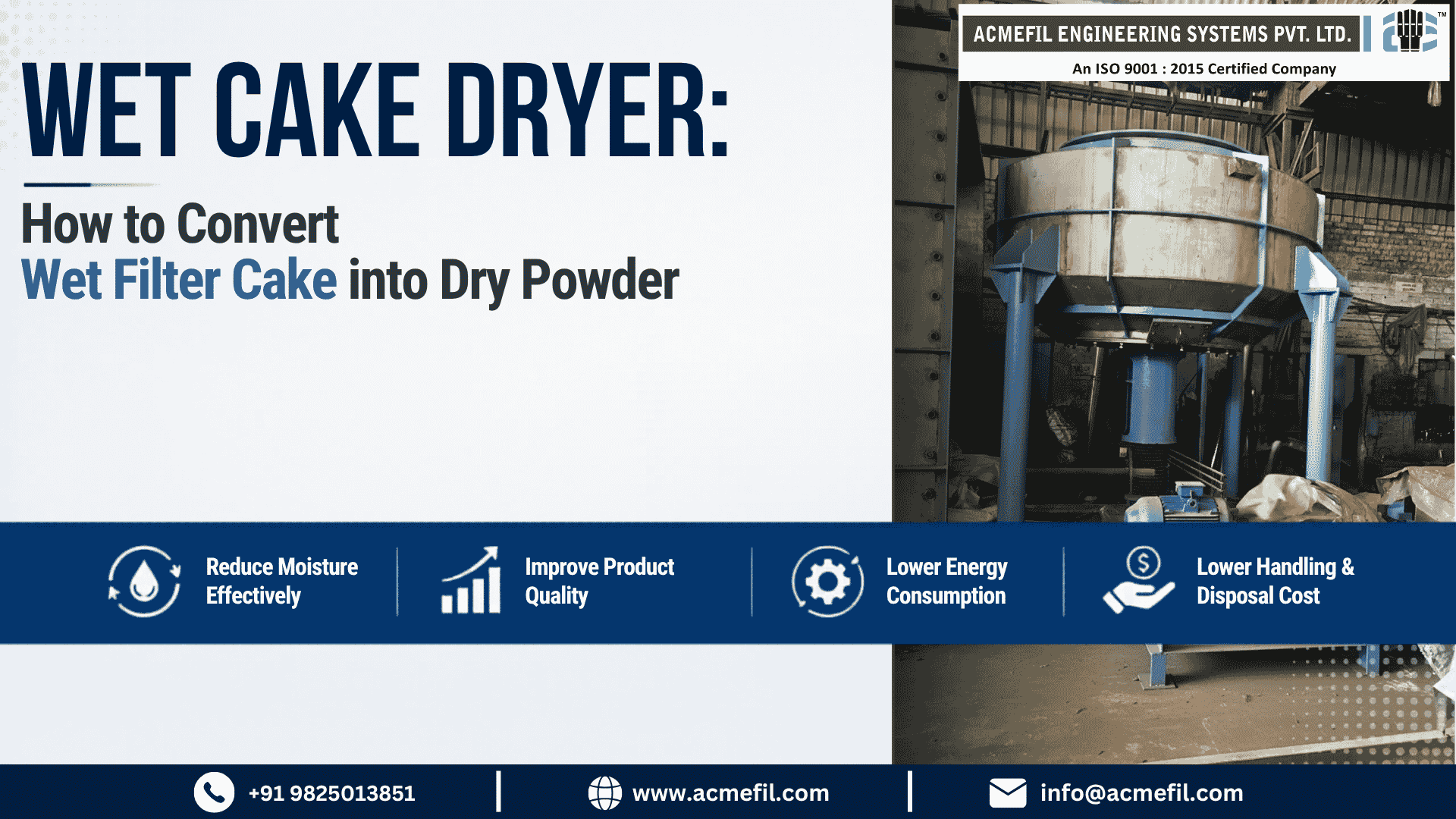
A wet cake dryer is used when filter cake, paste, gelatinous material or high-viscosity sludge must be converted into a dry powder. For many chemical, dye, pigment and agrochemical plants, a standard flash dryer is not enough because wet cake forms lumps and blocks the drying path. In those cases, spin flash drying becomes a practical wet cake drying equipment choice because it breaks, disperses and dries the material in one continuous system.
When I review a wet cake drying inquiry, I do not start with dryer capacity. I start with the feed behavior.
Does the cake crumble easily?
Does it smear like paste?
Does it form sticky lumps?
Does it come directly from a filter press?
Does the final product need to remain free-flowing?
These answers decide whether you need a simple flash dryer, fluid bed dryer, tray dryer, paddle dryer or a spin flash dryer.
For wet cake to powder drying, the most common mistake is assuming that “drying” is only about heat. In reality, wet cake drying is equally about material dispersion. If the wet cake does not break into small particles inside the dryer, hot air cannot contact the surface properly. The result is uneven moisture, wet lumps, wall build-up and frequent cleaning.
What Is Wet Cake in Industrial Drying?
Wet cake is a partially dewatered solid mass, usually discharged from a filter press, centrifuge or filtration system. It is not a free-flowing powder yet. It still contains surface moisture, bound moisture or trapped liquid inside the cake structure.
Common wet cake forms include:
- Filter press cake from dye intermediates
- Reactive dye wet cake
- Pigment press cake
- Agrochemical wet cake
- Chemical intermediate cake
- High-viscosity sludge
- Gelatinous paste
- Slimy process residue
A wet filter cake dryer must handle these feed forms without choking at the inlet, forming balls inside the drying chamber or carrying wet lumps into the powder discharge.
This is where the difference between a normal flash dryer and a spin flash dryer becomes important. You can read the detailed mechanism in this guide on the spin flash dryer working principle.
Why Standard Flash Dryers Struggle with Wet Cake
A standard flash dryer works well when the feed is already powdery, granular or easily dispersible. Hot air at high velocity picks up the particles, removes moisture and carries the product to a cyclone or bag filter.
But wet cake behaves differently.
It may enter the dryer as lumps, sticky paste or compact chunks. If this material is not broken immediately, the hot air flows around the lump instead of through the material surface. The outside dries first, the inside remains wet and the lump may stick to the wall or drop out before proper drying.
| Feed Condition | Standard Flash Dryer | Spin Flash Wet Cake Dryer |
|---|---|---|
| Free-flowing powder | Suitable | Usually not required |
| Centrifuged cake with surface moisture | Often suitable | May be used if lumping is present |
| Filter press wet cake | Often difficult | Suitable when properly designed |
| Slimy paste | Not suitable in most cases | Suitable with disintegrator and controlled feed |
| Gelatinous material | High choking risk | Better fit after pilot validation |
| High-viscosity sludge | Difficult | Common spin flash application |
| Wet cake to powder conversion | Limited | Stronger fit |
This is why many wet cake drying projects need equipment that can disintegrate the material before or during drying. A spin flash dryer does exactly that.
For buyers comparing equipment options, this article on how to choose a spin flash dryer is useful before finalizing a vendor.
How a Spin Flash Dryer Works as Wet Cake Drying Equipment
A spin flash dryer combines feeding, lump breaking, hot air drying and powder separation in a continuous process.
The typical wet cake drying process works like this:
- Wet cake is fed through a controlled screw feeder.
- A lump breaker or feed agitator prevents large chunks from entering uncontrolled.
- The material reaches the disintegrator zone.
- A cage mill or pin mill type disintegrator breaks the cake into smaller fragments.
- Hot air contacts the newly exposed wet surface.
- Moisture evaporates rapidly because the material is dispersed.
- Dried particles move with the air stream.
- Product is separated through cyclone and bag filter systems.
- Dry powder is discharged through an air lock rotary valve or suitable discharge arrangement.
The key point is simple. The wet cake dryer must create surface area before heat can work efficiently.
Without disintegration, hot air cannot solve the problem alone.
ACMEFIL’s spin flash drying technology is designed for wet cake, slimy paste, gelatinous material, filter cakes, pastes and high-viscosity sludge. Their system can use cage mill or pin mill type disintegrators depending on feed behavior, and pilot trials are available for process validation through the ACMEFIL spin flash dryer facility.
Wet Filter Cake Dryer Applications
Wet cake dryers are used in industries where filtration produces a wet solid that must become a stable powder for packing, handling, downstream processing or disposal.
| Industry | Typical Wet Cake Material | Drying Requirement |
|---|---|---|
| Dyestuff | Reactive dyes, dye intermediates, J-Acid, N-Methyl J-Acid | Convert sticky filter cake into dry powder |
| Pigments | Organic and inorganic pigment cakes | Reduce moisture without hard lumps |
| Agrochemicals | Pesticide or intermediate wet cake | Controlled drying for powder handling |
| Chemicals | Acetanilide, Sulfotobias Acid, specialty intermediates | Continuous wet cake to powder drying |
| Effluent treatment | High-viscosity sludge | Reduce moisture and improve disposal handling |
| Inorganic chemicals | Filter cake from reaction or precipitation process | Dry product for storage or packing |
For sludge-specific cases, this page on spin flash dryer for sludge drying gives a closer view of how sludge feed behavior affects dryer selection.
Wet Cake to Powder Dryer: What Decides the Final Powder Quality?
A wet cake to powder dryer does not automatically guarantee good powder. The final result depends on feed preparation, drying temperature, residence time, particle breakage and separation efficiency.
The main factors are:
Feed Moisture
Higher moisture increases evaporation load. A spin flash dryer can dry wet cake, but the feed should still be properly dewatered before drying. Sending avoidable free water into any dryer increases fuel load and may reduce throughput.
Cake Texture
Two cakes with the same moisture percentage can behave completely differently. One may crumble. Another may smear and form sticky balls. Texture decides the feeder, lump breaker and disintegrator design.
Stickiness During Drying
Some materials are not sticky at the feed stage but become sticky during partial drying. This is a common cause of wall build-up. Pilot testing is useful for identifying this risk before full-scale purchase.
Heat Sensitivity
Spin flash dryers have short residence time, so heat influence on many heat-sensitive products can be lower compared with long-duration drying methods. Still, inlet temperature, outlet temperature and product exposure must be selected based on actual material behavior.
Separation System
Cyclone and bag filter design matter because fine powder must be separated from the drying air. A poorly selected separation system can create product loss, dust emission or unstable discharge. For support equipment, ACMEFIL also manufactures bag filter systems used in industrial powder handling and air pollution control.
When Should You Choose a Wet Cake Dryer Instead of Other Dryers?
A wet cake dryer, especially a spin flash dryer, is a strong option when the plant needs continuous drying from wet cake to powder and the material can be broken into fine fragments during drying.
Choose spin flash wet cake drying when:
- The feed comes from a filter press
- The material is cake, paste, gelatinous or sludge-like
- Tray drying is too slow or labour-intensive
- Paddle drying gives a different product texture than required
- Final output must be powdery or easily packable
- The product needs short residence time
- Continuous operation is preferred
- Manual handling of wet cake must be reduced
Do not select it blindly when:
- The material contains volatile solvents and needs a closed-loop system
- The feed is a pumpable slurry with too much free water
- The final product melts, softens or becomes sticky in the target temperature range
- The feed has large hard lumps that need pre-crushing
- The required product is granule, flake or agglomerate instead of powder
For broader process comparison, the guide on comparing spin flash dryers vs other drying systems can help during early technology selection.
Wet Cake Dryer Design Points Buyers Should Check
Before you ask for a quotation, collect proper feed and process data. A weak RFQ usually leads to a weak dryer selection.
| RFQ Data Required | Why It Matters |
|---|---|
| Wet cake moisture percentage | Decides evaporation load |
| Required final moisture | Decides drying duty and outlet conditions |
| Bulk density | Affects feeder and discharge design |
| Cake texture | Decides lump breaker and disintegrator type |
| Stickiness | Affects chamber design and cleaning risk |
| Heat sensitivity | Affects inlet and outlet temperature selection |
| Particle size requirement | Affects disintegration and final powder handling |
| Hourly feed rate | Decides dryer capacity |
| Material of construction | Depends on corrosion, hygiene and product compatibility |
| Dust behavior | Affects cyclone, bag filter and safety design |
| Upstream equipment | Filter press or centrifuge discharge affects feeding |
| Downstream packing | Affects powder discharge and conveying arrangement |
For discharge control, equipment such as an air lock rotary valve may be required to maintain stable powder removal while controlling air ingress or egress.
Common Mistakes in Wet Cake Drying Equipment Selection
Mistake 1: Buying Based Only on Evaporation Capacity
Capacity matters, but evaporation load alone is not enough. A dryer may have enough heat duty and still fail if the wet cake cannot be dispersed.
Mistake 2: Ignoring the Feed Point
Most wet cake drying problems start at the feeding zone. If the screw feeder, lump breaker and disintegrator are not matched to the cake, the dryer will face choking or uneven drying.
Mistake 3: Treating Wet Cake Like Powder
A wet filter cake dryer is not only a hot air system. It is a material handling system, size reduction system and drying system combined.
Mistake 4: Skipping Pilot Trials
For sticky, gelatinous or high-viscosity material, pilot testing can prevent costly full-scale mistakes. ACMEFIL has an in-house pilot plant facility with a spin flash dryer rated at 10 kg/hr water evaporation for trials and process development.
Mistake 5: Not Planning for Dust Collection
Dry powder leaving the dryer must be separated properly. Cyclone and bag filter selection should not be treated as an afterthought.
Pilot Trial: The Safest Way to Validate Wet Cake to Powder Drying
In my experience, wet cake drying should be validated when the material is sticky, gelatinous, heat-sensitive or commercially critical. Lab moisture data is useful, but it does not show how the cake behaves inside a high-velocity hot air stream.
A pilot trial helps answer practical questions:
- Will the wet cake feed continuously?
- Does it break cleanly or smear inside the disintegrator?
- What inlet and outlet temperature range works?
- Does the product become powder or remain lumpy?
- Is there wall sticking?
- Is cyclone and bag filter separation stable?
- What final moisture is practically achievable?
This is especially important for dye intermediates, pigments, agrochemicals and sludge applications where two materials may look similar on paper but behave very differently in the dryer.
For application-level reading, see applications of spin flash dryers across industries.
Wet Cake Dryer Maintenance Considerations
A well-selected wet cake dryer reduces operating headaches, but it still needs proper maintenance.
The main inspection areas are:
- Feed screw and agitator
- Lump breaker or disintegrator wear
- Hot air inlet section
- Dryer chamber build-up
- Cyclone and bag filter pressure drop
- Rotary valve sealing
- Temperature sensors and control panel
- Product discharge consistency
Sticky products require more attention than free-flowing powders. Operators should track pressure drop, outlet temperature, feed rate and product moisture daily. A small change in feed moisture or cake texture can change dryer behavior.
The maintenance cost side is covered separately in this guide on spin flash dryer maintenance and cost analysis.
How ACMEFIL Supports Wet Cake Drying Projects
ACMEFIL Engineering Systems Pvt. Ltd. manufactures industrial drying and concentrating equipment from Ahmedabad, India. For wet cake dryer applications, the important support is not only fabrication. It is process selection.
The company’s product range includes spin flash dryers, flash dryers, fluid bed dryers, spray dryers, evaporators, ZLD systems and supporting equipment. For wet cake projects, the technical discussion usually includes feed behavior, drying duty, hot air generation, disintegrator choice, separation system and pilot validation.
When heat source selection is part of the project, ACMEFIL also manufactures supporting equipment such as direct fired hot air generators and indirect fired hot air generators depending on process requirements.
Before finalizing wet cake drying equipment, it is better to send a real material sample and process data. The right wet cake dryer is selected around the material, not around a catalogue name.
For project discussion, use the SpinFlashDrying.com contact page and share your wet cake moisture, feed rate, final moisture target and material behavior.
FAQs
What is the best dryer for wet cake drying?
For filter cake, slimy paste, gelatinous material and high-viscosity sludge, a spin flash dryer is often a strong wet cake dryer option because it breaks and dries the material in the same system. The final selection still depends on moisture, stickiness, heat sensitivity and powder requirement.
Can a wet filter cake dryer convert cake directly into powder?
Yes, in many applications a wet filter cake dryer can convert filter cake into powder, but only if the feed can be continuously metered, disintegrated and dried without excessive sticking. Pilot trials are recommended for difficult materials.
Why does wet cake choke inside a normal flash dryer?
Wet cake can enter as lumps or sticky paste. If it does not disperse quickly, hot air cannot contact enough surface area. The material may form wet balls, stick to the chamber or block the dryer inlet.
Which industries use wet cake drying equipment?
Wet cake drying equipment is commonly used in dyestuff, pigments, dye intermediates, agrochemicals, chemicals, inorganic chemicals and sludge drying applications.
What data is needed before selecting a wet cake dryer?
You should provide wet cake moisture, final moisture target, feed rate, bulk density, cake texture, stickiness, heat sensitivity, material of construction requirement, upstream equipment and required final powder form.
Conclusion
A wet cake dryer should not be selected only by asking, “How much moisture must be removed?” The better question is, “Can this wet cake be fed, broken, dried and separated continuously without choking or product damage?”
For wet filter cake, paste, gelatinous feed and high-viscosity sludge, spin flash drying is often the right wet cake to powder dryer approach because it combines disintegration with short-residence hot air drying. But the feed must be tested honestly. If the cake is highly sticky, heat-sensitive or unusual, a pilot trial is the safest step before full-scale equipment selection.
Share your wet cake sample data, moisture level, feed rate and final powder requirement with the Acmefil team before finalizing the dryer configuration.

Siddharth Nair is the Technical Director at Acmefil Engineering Systems Pvt. Ltd., an ISO 9001:2015 certified manufacturer of industrial drying and evaporation systems headquartered in Ahmedabad, Gujarat, he has led technical evaluation, application engineering and customer solution design for spray dryers, multi-effect evaporators, agitated thin film dryers, spin flash dryers and zero liquid discharge systems.