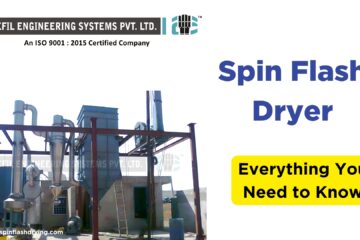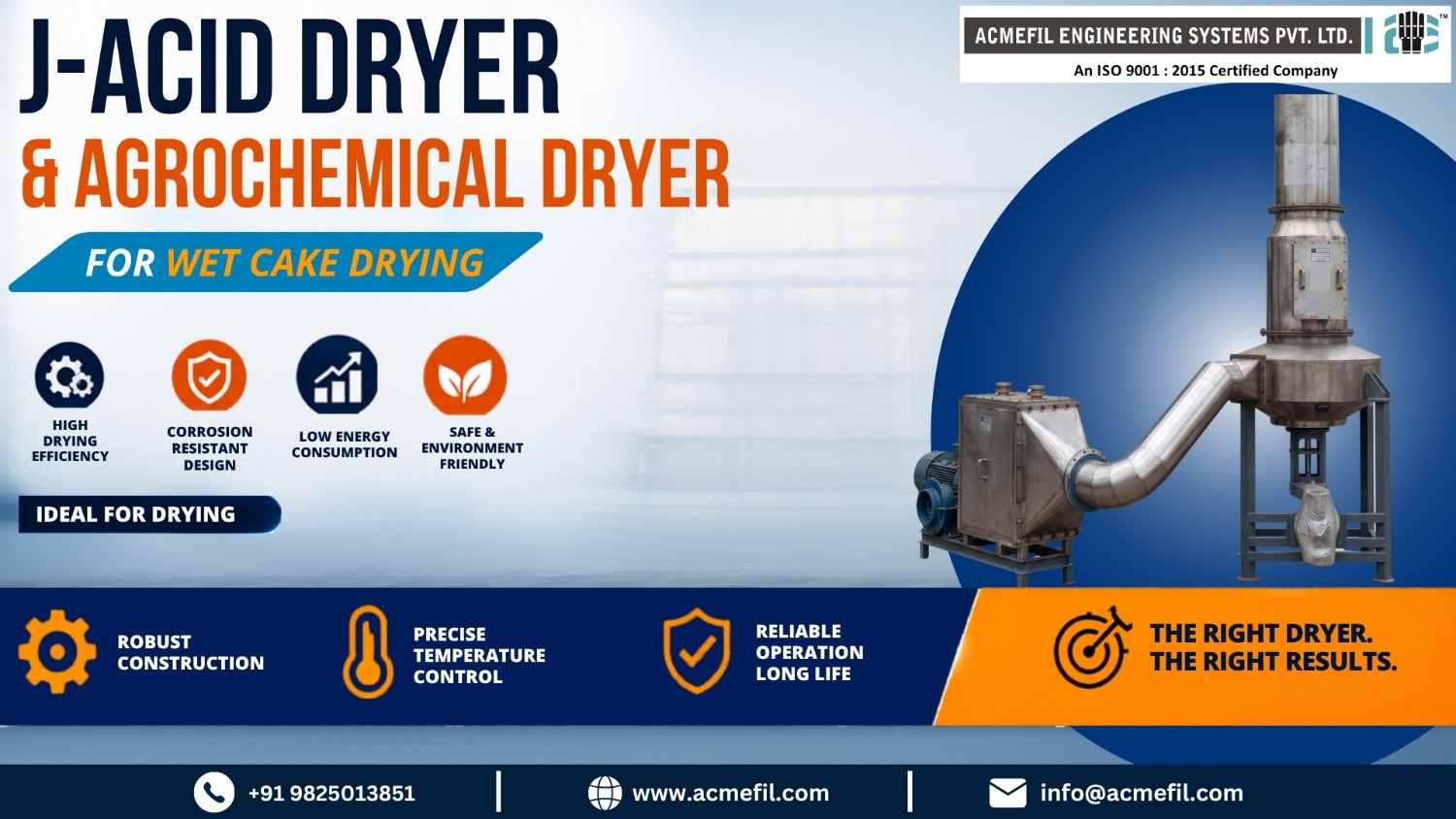
A J-Acid dryer is used to dry J-Acid wet cake, filter cake or paste-like dye intermediate feed into a dry powder or dry solid form. For difficult feeds such as J-Acid, N-Methyl J-Acid, Acetanilide, Sulfotobias Acid and many agrochemical intermediates, a spin flash dryer is often evaluated because it combines wet lump breaking and hot air drying in one continuous system.
The key point is simple. Do not select the dryer only by product name. Select it by feed behaviour.
If the material comes from a filter press as sticky wet cake, slimy paste, gelatinous mass or high-viscosity cake, a standard flash dryer may struggle. The feed may clump, bridge, choke the inlet or dry unevenly. In these cases, the disintegrator action inside a spin flash dryer becomes important.
For a wider technology base, you can also refer to the spin flash dryer working principle before finalizing dryer selection.
What Is a J-Acid Dryer?
A J-Acid dryer is industrial drying equipment used to reduce moisture from J-Acid wet cake or filter cake after filtration. In dye intermediate plants, the feed is often not a free-flowing powder. It may be sticky, lumpy, cohesive or paste-like.
That feed condition decides the dryer type.
For J-Acid drying equipment, the buyer should check:
| Selection Point | Why It Matters |
|---|---|
| Feed form | Confirms whether the material is wet cake, paste, slurry or powder |
| Initial moisture | Defines evaporation load |
| Final moisture target | Defines drying requirement and outlet condition |
| Stickiness and lump strength | Decides whether disintegrator action is needed |
| Heat sensitivity | Decides hot air temperature approach and residence time |
| Corrosive or abrasive nature | Decides material of construction |
| Dust behaviour | Decides cyclone and bag filter arrangement |
| Powder specification | Decides final discharge and collection design |
In my experience, buyers often ask for a dryer quote before confirming the real cake behaviour. That is risky. Two wet cakes with similar moisture can behave completely differently inside the feed zone.
Why Spin Flash Drying Fits Many Dye Intermediate Wet Cakes
A spin flash dryer is not just a hot air dryer. It is a drying system with mechanical disintegration at the feed point.
Wet cake enters through a controlled feeding system. A rotating disintegrator breaks the wet lumps into smaller particles. Hot air contacts the broken particles immediately. Moisture evaporates rapidly while the material moves with the air stream. The dried product is then separated through cyclone and bag filter arrangements.
This matters for dye intermediates because many feeds are not easy to disperse.
Typical problem materials include:
- J-Acid wet cake
- N-Methyl J-Acid wet cake
- Acetanilide wet cake
- Sulfotobias Acid cake
- Reactive dye intermediates
- Pigment cakes
- Agrochemical intermediate cakes
- High-viscosity chemical sludge
- Paste-like filter press discharge
For more application context, see this guide on applications of spin flash dryers across industries.
J-Acid Dryer Selection: What the Plant Should Check First
For J-Acid drying, the feed usually needs technical evaluation before dryer sizing. The most important question is not “What capacity dryer do I need?” It is “Can the wet cake be fed, broken, dried and discharged without choking?”
Before selecting a J-Acid dryer, prepare these details:
| Required Data | Practical Use in Dryer Design |
|---|---|
| Wet cake feed rate | Helps calculate dryer size and heat load |
| Initial and final moisture | Defines water evaporation duty |
| Cake temperature sensitivity | Helps decide drying temperature profile |
| Cake stickiness | Helps decide feed screw and disintegrator design |
| Lump hardness | Helps decide cage mill or pin mill type action |
| Bulk density | Affects chamber loading and pneumatic conveying |
| Material compatibility | Helps select contact material |
| Dust fineness | Affects cyclone, bag filter and product recovery |
| Cleaning requirement | Affects access doors and maintenance design |
A good J-Acid drying equipment discussion should begin with feed testing, not catalogue model selection.
N-Methyl J-Acid Dryer: Why Feed Control Matters
N-Methyl J-Acid dryer selection depends heavily on steady feeding. If the wet cake bridges in the hopper or enters the chamber in lumps, the dryer may face uneven moisture, overload, pressure fluctuation or partial choking.
A spin flash dryer helps because the feed system and disintegrator work together.
The feed screw controls the entry rate. The disintegrator breaks the wet mass. Hot air dries the broken particles while they remain suspended in the drying stream.
For this reason, N-Methyl J-Acid dryer design should focus on:
- Variable speed feed screw selection
- Hopper design for sticky wet cake
- Lump breaking at the feed zone
- Residence time control
- Final moisture requirement
- Cyclone and bag filter collection
- Product contact material
- Cleaning and inspection access
A standard flash dryer should be evaluated only when the feed already disperses properly and does not require aggressive lump breaking.
Acetanilide Dryer: Do Not Ignore Heat Exposure
Acetanilide dryer selection should consider both drying behaviour and product quality expectations. If the feed is wet cake or paste-like, mechanical disintegration can improve surface area and help moisture removal. But the process team still has to check whether the product can tolerate the selected hot air conditions.
A spin flash dryer can offer short residence time compared with many conventional drying routes. That can be useful for products where long heat exposure is undesirable. Still, heat sensitivity should not be assumed from the name alone. It should be checked with feed data, sample trials and final product requirements.
For Acetanilide drying equipment, I would normally ask:
- Is the feed filter cake, paste, powder or slurry?
- Does it form lumps after filtration?
- What is the inlet moisture and required final moisture?
- What is the acceptable product temperature exposure?
- Is direct hot air acceptable, or should indirect heating be evaluated?
- Does the final powder need fine collection through a bag filter?
- Are there dust, safety or housekeeping concerns?
This is where proper spin flash dryer design and operation becomes important.
Sulfotobias Acid Dryer: Handling Sticky Dye Intermediate Cake
A Sulfotobias Acid dryer should be selected with special attention to wet cake handling. In dye intermediate drying, the main operational problem is often not evaporation alone. The problem is feed movement.
If the cake sticks in the hopper, bridges above the screw, enters as large lumps or coats the feed zone, the drying system becomes unstable.
A spin flash dryer addresses this by combining:
- Controlled wet cake feeding
- Lump breaking through disintegrator action
- Immediate hot air contact
- Pneumatic movement of dried particles
- Product separation through cyclone and bag filter
- Rotary discharge to reduce air leakage
The exact design should still be confirmed by feed trials or at least by detailed product characterization. For Sulfotobias Acid and similar intermediates, a wrong dryer selection can create recurring cleaning, choking and moisture variation problems.
Agrochemical Dryer: When Spin Flash Dryer Is Suitable
An agrochemical dryer can mean different equipment depending on the product. Some agrochemical products need granulation or uniform low-temperature drying. Some are free-flowing powders. Some are wet cakes or paste-like intermediates from filtration.
Spin flash drying is most relevant when the agrochemical feed is:
- Wet cake from a filter press
- Sticky chemical cake
- Paste-like intermediate
- High-moisture lump-forming material
- Material that needs mechanical breaking during drying
- Feed that must become dry powder in a continuous process
Spin flash drying may not be the best choice when the product needs large granules, long residence time, very gentle handling or a special solvent-safe system. Those cases need separate process review.
This is why dryer selection should be based on product behaviour, not only the broad word “agrochemical.”
J-Acid Dryer vs Standard Flash Dryer vs Fluid Bed Dryer
| Selection Factor | Spin Flash Dryer | Standard Flash Dryer | Fluid Bed Dryer |
|---|---|---|---|
| Best feed condition | Wet cake, paste, gelatinous feed, sticky chemical cake | Free-flowing powder or easily dispersible cake | Granular or fluidizable solids |
| Main action | Mechanical disintegration plus hot air drying | Pneumatic hot air drying | Fluidization through upward air flow |
| Suitable for J-Acid wet cake | Often evaluated when cake is sticky or lumpy | Only if feed disperses easily | Only if material can fluidize properly |
| Feed challenge handled | Lumps, stickiness, poor dispersion | Surface moisture on dispersible feed | Uniform drying of particles or granules |
| Risk if wrongly selected | Choking, sticking, uneven moisture | Poor dispersion if feed is too cohesive | Defluidization, channeling or poor movement |
| Buyer decision point | Choose when wet feed must be broken during drying | Choose when feed is already easy to convey | Choose when particle bed behaviour is suitable |
For buyers comparing options, this spin flash dryer vs other drying technologies guide gives a broader selection view.
Cage Mill or Pin Mill Type Spin Flash Dryer?
ACMEFIL’s spin flash dryer catalogue includes cage mill type and pin mill type disintegrator options. The selection depends on feed behaviour.
| Disintegrator Selection Point | What to Check |
|---|---|
| Lump strength | Harder lumps may need stronger breaking action |
| Stickiness | Sticky material needs feed-zone design that reduces buildup |
| Fibrous or pasty behaviour | Impacts rotor and chamber design |
| Required powder form | Affects breaking intensity and residence profile |
| Heat sensitivity | Affects drying air approach and exposure time |
| Maintenance access | Important for cleaning, inspection and long-term operation |
Do not select cage mill or pin mill only from a brochure image. The better method is to review a real sample, feed behaviour and final powder requirement.
For technical evaluation, the buyer can begin with this guide on how to choose a spin flash dryer.
How the J-Acid Drying Process Works in a Spin Flash Dryer
The process flow is usually understood in six steps.
Wet Cake Feeding
J-Acid, N-Methyl J-Acid, Acetanilide, Sulfotobias Acid or agrochemical wet cake is fed through a hopper and controlled feed screw. Feed rate stability is critical.
Lump Breaking
The disintegrator breaks the wet cake into smaller particles. This increases surface area and improves hot air contact.
Hot Air Contact
Hot air enters the drying chamber and contacts the disintegrated material. Direct or indirect heating should be selected based on product sensitivity and contamination risk.
Rapid Moisture Removal
Drying occurs while the broken particles remain suspended in the air stream. This gives short residence time compared with many static drying methods.
Powder Separation
The dry product travels to the cyclone separator and bag filter system. The cyclone collects major product fraction, while the bag filter captures finer particles and supports cleaner exhaust handling.
Controlled Discharge
The dry product discharges through rotary valve arrangements. Air leakage control is important for stable operation and powder recovery.
ACMEFIL also manufactures supporting equipment such as spin flash dryers, flash dryers, bag filters and hot air generators for complete drying system design.
Common RFQ Mistakes in J-Acid and Agrochemical Dryer Buying
Many dryer RFQs are incomplete. They mention only product name and capacity. That is not enough for chemical wet cake drying.
Avoid these mistakes:
| Mistake | Better Approach |
|---|---|
| Asking only for “J-Acid dryer price” | Share feed rate, moisture, cake behaviour and final target |
| Assuming all dye intermediates dry the same way | Treat each product as a separate drying case |
| Ignoring stickiness | Test or describe cake handling behaviour clearly |
| Ignoring dust collection | Confirm cyclone, bag filter and product recovery needs |
| Ignoring material of construction | Check corrosion, abrasion and cleaning needs |
| Ignoring heat sensitivity | Confirm allowable product temperature exposure |
| Buying without trial for difficult feed | Use pilot testing when feed behaviour is uncertain |
A dryer that looks cheaper at RFQ stage can become expensive if it chokes, needs frequent cleaning or fails to hit final moisture consistently.
Pilot Testing for J-Acid and Agrochemical Wet Cake Drying
Wet cake drying is difficult to predict from a datasheet alone. Laboratory moisture values are useful, but they do not fully show how the cake behaves under screw feeding, disintegration, hot air contact and pneumatic movement.
ACMEFIL has an in-house R&D pilot facility with spin flash dryer pilot capacity of 10 kg/hr water evaporation. For difficult materials, pilot trials can help evaluate:
- Feed screw behaviour
- Lump breaking performance
- Product sticking tendency
- Moisture removal behaviour
- Cyclone and bag filter collection
- Heat exposure impact
- Scale-up suitability
For J-Acid dryer, N-Methyl J-Acid dryer, Acetanilide dryer, Sulfotobias Acid dryer and agrochemical dryer projects, this trial stage can reduce selection risk before full-scale procurement.
When Spin Flash Drying May Not Be the Right Dryer
Spin flash drying is useful, but it is not universal.
It may not be the first choice when:
- The feed is already a free-flowing powder
- The product cannot tolerate mechanical breaking
- The final product must remain as large granules
- Long residence time is needed for internal moisture diffusion
- The feed contains solvent or reactive material needing special safety design
- Dust hazard review is incomplete
- The product needs a different heating or containment arrangement
The right dryer is the one that matches feed behaviour, moisture target, safety condition and final product quality.
FAQs
What is the best dryer for J-Acid wet cake?
A spin flash dryer is often evaluated for J-Acid wet cake when the feed is sticky, lumpy, slimy or paste-like. It breaks wet lumps through a disintegrator and dries the material in a hot air stream. Final selection should be based on moisture, feed behaviour, heat sensitivity and powder requirement.
Can the same dryer handle J-Acid and N-Methyl J-Acid?
Possibly, but it should not be assumed. J-Acid and N-Methyl J-Acid may behave differently in wet cake form. Feed stickiness, lump strength, moisture, corrosive nature and final moisture target must be checked before using one dryer design for both products.
Is a standard flash dryer suitable for Acetanilide drying?
A standard flash dryer may be suitable only if the Acetanilide feed is free-flowing or easy to disperse. If the feed is wet cake, paste-like or lumpy, a spin flash dryer may be a better evaluation route because it includes mechanical disintegration.
What data is required for an agrochemical dryer quotation?
A useful agrochemical dryer RFQ should include feed form, feed rate, initial moisture, final moisture, stickiness, bulk density, heat sensitivity, material compatibility, dust behaviour, available utilities and final product requirement.
Why is a bag filter important in J-Acid drying equipment?
A bag filter helps capture fine powder from exhaust air after drying. In spin flash dryer systems, cyclone and bag filter selection affects powder recovery, dust control, exhaust cleanliness and stable system pressure.
Conclusion
For J-Acid dryer, N-Methyl J-Acid dryer, Acetanilide dryer, Sulfotobias Acid dryer and agrochemical dryer applications, the safest selection path starts with feed behaviour. If the material is wet cake, sticky paste, gelatinous cake or high-viscosity chemical feed, spin flash drying deserves serious evaluation because it combines disintegration and drying in one continuous process.
Before finalizing equipment, confirm the actual feed form, moisture load, heat sensitivity, stickiness, material compatibility and dust collection requirement. For uncertain or difficult products, pilot testing is the most practical way to reduce selection risk.
To discuss a wet cake or dye intermediate drying application, share your feed data through the SpinFlashDrying.com contact page.

Siddharth Nair is the Technical Director at Acmefil Engineering Systems Pvt. Ltd., an ISO 9001:2015 certified manufacturer of industrial drying and evaporation systems headquartered in Ahmedabad, Gujarat, he has led technical evaluation, application engineering and customer solution design for spray dryers, multi-effect evaporators, agitated thin film dryers, spin flash dryers and zero liquid discharge systems.