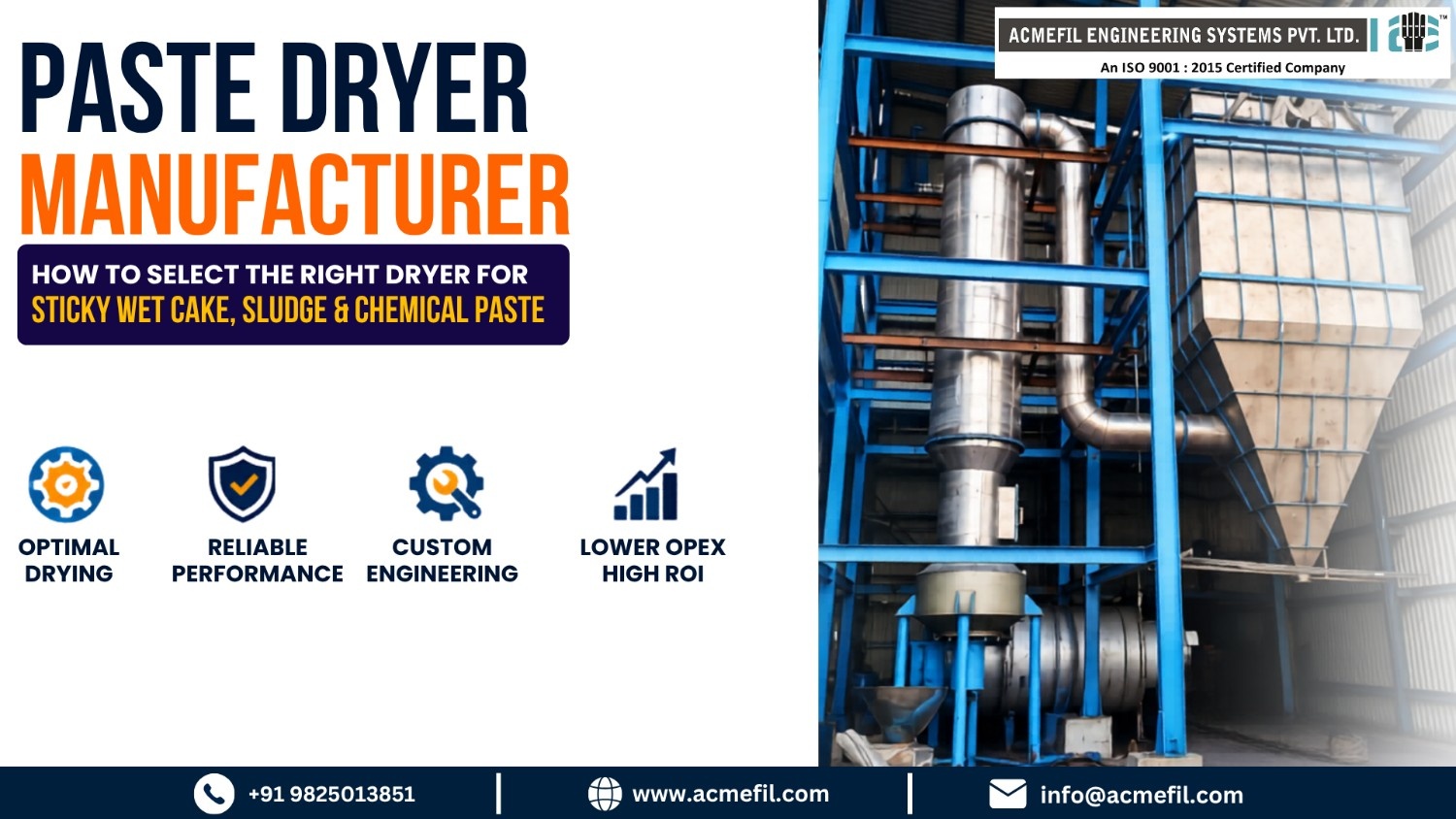
A good paste dryer manufacturer should not only supply a drying machine. The manufacturer must first understand whether your material is a wet cake, slimy paste, gelatinous mass, high-viscosity sludge, pigment cake, dyestuff intermediate or agrochemical paste. These materials behave very differently inside a dryer. If the feed cannot be broken, dispersed and dried quickly, the result is choking, lump formation, uneven moisture and poor powder recovery.
In my experience, most paste drying problems start before the machine is purchased. The buyer asks for a “dryer,” but the real requirement is a dryer that can handle sticky feed behavior at the feed point.
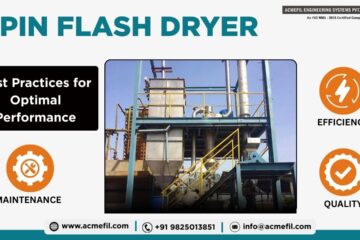
For many chemical, dye, pigment, agrochemical and sludge applications, a spin flash dryer is often considered because it combines wet cake disintegration, hot air drying and pneumatic product separation in one continuous system.
What Is a Paste Dryer?
A paste dryer is industrial drying equipment used to convert wet, sticky, semi-solid or high-moisture material into dry powder, granules or reduced-moisture solids.
The word “paste” is broad. In plant operation, it may refer to:
- Filter press discharge
- Centrifuged wet cake
- Sticky chemical paste
- Dye intermediate cake
- Pigment cake
- Agrochemical wet cake
- Gelatinous paste
- High-viscosity sludge
- ETP sludge or process sludge
- Crystalline or semi-crystalline wet mass
This is why a paste dryer manufacturer should not recommend equipment only from the product name. The correct selection depends on feed moisture, stickiness, lump size, heat sensitivity, final moisture requirement, bulk density, particle behavior and whether the product can be safely dispersed in hot air.
Why Standard Dryers Fail With Sticky Paste
Sticky paste does not behave like free-flowing powder. It does not automatically disperse in the drying air.
When wet paste enters a standard flash dryer or poorly designed hot air dryer, these problems are common:
- The material forms lumps instead of fine particles.
- Sticky mass builds up at the feed point.
- The drying duct or chamber starts choking.
- Moisture removal becomes uneven.
- Some particles overdry while inner lumps remain wet.
- The cyclone or bag filter receives inconsistent product.
- Operators increase temperature to compensate, which may damage heat-sensitive products.
- Manual cleaning and downtime increase.
The core issue is usually not only “drying capacity.” It is feed preparation. Sticky paste must be broken into small fragments before or during hot air contact.
That is where the disintegrator system in a spin flash dryer working principle becomes important.
Why Spin Flash Dryer Is Commonly Used as a Paste Dryer
A spin flash dryer is designed for wet cake, filter cake, slimy paste and gelatinous materials that a simple flash dryer cannot handle properly.
The system uses a controlled feeding arrangement and a high-speed disintegrator at the feed zone. As the paste enters the dryer, the disintegrator breaks lumps and exposes more surface area to hot air. The broken particles dry in suspension and move with the air stream toward the cyclone and bag filter system.
This makes spin flash drying suitable for many paste-to-powder applications where the material can be mechanically disintegrated and pneumatically conveyed.
Typical applications include:
- Chemical wet cake drying
- Dye intermediate drying
- Reactive dye cake drying
- Pigment cake drying
- Agrochemical paste drying
- High-viscosity sludge drying
- Filter press cake drying
- Wet cake to powder drying
- J-Acid and similar dye intermediate drying
- Inorganic chemical paste drying
For a deeper equipment-level understanding, see this guide on spin flash dryer components.
Paste Dryer Selection: Which Dryer Fits Which Feed?
Not every paste should go into the same dryer. A responsible paste dryer manufacturer should separate the feed by behavior, not just by industry.
| Feed Condition | Common Material Example | Suitable Dryer Direction | Selection Note |
|---|---|---|---|
| Sticky wet cake from filter press | Dyes, pigments, agrochemicals, chemical cake | Spin flash dryer | Needs disintegrator, controlled feed screw and hot air contact |
| Slimy or gelatinous paste | Dye intermediates, high-moisture chemical paste | Spin flash dryer with proper disintegrator | Pilot trial is strongly recommended |
| High-viscosity sludge | ETP sludge, process sludge | Spin flash dryer or sludge dryer, depending on behavior | Feed consistency and ash/solid content must be checked |
| Centrifuged powder or granular cake | Chemicals, pigments, minerals | Flash dryer | Works better when material is less sticky and can convey pneumatically |
| Heat-sensitive granular product | Pharma, food, fine chemicals | Fluid bed dryer or controlled hot air system | Low-temperature drying and residence time matter |
| Highly viscous liquid concentrate | Effluent concentrate, thick slurry | ATFD or evaporation-drying route | Not always suitable for direct spin flash drying |
If the material is sticky at feed point but becomes powder after disintegration, spin flash drying is usually worth evaluating. If the material remains tacky throughout heating, direct flash-type drying may not be suitable without preconditioning or process change.
What a Good Paste Dryer Manufacturer Should Check Before Quoting
A paste dryer quotation should not be based only on kilograms per hour of wet feed. Wet feed capacity alone is incomplete because drying duty depends on moisture load and final moisture target.
Before quoting, the manufacturer should ask for:
- Wet feed rate
- Initial moisture percentage
- Required final moisture percentage
- Product temperature sensitivity
- Bulk density
- Lump size from filter press or centrifuge
- Stickiness and gelatinous nature
- Material pH and corrosiveness
- Solvent or water-based moisture
- Required MOC, such as MS, SS 304 or SS 316
- Dust collection requirement
- Available utilities, fuel and electrical load
- Current drying method and pain points
- Final product use, packing and powder handling needs
For difficult feeds, the best answer is not a fast quotation. The best answer is a controlled drying trial.
ACMEFIL’s in-house pilot facility includes spin flash dryer pilot capability of 10 kg/hr water evaporation for process development and validation. This is useful when the feed is sticky, heat-sensitive or difficult to predict at full scale.
Key Design Features in a Paste Dryer
A paste dryer used for sticky wet cake should include more than a drying chamber. The critical performance points are usually in the feeding, disintegration and separation sections.
Controlled Feed System
Sticky paste cannot be dumped into a dryer randomly. A variable-speed feed screw helps maintain consistent feed rate and reduces sudden overloading.
Lump Breaker or Disintegrator
The disintegrator breaks wet cake into smaller particles. In spin flash dryers, cage mill type and pin mill type disintegrators are commonly used depending on the feed nature.
You can read more about these configurations here:
Hot Air Contact
Hot air must contact freshly exposed particle surface quickly. This improves moisture evaporation and reduces the chance of wet lumps travelling through the system.
Short Residence Time
Spin flash drying usually works with short product residence time. This is helpful for many heat-sensitive products, but it does not remove the need for product trials.
Cyclone and Bag Filter Separation
After drying, the product is separated from the air stream through cyclone and bag filter systems. Dust load, particle size and product recovery expectation must be considered during system design.
For more on dust handling, see spin flash dryer dust collection.
Clean Operating Environment
A closed and properly ducted drying system reduces manual handling of wet paste and dried powder. This is important in dyes, pigments, chemicals and agrochemical plants where dust and operator exposure must be controlled.
Paste Dryer for Chemical Industry
Chemical paste drying is one of the strongest use cases for spin flash dryers because many chemical products come from filtration, centrifuging or reaction mass separation.
Common chemical paste drying challenges include:
- High initial moisture
- Sticky filter cake
- Corrosive product behavior
- Heat sensitivity
- Fine powder dusting
- Batch-to-batch feed variation
- Final moisture specification pressure
- Product color or quality sensitivity
For inorganic chemicals, pigments, dyes and intermediates, the paste dryer manufacturer must understand both drying behavior and downstream powder handling.
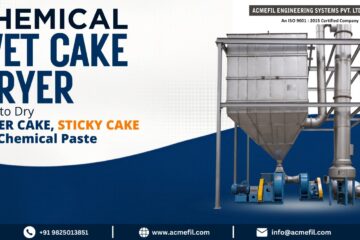
If your plant is drying chemical wet cake, this related guide on chemical wet cake dryer will help you evaluate the application more specifically.
Paste Dryer for Pigments and Dyes
Pigment and dyestuff plants often deal with filter cakes that are sticky, colored, fine and dust-prone after drying. Poor dryer selection can create three major problems:
- Uneven final moisture
- Powder loss through inefficient separation
- Cleaning difficulty due to product build-up
In pigment and dye applications, the disintegrator, residence time, hot air temperature profile and product collection system must be selected together. A strong dryer body alone will not solve poor feed dispersion.
For pigment-focused applications, see pigment drying equipment.
Paste Dryer for Sludge and High-Viscosity Waste
Sludge behaves differently from chemical paste because it may contain mixed solids, salts, organics and variable moisture. ETP sludge or process sludge can change from batch to batch.
Before selecting a sludge paste dryer, check:
- Is the sludge pumpable, scoopable or cake-like?
- Does it become sticky when heated?
- Is the final product powder, granule or reduced-volume solid?
- Is there odor, corrosive vapor or emission concern?
- What is the ash and volatile content?
- Will the dried product be disposed, reused or packed?
For sludge applications, dryer selection should be done carefully. A spin flash dryer may work for some high-viscosity sludge feeds, but some sludge materials need a different drying route.
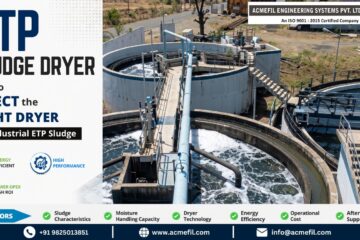
For more detail, read spin flash dryer for sludge drying.
How to Compare Paste Dryer Manufacturers
When comparing paste dryer manufacturers, do not compare only the lowest machine price. A cheaper dryer that chokes, overdrys product or misses final moisture will become expensive after commissioning.
Use this practical checklist:
| Evaluation Point | Why It Matters |
|---|---|
| Paste drying experience | Sticky feed needs application knowledge, not only fabrication |
| Trial facility | Pilot testing reduces full-scale risk |
| Disintegrator selection | Cage mill and pin mill choices affect lump breaking |
| Feed screw design | Inconsistent feed causes choking and moisture variation |
| Hot air system design | Temperature, airflow and residence time decide drying performance |
| Dust collection | Cyclone and bag filter sizing affects powder recovery |
| Material of construction | Corrosive chemical paste may need suitable contact parts |
| Maintenance access | Sticky products need cleaning-friendly design |
| Installation and commissioning support | Drying systems need site-level tuning |
| Honest technical evaluation | Not every paste is suitable for the same dryer |
A good manufacturer should be comfortable saying, “We need to test this material first,” instead of forcing one standard model for every product.
What Information Should You Send for a Paste Dryer RFQ?
To receive a technically useful quotation, share these details with the paste dryer manufacturer:
- Product name and industry
- Wet feed rate in kg/hr
- Initial moisture percentage
- Required final moisture percentage
- Current drying method
- Source of wet cake, such as filter press, centrifuge or reactor discharge
- Feed consistency, sticky, slimy, granular, crystalline or gelatinous
- Lump size at dryer feed
- Heat sensitivity and maximum product temperature limit
- Bulk density of wet and dry product
- MOC requirement
- Fuel preference, such as gas, diesel, coal, wood or other available utility
- Dust collection requirement
- Site space limitation
- Automation expectation
- Required final powder form and packing method
If you are unsure about feed behavior, send a representative sample for trial before finalizing full-scale equipment.
Where ACMEFIL Fits as a Paste Dryer Manufacturer
ACMEFIL Engineering Systems Pvt. Ltd. manufactures industrial drying and concentrating equipment from Ahmedabad, India. The company’s drying portfolio includes spin flash dryers, flash dryers, fluid bed dryers, spray dryers, evaporators and related air pollution control systems.
For sticky paste, wet cake and gelatinous material applications, the ACMEFIL spin flash dryer is the main support technology because it is designed around feed disintegration and hot air drying. For less sticky powders or centrifuged cakes, flash dryer systems may also be evaluated. For granular and heat-sensitive products, fluid bed dryer systems may be more suitable.
This is the important point: paste drying should be selected by material behavior, not by equipment name.
Conclusion
If you are searching for a paste dryer manufacturer, start with the nature of your feed. Sticky wet cake, filter cake, gelatinous paste, pigment cake, chemical paste and high-viscosity sludge need controlled feeding, strong disintegration, correct hot air contact and reliable powder separation.
A spin flash dryer is often a practical choice for paste-to-powder drying when the material can be broken and dried in suspension. But the safest route is to validate the feed through technical evaluation or pilot testing before final equipment selection.
For paste dryer selection, wet cake drying trials or spin flash dryer sizing, share your product details, feed moisture, final moisture target and current drying problem with the engineering team.
FAQs
What is the best dryer for sticky paste?
For many sticky paste and wet cake applications, a spin flash dryer is suitable because it uses a disintegrator to break the feed at the entry point before drying it in hot air. However, the final choice depends on feed stickiness, moisture, heat sensitivity and whether the material can be dispersed safely.
Can a paste dryer handle filter press cake directly?
Yes, in many applications a spin flash dryer can be designed to accept material from filter press discharge through a controlled feeding system. The feed screw, lump breaker and disintegrator design are critical to avoid choking.
Is a flash dryer suitable for paste drying?
A standard flash dryer is generally better for powders, granules or centrifuged cakes with surface moisture. Sticky paste and gelatinous wet cake usually need a spin flash dryer because the feed must be disintegrated before drying.
Which industries use paste dryers?
Paste dryers are used in dyes, pigments, chemicals, agrochemicals, inorganic chemicals, sludge handling, ETP waste processing and other industries where wet cake or sticky semi-solid material must be converted into dry powder or lower-moisture solids.
Why is pilot testing important before buying a paste dryer?
Pilot testing helps confirm whether the paste breaks properly, dries uniformly, meets final moisture targets and can be separated through cyclone and bag filter systems. This is especially important for sticky, gelatinous, heat-sensitive or variable feed materials.

Siddharth Nair is the Technical Director at Acmefil Engineering Systems Pvt. Ltd., an ISO 9001:2015 certified manufacturer of industrial drying and evaporation systems headquartered in Ahmedabad, Gujarat, he has led technical evaluation, application engineering and customer solution design for spray dryers, multi-effect evaporators, agitated thin film dryers, spin flash dryers and zero liquid discharge systems.