Agrochemical drying equipment is used to convert wet cake, filter cake, paste, slurry, granules or powder into a stable dry product for packing, blending or further processing. For many agrochemical intermediates, the right dryer is not selected only by capacity. It depends on feed moisture, stickiness, heat sensitivity, particle size, dust load, solvent risk and final moisture requirement.
In my experience, the biggest mistake is treating all agrochemical products as normal chemical powders. Many are not. Some behave like sticky wet cake. Some form lumps. Some need fast drying with minimum heat exposure. That is where dryer selection becomes critical.
What Is Agrochemical Drying Equipment?
Agrochemical drying equipment refers to industrial dryers used for pesticide intermediates, herbicide intermediates, fungicide intermediates, crop protection chemicals and related chemical products where moisture must be removed after filtration, centrifuging, crystallization, synthesis or washing.
Common feed forms include:
- Wet cake from filter press
- Centrifuged cake
- Sticky paste
- Gelatinous material
- High-moisture sludge-type feed
- Slurry or liquid concentrate
- Free-flowing powder or granules
- Heat-sensitive chemical intermediates
A dryer that works well for free-flowing powder may fail badly when the same plant tries to process sticky filter cake. Before selecting any spin flash dryer, flash dryer, fluid bed dryer or spray dryer, the feed behavior must be checked under real process conditions.
Why Agrochemical Drying Is Difficult
Agrochemical drying is not only about removing water. The product must remain stable, flowable and suitable for downstream use.
The main technical challenges are:
| Drying Challenge | What Can Go Wrong | What to Check Before Dryer Selection |
|---|---|---|
| Sticky wet cake | Feed builds up at inlet or drying chamber | Cake texture, lump size, stickiness, initial moisture |
| Heat-sensitive product | Product degrades, discolours or loses active quality | Maximum safe product temperature and residence time |
| Uneven feed moisture | Final product moisture varies batch to batch | Moisture range from filter press or centrifuge |
| Fine powder generation | Dust load increases at cyclone and bag filter | Particle size, bulk density and dust explosibility risk |
| Corrosive chemistry | Dryer parts wear or corrode early | MOC requirement such as SS 304, SS 316 or special alloy |
| Poor flowability | Discharge, packing and conveying problems | Final powder behaviour and downstream equipment |
| Solvent traces | Fire, explosion or emission risk | Solvent content, flash point, VOC and EHS review |
For agrochemical products, I prefer starting with feed behavior. If the material is sticky, pasty or gelatinous, the drying system must break and disperse the feed before hot air can remove moisture properly.
Best Dryer for Agrochemical Wet Cake and Filter Cake
For many agrochemical wet cake and filter cake applications, a spin flash dryer is often the first technology to evaluate.
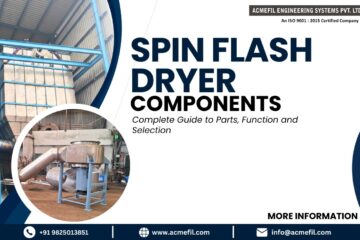
A spin flash dryer is designed for wet cake, paste, gelatinous material and high-viscosity feed where a standard flash dryer cannot handle the material properly. The key difference is the disintegrator at the feed point. This mechanical action breaks the wet cake into smaller particles as the material enters the hot air stream.
That matters because agrochemical wet cake does not always disperse by air velocity alone. If lumps remain large, the outside dries first while the inside stays wet. This leads to uneven moisture, rejected product and choking inside the system.
A spin flash dryer helps by combining:
- Wet cake feeding
- Lump breaking
- Mechanical disintegration
- Hot air contact
- Short residence drying
- Powder separation through cyclone and bag filter
- Continuous discharge
For a deeper technical explanation, read the spin flash dryer working principle before finalizing the equipment type.
How a Spin Flash Dryer Works in Agrochemical Drying
In a typical agrochemical wet cake drying system, the process flow is:
- Wet cake is discharged from filter press, centrifuge or upstream separation equipment.
- A feed screw or feeding arrangement pushes the material toward the dryer inlet.
- A lump breaker or disintegrator breaks large wet lumps.
- Hot air enters the drying chamber at controlled velocity and temperature.
- Wet particles are dispersed and dried in suspension.
- Coarser or wetter particles remain longer until properly dried.
- Dried powder moves with air to the cyclone separator.
- Fine dust is controlled through a bag filter or pulse jet bag filter.
- Final dry product is discharged through rotary valve or suitable powder handling equipment.
The main advantage is that drying and deagglomeration happen together. This is why spin flash drying is useful for agrochemical materials that are difficult to dry in tray dryers, rotary dryers or simple pneumatic flash dryers.
For design-level details, refer to design and operation inside spin flash dryers.
Which Agrochemical Dryer Should You Choose?
Not every agrochemical material should go into a spin flash dryer. Dryer selection depends on feed form and product objective.
| Feed Condition | Suitable Dryer Type | Why It Fits |
|---|---|---|
| Sticky wet cake or filter cake | Spin flash dryer | Breaks lumps and dries wet cake in hot air stream |
| Slimy paste or gelatinous material | Spin flash dryer with cage mill or pin mill type disintegrator | Helps disperse difficult feed before drying |
| Centrifuged cake with lower stickiness | Flash dryer | Suitable when feed can be pneumatically conveyed and mainly needs surface moisture removal |
| Free-flowing powder or granules | Fluid bed dryer or vibratory fluid bed dryer | Gives controlled drying with good air-solid contact |
| Liquid slurry or solution | Spray dryer | Converts liquid feed into dry powder through atomization |
| Viscous concentrate from effluent or process stream | ATFD or evaporation plus drying system | Better when feed is not suitable for direct flash-type drying |
ACMEFIL’s drying portfolio also includes flash dryers, fluid bed dryers and spray dryers, so the selection can be based on feed behavior rather than forcing one technology into every application.
When Spin Flash Drying Is a Strong Fit
A spin flash dryer for agrochemicals is usually worth evaluating when:
- Feed comes as wet cake from a filter press
- Material forms lumps during feeding
- Product is pasty, sticky or gelatinous
- Standard flash drying creates choking or uneven drying
- Continuous drying is preferred over batch tray drying
- Final product is required as powder
- Short residence time is important
- Manual handling must be reduced
- Clean dust-controlled operation is required
This is also why spin flash drying is widely discussed for chemical wet cake, dye intermediates, pigments, agro chemicals and similar difficult drying duties. You can review more use cases on applications of spin flash dryers.
When Spin Flash Drying May Not Be the Right Choice
A spin flash dryer is not a universal solution. It may not be the correct fit when:
- Product cannot tolerate mechanical disintegration
- Particle shape must remain intact
- Feed is a clear liquid or low-viscosity slurry
- Product needs long controlled residence time
- Feed contains significant solvent risk without safety review
- Final product must be granulated rather than powdered
- The product is extremely abrasive and MOC/wear design is not addressed
For these cases, a spray dryer, fluid bed dryer, vacuum dryer, ATFD or other equipment may be more suitable. The safest approach is to compare dryer technologies using actual feed data. This comparison guide on spin flash dryers vs other drying technologies will help during early technical evaluation.
Key Components in Agrochemical Drying Equipment
A complete agrochemical drying system is more than the main dryer body. The supporting equipment decides whether the plant runs smoothly or keeps choking.
Important components include:
| Component | Role in Agrochemical Drying |
|---|---|
| Feed screw | Controls wet cake feed rate into dryer |
| Lump breaker | Reduces large cake lumps before drying |
| Cage mill or pin mill disintegrator | Breaks and disperses sticky feed at dryer inlet |
| Hot air generator | Provides required drying air temperature |
| Drying chamber | Gives contact time between hot air and wet particles |
| Cyclone separator | Separates dried powder from air stream |
| Bag filter | Controls fine dust and improves clean operation |
| Rotary air lock valve | Discharges product while controlling air leakage |
| Control panel | Manages feed rate, temperature, airflow and safety interlocks |
| Ducting and exhaust system | Maintains airflow and plant dust control |
For agrochemical drying, I pay special attention to feed screw design, disintegrator type, bag filter sizing and material of construction. These areas decide long-term reliability.
For dust control equipment, ACMEFIL’s bag filter systems can be evaluated as part of the drying plant package.
Cage Mill Type vs Pin Mill Type Spin Flash Dryer
Agrochemical wet cakes do not all break the same way. Some need stronger impact. Some need gentler disintegration. That is why spin flash dryers may use cage mill or pin mill type disintegrators depending on feed behavior.
| Disintegrator Type | Better For | Selection Point |
|---|---|---|
| Cage mill type | Tougher wet cake and lumpy feed | Useful where stronger breaking action is required |
| Pin mill type | Softer paste-like or more dispersible material | Useful where controlled disintegration is preferred |
The final selection should not be made from the product name alone. Two agrochemical wet cakes with the same moisture percentage can behave differently because of crystal size, filtration quality, binder effect, stickiness and upstream washing process.
Feed Data Required Before Quoting Agrochemical Drying Equipment
A serious dryer proposal needs more than “required capacity.” For accurate selection, provide:
- Product name and application
- Feed form, wet cake, paste, slurry, powder or granule
- Initial moisture percentage
- Required final moisture percentage
- Wet cake bulk density
- Lump size after filter press or centrifuge
- Stickiness and thixotropic behavior
- Heat sensitivity or maximum product temperature
- Solvent content, if any
- pH and corrosive nature
- MOC preference
- Required evaporation load
- Operating hours per day
- Preferred fuel for hot air generation
- Dust handling and emission control requirements
- Downstream packing or conveying method
Without this data, dryer selection becomes guesswork. In agrochemical plants, guesswork becomes expensive after installation.
Pilot Trial Before Full-Scale Agrochemical Dryer Selection
For difficult agrochemical products, pilot testing is valuable. ACMEFIL has pilot plant facilities for drying trials, including spin flash dryer trials at 10 kg/hr water evaporation capacity.
A pilot trial helps confirm:
- Whether the wet cake feeds properly
- Whether lumps break as expected
- Whether target moisture is achievable
- Whether product colour or quality changes
- Whether powder flow is acceptable
- Whether dust load is manageable
- Whether spin flash, flash, fluid bed or another dryer is the better fit
This is especially useful when the product is new, sensitive, sticky or high value. Before committing to a full-scale plant, a pilot run gives practical answers that a datasheet cannot provide.
For project evaluation, ACMEFIL’s design and engineering team can review feed data and help define the correct drying route.
Common RFQ Mistakes in Agrochemical Dryer Procurement
Many dryer RFQs fail because they ask for price before defining the process. These are the mistakes I see most often:
| Mistake | Why It Creates Risk |
|---|---|
| Asking only for kg/hr capacity | Dryer size depends on water evaporation load, not only wet feed quantity |
| Not sharing moisture data | Initial and final moisture decide heat load and residence time |
| Ignoring feed stickiness | Sticky cake can choke a wrongly selected dryer |
| Assuming one dryer fits all products | Agrochemical products vary widely in feed behavior |
| Not checking heat sensitivity | Product can degrade even if moisture target is achieved |
| Ignoring dust collection | Fine powders need cyclone and bag filter design |
| Not discussing MOC | Corrosion can reduce equipment life |
| Skipping trial for difficult feed | Full-scale risk remains high when feed behavior is unknown |
If you are preparing an RFQ, start with feed data and product behavior first. Equipment price should come after technical fit is confirmed.
Practical Selection Guide for Buyers
Use this quick decision path:
- If the feed is wet cake, sticky paste or gelatinous material, evaluate a spin flash dryer first.
- If the feed is free-flowing powder with mainly surface moisture, evaluate a flash dryer.
- If the feed is granule or powder needing controlled low-temperature drying, evaluate a fluid bed dryer.
- If the feed is liquid slurry or solution, evaluate a spray dryer.
- If the feed is highly viscous concentrate, evaluate evaporation, ATFD or a combined drying system.
- If the feed contains solvent or flammable material, do not proceed without safety and EHS review.
For a detailed buyer checklist, read how to choose a spin flash dryer.
Safety and Compliance Notes for Agrochemical Drying
Agrochemical drying must be reviewed carefully because many products are dusty, corrosive, toxic, heat-sensitive or solvent-affected.
Before final design, check:
- Dust exposure and containment
- Explosion and fire risk
- Solvent traces
- Operator safety
- Material of construction
- Emission control
- Product contamination risk
- Cleaning access
- Local pollution control requirements
- Plant EHS standards
A dryer should not be selected only because it can remove moisture. It must also fit the plant’s safety, maintenance and compliance environment.
FAQs
What is the best drying equipment for agrochemical wet cake?
For sticky agrochemical wet cake, filter cake and paste, a spin flash dryer is often the best equipment to evaluate because it breaks wet lumps through a disintegrator and dries the dispersed particles in a hot air stream. Final selection depends on moisture, stickiness, heat sensitivity and trial results.
Can a flash dryer dry agrochemical wet cake?
A standard flash dryer works better for powders, free-flowing material or centrifuged cakes with manageable surface moisture. If the agrochemical feed is sticky, slimy, pasty or highly lumpy, a spin flash dryer is usually more suitable than a simple flash dryer.
Which dryer is used for pesticide intermediate drying?
Pesticide intermediate drying may use a spin flash dryer, flash dryer, fluid bed dryer or spray dryer depending on the feed form. Wet cake and paste normally point toward spin flash drying. Free-flowing powders may suit flash or fluid bed drying. Liquid slurry may need spray drying.
Why does agrochemical wet cake choke inside a dryer?
Wet cake chokes when it enters the dryer as large sticky lumps and does not disperse properly in the hot air stream. Poor feed screw design, no lump breaking, wrong disintegrator selection, high stickiness and incorrect airflow can all cause choking.
What data is required to select agrochemical drying equipment?
The minimum data includes feed form, initial moisture, final moisture, wet feed rate, product temperature limit, stickiness, bulk density, lump size, solvent content, corrosive nature, MOC requirement and downstream powder handling needs.
Conclusion
Agrochemical drying equipment should be selected from feed behavior, not from product name alone. A wet cake from a filter press, a sticky pesticide intermediate paste and a free-flowing agrochemical powder need different drying logic.
For difficult wet cake, paste and gelatinous agrochemical feeds, a spin flash dryer is often the most practical equipment to evaluate because it combines lump breaking, hot air drying and continuous powder separation in one system. For powders, granules, liquid slurry or viscous concentrate, another dryer may be technically better.
If your agrochemical product is choking in an existing dryer or you are planning a new drying line, share your feed data, moisture target and product handling limits through the SpinFlashDrying.com contact page. The correct next step is not only a quotation. It is confirming which drying technology fits your material.

Siddharth Nair is the Technical Director at Acmefil Engineering Systems Pvt. Ltd., an ISO 9001:2015 certified manufacturer of industrial drying and evaporation systems headquartered in Ahmedabad, Gujarat, he has led technical evaluation, application engineering and customer solution design for spray dryers, multi-effect evaporators, agitated thin film dryers, spin flash dryers and zero liquid discharge systems.