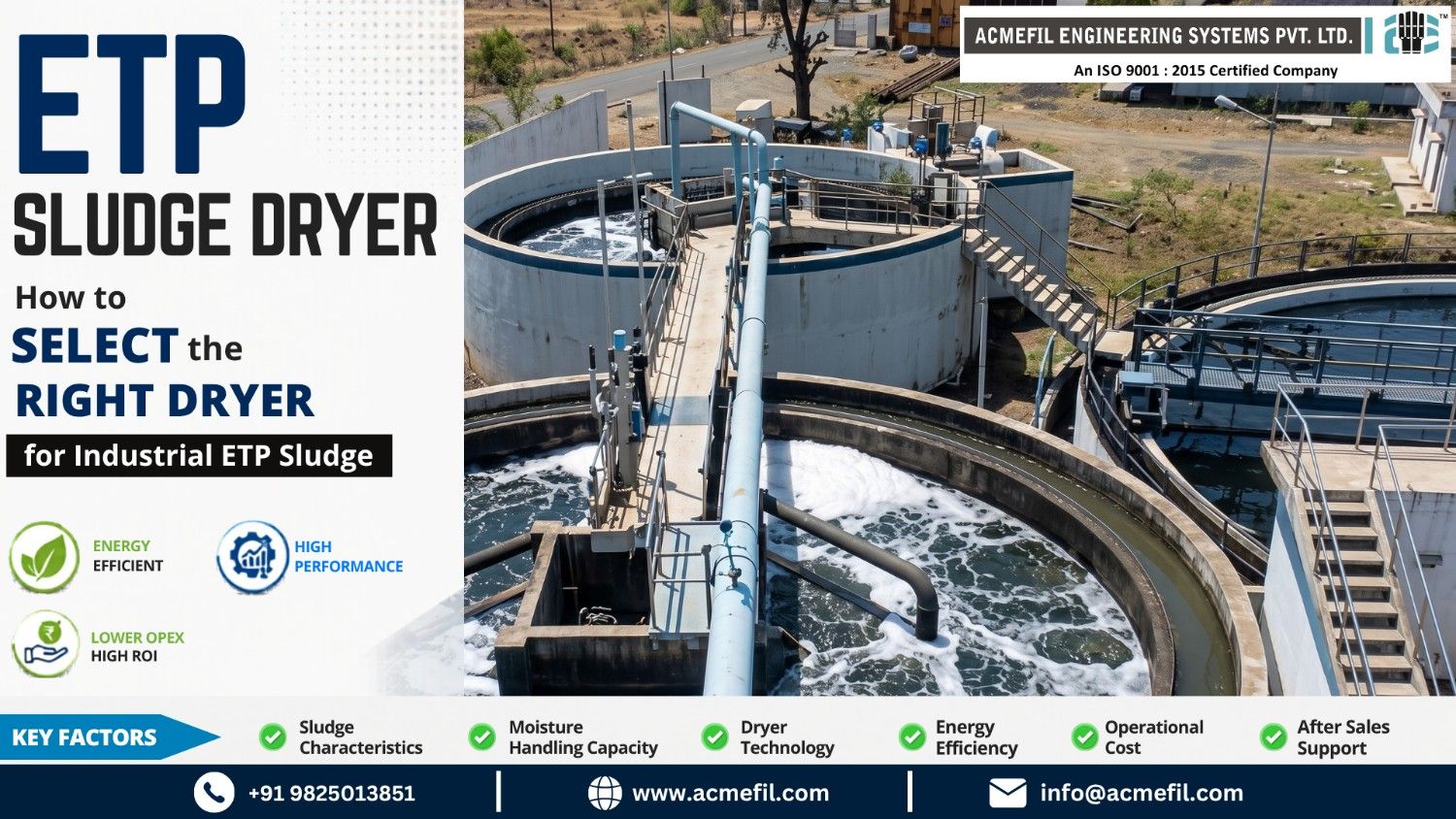
An ETP sludge dryer is used to reduce moisture from sludge generated in an effluent treatment plant after filtration, centrifuging, or filter press dewatering. The main purpose is not just “drying”. It is to make wet sludge easier to handle, store, transport, and send for approved disposal, co-processing, incineration, or further treatment depending on the sludge analysis and local compliance requirement.
In many chemical, dye, pigment, textile, pharma, and wastewater treatment plants, the real problem is not only sludge volume. The problem is sticky, high-moisture, difficult-to-feed sludge that blocks normal dryers and creates handling issues.
What Is an ETP Sludge Dryer?
An ETP sludge dryer is industrial drying equipment designed to remove moisture from sludge produced by an effluent treatment plant. In most plants, sludge comes out after chemical treatment, biological treatment, sedimentation, filtration, or dewatering.
The feed may look like:
- Wet filter cake from a filter press
- Sticky sludge from chemical ETP
- High-viscosity paste from effluent treatment
- Semi-solid sludge from ZLD systems
- Sludge mixed with salts, organics, pigments, dyes, or chemical residues
For a buyer, the important point is this: ETP sludge is not a normal powder. It is often sticky, compressible, variable in moisture, and difficult to disperse. That is why the dryer must be selected based on sludge behavior, not only on evaporation capacity.
For difficult sludge applications, a spin flash dryer for sludge drying is often evaluated when the sludge is available as wet cake, paste, or high-viscosity feed that needs fast disintegration and drying.
Why ETP Sludge Drying Is Needed
ETP sludge drying is usually considered when the plant wants to reduce sludge handling problems after dewatering. A filter press or centrifuge removes free water, but the remaining cake can still contain high bound moisture.
Drying helps in four practical ways.
First, it reduces the weight and volume of wet sludge. This can lower the burden on storage and transport, although the exact reduction depends on feed moisture and target outlet moisture.
Second, it improves handling. A wet, sticky cake is difficult to move through hoppers, bags, bins, and conveyors. A properly dried output is easier to collect and transfer.
Third, it supports downstream disposal or utilization routes. Some plants need dried sludge for authorized co-processing, incineration, TSDF handling, or further treatment. The permitted route depends on sludge composition and regulatory approval.
Fourth, it reduces plant housekeeping issues. Wet sludge storage can create odor, leakage, floor contamination, and manual handling problems.
One point I always clarify during technical discussions: drying does not automatically make ETP sludge non-hazardous. The classification depends on chemical analysis and applicable pollution control requirements. The dryer only changes the moisture condition. It does not remove all regulatory responsibility.
Where ETP Sludge Comes From in an Industrial Plant
ETP sludge can come from different treatment stages. Each source changes how the dryer should be selected.
| Sludge Source | Typical Feed Form | Dryer Selection Concern |
|---|---|---|
| Chemical precipitation sludge | Sticky wet cake or paste | High salts, variable pH, corrosion risk |
| Biological sludge | Soft, fibrous, high moisture sludge | Odor, low bulk density, feeding difficulty |
| Textile and dye ETP sludge | Colored cake, sticky sludge | Pigments, dyes, inorganic salts, dust control |
| Pharma and chemical ETP sludge | Dense wet cake or paste | Solvent traces, odor, safety review |
| ZLD sludge or concentrate residue | Salt-rich semi-solid material | Scaling, corrosion, final disposal route |
| CETP sludge | Mixed industrial sludge | Highly variable composition, trial strongly preferred |
This is why one universal sludge dryer design does not work for every ETP. The correct approach is to start with sludge characterization, then select the drying method.
ETP Sludge Dryer Working Principle
The basic working principle of an ETP sludge dryer is simple. Wet sludge is fed into a drying system where heat removes moisture and converts the sludge into a drier solid form.
A typical drying sequence includes:
- Dewatered sludge is collected from a filter press, centrifuge, or sludge handling system.
- A feed screw, agitator, or lump breaker controls feeding into the dryer.
- Hot air or indirect heat transfers energy to the wet sludge.
- Moisture evaporates from the sludge surface and internal structure.
- Dried solids are separated from the exhaust air through cyclone separators, bag filters, or other dust collection systems.
- The final dried material is collected for storage, disposal, or approved downstream use.
In a spin flash type system, the important action happens at the feed point. The sludge enters near a disintegrator, where lumps are broken into smaller particles while hot air carries and dries the material. You can understand this mechanism better in this guide on the spin flash dryer working principle.
Why Normal Flash Dryers May Fail with ETP Sludge
A standard flash dryer works well when the feed is free-flowing, granular, powdery, or already easy to disperse. ETP sludge is different.
In many plants, the sludge behaves like a compressible paste. When it enters a simple pneumatic drying line, it may not disperse properly. Instead, it can form lumps, stick near the feed inlet, overload the duct, or create inconsistent drying.
Common failure points include:
- Sludge bridging in the feed hopper
- Screw feeder choking due to sticky cake
- Large lumps entering the hot air stream
- Material sticking to duct walls
- Uneven outlet moisture
- Dust carryover due to improper separation
- Bag filter blinding because of wet fines
- Frequent cleaning shutdowns
This is why sludge feed preparation matters as much as the dryer itself. For wet cake and paste-like feed, dryer selection should include feeding system design, disintegrator design, material of construction, exhaust handling, and dust collection.
Which Dryer Is Best for ETP Sludge?
There is no single best dryer for every ETP sludge. The right dryer depends on feed moisture, stickiness, heat sensitivity, chemical composition, plant space, fuel availability, and target outlet moisture.
| Dryer Type | Better Fit | Limitation to Check |
|---|---|---|
| Spin flash dryer | Sticky wet cake, paste, high-viscosity sludge that needs lump breaking and fast drying | Feed must be suitable for disintegration and pneumatic conveying after drying |
| Paddle dryer | Sludge requiring indirect heating and controlled residence time | Larger footprint and different handling compared to flash drying |
| Flash dryer | Centrifuged cake or powder with mostly surface moisture | Not suitable for very sticky paste without proper disintegration |
| Fluid bed dryer | Granular or free-flowing solids | Usually not suitable for sticky wet sludge at the inlet stage |
| Solar sludge dryer | Low-cost drying where land and time are available | Weather-dependent and slow |
| Vacuum dryer | Heat-sensitive or special sludge streams | Higher capital and operating complexity |
For sticky ETP sludge, I normally do not start by asking only for capacity. I first ask how the sludge behaves in hand: does it crumble, smear, flow, bridge, or form rubbery lumps? That behavior tells more about dryer risk than the kg/hr number alone.
For plants comparing multiple technologies, this page on how to choose a spin flash dryer is a useful supporting read.
When a Spin Flash Dryer Is Suitable for ETP Sludge
A spin flash dryer can be suitable for ETP sludge when the sludge is available as wet cake, filter cake, sticky paste, gelatinous material, or high-viscosity feed that needs immediate lump breaking at the feed point.
The system is especially relevant when:
- The sludge comes from a filter press
- The cake is not free-flowing
- Manual breaking of lumps is becoming a problem
- The plant needs continuous drying instead of tray drying
- The sludge can be dried through hot air contact
- Final dried material can be separated by cyclone and bag filter
- A trial confirms that the sludge disperses and dries properly
In a properly designed spin flash dryer, the feed screw meters sludge into the drying chamber, while the disintegrator breaks wet lumps. Hot air contacts the smaller particles, moisture evaporates quickly, and the dried solids are carried to the collection system.
For ETP sludge, this is much more practical than forcing sticky material into a standard flash dryer without a disintegration stage.
Important Design Factors in an ETP Sludge Dryer
Feed moisture and target outlet moisture
The first sizing question is water evaporation load. A dryer is not sized only by wet feed quantity. It is sized by how much water must be removed per hour.
For example, two plants may both say they have 500 kg/hr sludge. But if one sludge has 55% moisture and another has 75% moisture, the dryer duty is completely different.
You should share:
- Wet feed rate
- Initial moisture
- Required final moisture
- Bulk density
- Feed temperature
- Expected operating hours per day
Sludge stickiness and lump behavior
Sticky sludge needs controlled feeding and lump breaking. If the feed forms large lumps, the dryer must have a proper disintegrator or pre-conditioning system.
In spin flash systems, cage mill or pin mill type disintegrators may be evaluated depending on the material behavior.
Chemical composition and corrosion risk
ETP sludge may contain chlorides, sulphates, acids, alkalis, organics, pigments, metal salts, or other residues. These affect material of construction and exhaust treatment.
Before final design, the dryer manufacturer should review:
- pH
- Chloride content
- Solvent traces, if any
- Organic load
- Ash content
- Abrasiveness
- Hazardous classification
- Disposal requirement
Heat sensitivity and safety
Some sludge streams may contain volatile compounds or heat-sensitive components. Others may generate odor or fumes during drying. In such cases, exhaust handling, fire risk, temperature control, and plant safety review become important.
Dust collection and exhaust handling
A sludge dryer should not be evaluated without the dust collection system. Dried sludge fines can be dusty, sticky, or corrosive.
Common downstream equipment may include:
- Cyclone separator
- Pulse jet bag filter
- Rotary air lock valve
- Scrubber, if fumes or acidic gases need treatment
- ID fan and ducting
- Chimney as per plant requirement
For dust-heavy applications, the bag filter design must match the nature of the dried sludge, not only the air volume.
ETP Sludge Dryer in ZLD Systems
In a zero liquid discharge system, sludge drying may come after membrane treatment, evaporation, concentration, and final solids handling. The drying step depends on whether the plant is handling sludge cake, evaporator concentrate, salt-rich residue, or mixed solids.
A complete zero liquid discharge system may include membrane treatment, multi-effect evaporator, ATFD, sludge dryer, or effluent drying equipment depending on the application.
The mistake many buyers make is separating the dryer discussion from the upstream ETP or ZLD process. The dryer will only perform consistently if the upstream feed is reasonably stable. If the ETP sludge moisture changes every shift, the dryer outlet moisture will also fluctuate unless the system is designed with enough control margin.
Buyer Checklist Before Asking for an ETP Sludge Dryer Quote
Before sending an RFQ for an ETP sludge dryer, prepare this information.
| RFQ Data Required | Why It Matters |
|---|---|
| Wet sludge quantity, kg/hr or ton/day | Determines feed handling and dryer size |
| Initial moisture percentage | Determines water evaporation load |
| Required final moisture | Defines drying duty and outlet target |
| Sludge source | Chemical, biological, textile, dye, pharma, CETP, ZLD |
| Sludge consistency | Sticky, crumbly, paste-like, fibrous, granular |
| Chemical analysis | Helps decide MOC, safety, and disposal route |
| pH and chloride level | Important for corrosion review |
| Operating hours per day | Affects dryer sizing and utility planning |
| Fuel or heat source available | Hot air generator, steam, thermic fluid, gas, oil, solid fuel |
| Final disposal route | TSDF, co-processing, incineration, authorized handling |
| Space available | Determines layout feasibility |
| Dust/fume control requirement | Affects cyclone, bag filter, scrubber, and stack design |
If this data is not available, the first step should be sampling and trial. For difficult sludge, a dryer trial is often more valuable than a theoretical quotation.
You can discuss trial suitability and equipment selection with Acmefil’s team through the SpinFlashDrying.com contact page.
Common Mistakes While Buying an ETP Sludge Dryer
Selecting only by wet feed capacity
A 1 ton/day sludge dryer is not a complete specification. The important number is water evaporation load. Feed moisture and final moisture decide the actual thermal duty.
Ignoring feed system design
Most sludge dryer problems start before the drying chamber. Poor hopper design, wrong screw pitch, no lump breaker, and uncontrolled feeding can make even a good dryer perform badly.
Assuming every sludge can be dried the same way
ETP sludge from a dye plant, textile plant, pharma plant, food plant, and chemical plant can behave very differently. Dryer design must follow feed behavior.
Not checking material of construction
Corrosive sludge can damage contact parts, ducting, and dust collection equipment if the material of construction is selected casually.
Underestimating dust collection
Dried sludge fines must be separated properly. If the cyclone and bag filter are undersized or wrongly selected, the plant may face emission, housekeeping, and maintenance problems.
Skipping pilot trials
For sticky sludge, pilot testing can reveal feeding problems, lump behavior, drying response, outlet moisture trend, dust load, and product handling issues before full-scale procurement.
Acmefil’s sludge dryer and spin flash drying experience can support this evaluation where the application fits the feed behavior and process requirement.
Pilot Trial: The Safest Way to Validate ETP Sludge Drying
ETP sludge is one of those applications where I prefer testing over assumption. A lab report gives chemistry. A pilot trial gives process behavior.
A good trial should check:
- Whether sludge feeds continuously
- Whether lumps break properly
- Whether the material sticks inside the drying zone
- Whether outlet moisture target is achievable
- Whether dried sludge becomes powder, granule, or hard lump
- Whether dust collection is manageable
- Whether odor or fumes are generated
- Whether the output is suitable for the intended disposal route
For sludge drying, this is especially important because feed properties can change with upstream treatment chemistry. Coagulant dose, pH adjustment, filter press cycle, and incoming effluent variation all influence the final cake.
For operating practices after installation, this guide on spin flash drying best practices can help plant teams understand the key control points.
ETP Sludge Dryer Selection Summary
| If Your Sludge Condition Is | Consider This Direction |
|---|---|
| Sticky filter press cake | Spin flash dryer with proper feed screw and disintegrator |
| Free-flowing centrifuged powder/cake | Flash dryer may be evaluated |
| Salt-rich ZLD residue | Review ATFD, paddle dryer, or sludge dryer based on feed behavior |
| High odor sludge | Dryer plus exhaust/scrubber review needed |
| Corrosive chemical sludge | MOC and ducting review required |
| Variable sludge from CETP | Pilot trial strongly recommended |
| Heat-sensitive sludge | Lower temperature strategy or indirect drying may be needed |
The correct ETP sludge dryer is the one that matches the sludge, not the one with the most attractive catalogue capacity.
FAQs
What is an ETP sludge dryer?
An ETP sludge dryer is industrial equipment used to reduce moisture from sludge generated in an effluent treatment plant. It dries wet sludge cake, paste, or semi-solid sludge so the material becomes easier to handle, store, transport, and send for approved disposal or further processing.
Which dryer is suitable for sticky ETP sludge?
For sticky ETP sludge, a spin flash dryer may be suitable when the sludge is available as wet cake, paste, gelatinous material, or high-viscosity feed. The disintegrator breaks wet lumps at the feed point, allowing hot air to contact smaller particles for faster drying.
Can a normal flash dryer dry ETP sludge?
A normal flash dryer can dry some centrifuged cakes or powders with surface moisture, but it may fail with sticky ETP sludge. If the sludge forms lumps, bridges, or paste-like masses, a disintegrator-based system or another sludge dryer design should be evaluated.
Does drying make ETP sludge non-hazardous?
No. Drying only reduces moisture. It does not automatically change the regulatory classification of sludge. Hazardous or non-hazardous classification depends on sludge composition, lab analysis, and applicable pollution control requirements.
What information is needed to quote an ETP sludge dryer?
The most important data includes wet feed rate, initial moisture, required final moisture, sludge source, chemical analysis, pH, chloride level, stickiness, operating hours, heat source, space availability, and final disposal route.
Conclusion
An ETP sludge dryer should be selected after understanding the sludge, not before. Moisture percentage, stickiness, chemical composition, corrosion risk, dust load, exhaust handling, and final disposal route all affect the correct dryer design.
For filter press cake, sticky paste, and high-viscosity sludge, a spin flash dryer can be a strong option when pilot testing confirms that the sludge can be fed, disintegrated, dried, and collected consistently. For other sludge types, paddle dryers, flash dryers, ATFD systems, or other sludge drying equipment may be more suitable.
Before finalizing a dryer, share sludge samples, moisture data, chemical analysis, and disposal requirements with the equipment manufacturer. That one step can prevent costly design mismatch later.

Siddharth Nair is the Technical Director at Acmefil Engineering Systems Pvt. Ltd., an ISO 9001:2015 certified manufacturer of industrial drying and evaporation systems headquartered in Ahmedabad, Gujarat, he has led technical evaluation, application engineering and customer solution design for spray dryers, multi-effect evaporators, agitated thin film dryers, spin flash dryers and zero liquid discharge systems.