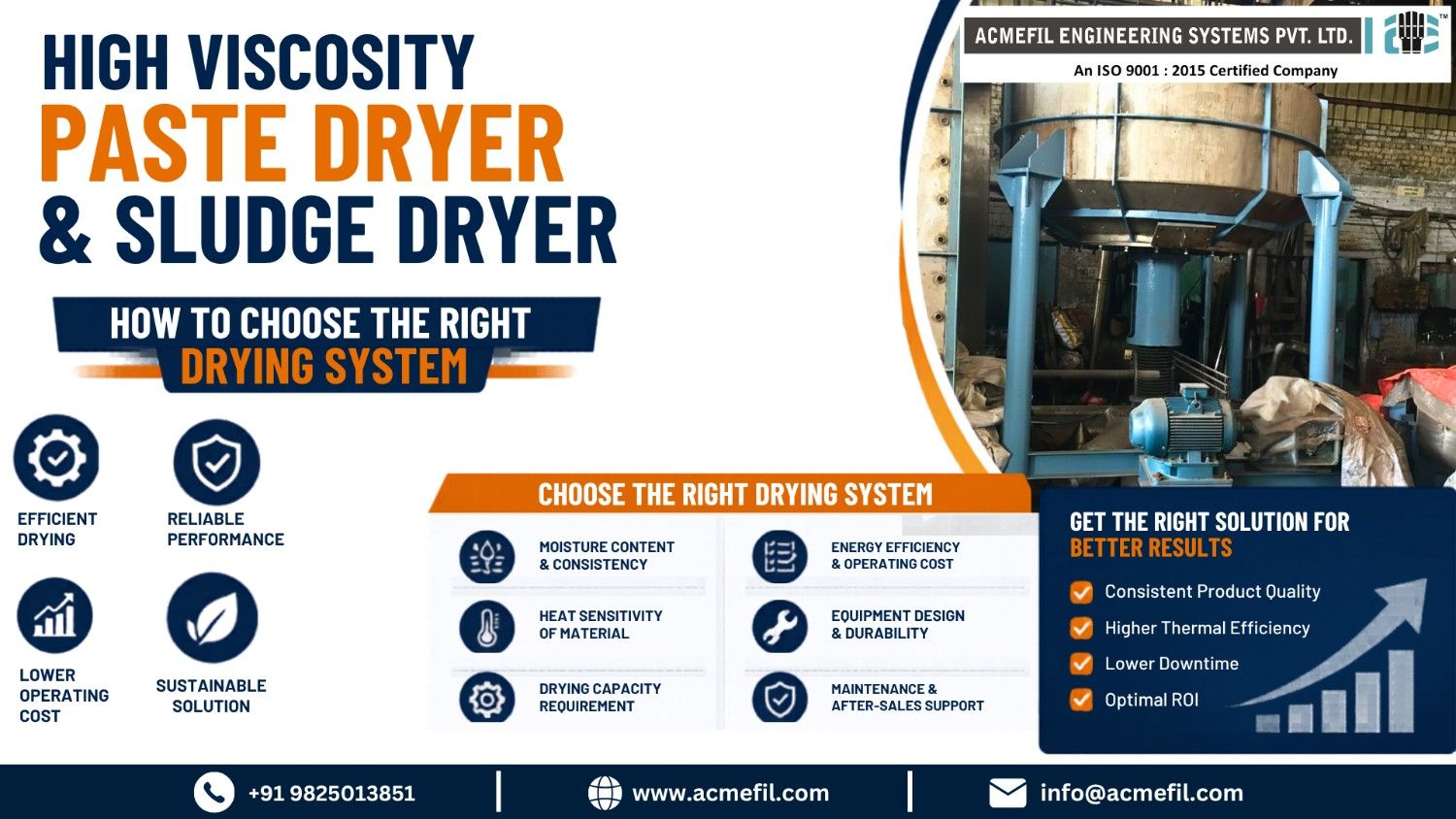
A high viscosity paste dryer must do more than evaporate moisture. It must first break, disperse and expose sticky material to hot air without choking the feed zone. For high viscosity sludge, gelatinous paste, filter cake and slimy wet cake, a spin flash dryer is often more suitable than a standard flash dryer because the disintegrator breaks the wet mass at the feed point before drying begins.
In my experience, many drying problems start because the buyer selects the dryer by moisture percentage alone. That is not enough. For paste and sludge, the real question is feed behavior.
Does the material flow?
Does it smear?
Does it form lumps?
Does it stick to metal?
Does it break under mechanical action?
Those answers decide the dryer.
What Is a High Viscosity Paste Dryer?
A high viscosity paste dryer is industrial drying equipment designed to convert sticky, thick, semi-solid or paste-like feed into a dry powder or granular product. The feed may come from a filter press, centrifuge, reactor discharge, effluent treatment plant or chemical process line.
Common feed forms include:
- Filter press cake
- Wet chemical cake
- Pigment paste
- Dyestuff paste
- Agrochemical paste
- Gelatinous sludge
- ETP sludge
- Sticky chemical intermediates
- Wet cake from dyes and pigments
A normal flash dryer works well when the material is already dispersed or free-flowing. A high viscosity paste dryer must handle a harder condition. The material enters as a sticky mass, and unless it is broken quickly, it can block the feed entry or form wet balls inside the drying chamber.
What Is a High Viscosity Sludge Dryer?
A high viscosity sludge dryer is drying equipment used when sludge has high solids, high stickiness or poor flow behavior. This is common in chemical plants, dye intermediate plants, pigment plants, agrochemical units and effluent treatment systems.
High viscosity sludge is difficult because it may behave differently at different moisture levels. At one point it may look pumpable. After partial drying, it may become rubbery, sticky or clay-like. If the dryer cannot handle this transition zone, it will face build-up, uneven drying and product discharge problems.
For this reason, a spin flash dryer for sludge drying is usually evaluated when the sludge must be converted quickly into powder and the feed can tolerate mechanical disintegration.
Why Standard Flash Dryers Struggle With High Viscosity Paste
A standard flash dryer depends on pneumatic conveying. Hot air picks up the feed particles and carries them through the drying line. This works only when the feed can disperse into small particles.
High viscosity paste behaves differently.
It can:
- Enter the dryer as lumps
- Smear at the feed point
- Stick to the screw feeder
- Form wet agglomerates
- Block the throat area
- Produce uneven final moisture
- Increase cleaning frequency
- Reduce effective throughput
This is why a buyer should not treat all flash drying systems as the same. A standard flash dryer and a spin flash dryer may both use hot air, but the feed handling mechanism is different.
For free-flowing centrifuged cake or powder, a standard flash dryer may be enough. For slimy paste, gelatinous wet cake or high viscosity sludge, the disintegration mechanism becomes critical.
How Spin Flash Drying Handles Sticky Paste and Sludge
A spin flash dryer adds a disintegrator at the feed point. The wet feed enters the drying chamber through a controlled feeding system. The rotating disintegrator breaks the material into smaller fragments while hot air contacts the exposed surface.
The process usually follows this logic:
- Wet paste, cake or sludge enters through a feed system.
- A variable speed feed screw controls feed rate.
- A lump breaker helps prevent large wet chunks from entering uncontrolled.
- The disintegrator breaks sticky mass into smaller particles.
- Hot air dries the exposed surface rapidly.
- Fine dried material is carried upward.
- Cyclone and bag filter separate product from air.
- Dried powder is discharged through a rotary air lock or suitable collection system.
This mechanism is explained further in the spin flash dryer working principle guide.
The key point is simple. In paste drying, the first battle is dispersion. Moisture removal comes after that.
Best Applications for a High Viscosity Paste Dryer
A high viscosity paste dryer is usually considered when the feed is too sticky for a standard flash dryer but still suitable for rapid hot air drying after disintegration.
| Feed Type | Common Problem | Suitable Dryer Direction |
|---|---|---|
| Filter press cake | Lumps, uneven moisture, poor dispersion | Spin flash dryer |
| Dyestuff paste | Sticky feed, color-sensitive handling, wet cake discharge | Spin flash dryer |
| Pigment paste | Agglomeration and surface moisture | Spin flash dryer after feed trials |
| Agrochemical wet cake | Sticky or semi-solid discharge from filtration | Spin flash dryer after safety review |
| Gelatinous sludge | Smearing, clumping and feed choking | Spin flash dryer if mechanically dispersible |
| Free-flowing centrifuged cake | Mainly surface moisture removal | Standard flash dryer may work |
| Highly viscous concentrate from evaporation | Wall fouling, poor flow, high stickiness | ATFD or sludge dryer may be evaluated |
The correct choice depends on feed behavior, moisture load, thermal sensitivity, dust characteristics and final product requirement.
High Viscosity Paste Dryer vs High Viscosity Sludge Dryer
The words paste and sludge are often used loosely in RFQs. That creates confusion.
Paste usually refers to a process material that still has product value. Examples include pigment paste, dye intermediate paste, chemical paste or agrochemical wet cake.
Sludge usually refers to waste or semi-waste material from treatment, filtration or effluent handling. Examples include ETP sludge, chemical sludge or high-solids effluent sludge.
Technically, both can be difficult to dry because both may be sticky. But the design priorities can change.
| Selection Factor | High Viscosity Paste Dryer | High Viscosity Sludge Dryer |
|---|---|---|
| Main objective | Product recovery or powder formation | Volume reduction, disposal, reuse or powder formation |
| Feed source | Filter press, reactor, centrifuge, process line | ETP, wastewater treatment, chemical treatment, filtration |
| Product value | Often higher | Usually lower, but application dependent |
| Cleanliness expectation | Higher, especially for pigment or chemical product | Depends on sludge type and disposal route |
| Final powder quality | Often important | Often moisture reduction and handling are more important |
| Dryer focus | Product quality, uniform drying, contamination control | Robust feeding, drying reliability, dust and odor handling where applicable |
For both cases, do not finalize the dryer based only on the words “paste” or “sludge.” Test the actual feed.
When Spin Flash Dryer Is the Better Choice
A spin flash dryer is a strong option when:
- The feed is wet cake, sticky paste or high viscosity sludge.
- The material can be mechanically broken.
- The final product should be powdery or granular.
- Short residence time is preferred.
- The feed comes directly from a filter press.
- Continuous drying is required.
- A clean operating environment is important.
- The material is used in dyes, pigments, agrochemicals or chemical intermediates.
ACMEFIL’s spin flash dryer manufacturer page can be used as a technical support reference when the buyer is evaluating equipment configuration for wet cake, paste and sludge drying.
When Spin Flash Dryer May Not Be the Right Choice
No dryer is correct for every material. A spin flash dryer may not be the first choice when:
- The material cannot tolerate mechanical impact.
- The feed contains large hard foreign particles.
- The feed is highly abrasive and metallurgy is not addressed.
- The material is solvent-rich and needs special inert or explosion-safe design.
- The product requires long residence time.
- The final product must remain in large granules without breakage.
- The feed behaves like a viscous liquid concentrate rather than a breakable paste or cake.
For some concentrated viscous feeds, an agitated thin film dryer, paddle dryer, tray dryer or other sludge dryer may be technically more suitable. For difficult waste sludge applications, ACMEFIL’s sludge dryer page can support broader dryer evaluation.
Feed Data Required Before Selecting the Dryer
Before selecting any high viscosity paste dryer or high viscosity sludge dryer, collect the process data properly. A serious dryer manufacturer cannot size the system accurately from only one line such as “moisture 40%.”
Share these details:
| Data Required | Why It Matters |
|---|---|
| Feed name and source | Identifies whether it is product, by-product or waste sludge |
| Initial moisture | Defines evaporation load |
| Required final moisture | Defines drying duty and product target |
| Feed form | Paste, cake, sludge, slurry, granules or lumps |
| Stickiness behavior | Decides feed screw, lump breaker and disintegrator design |
| Heat sensitivity | Helps decide temperature window and residence logic |
| Bulk density | Affects conveying and collection |
| Particle size requirement | Affects disintegration and final powder quality |
| Corrosive nature | Decides material of construction |
| Abrasiveness | Affects wear parts and maintenance planning |
| Dusting tendency | Decides cyclone, bag filter and dust control approach |
| Upstream equipment | Filter press, centrifuge, reactor or ETP discharge |
| Operating hours | Impacts duty cycle, automation and maintenance planning |
This is where many RFQs become weak. Buyers ask for “capacity per hour,” but the real sizing begins with water evaporation load and feed behavior.
Cage Mill Type vs Pin Mill Type Disintegrator
Spin flash dryers can use different disintegrator arrangements based on material behavior. ACMEFIL’s verified product range includes cage mill type and pin mill type disintegrator options for spin flash dryers.
The selection depends on:
- Lump size
- Stickiness
- Required particle breakage
- Feed consistency
- Product sensitivity
- Wear behavior
- Final powder requirement
A cage mill type disintegrator may be evaluated when stronger lump breaking is needed. A pin mill type arrangement may be evaluated where finer dispersion is required. The final choice should come after feed review or pilot trial, not from a catalogue assumption.
Role of Feed Screw and Lump Breaker
For high viscosity paste and sludge, the feeding system is not a small accessory. It is part of the drying solution.
A variable speed feed screw helps regulate feed rate. This prevents sudden overfeeding and allows the dryer to maintain stable drying conditions. A lump breaker helps reduce the risk of large wet chunks entering the drying zone and causing choking.
In many plants, dryer failure is blamed on hot air temperature or dryer size. But the real issue is often feed control. If the feed enters unevenly, the dryer will never produce stable output.
You can study this in more detail through the page on design and operation inside spin flash dryers.
Drying System Components for Paste and Sludge Applications
A complete high viscosity paste dryer system may include:
- Feed hopper
- Variable speed screw feeder
- Lump breaker
- Cage mill or pin mill disintegrator
- Drying chamber
- Hot air generator
- Air distribution system
- Cyclone separator
- Bag filter
- Product collection system
- Rotary air lock
- ID fan or exhaust system
- Control panel and instrumentation
The cyclone and bag filter are especially important when the dried powder is fine or dusty. For support equipment reference, ACMEFIL’s bag filter page can be used while planning dust separation and collection.
Comparison: Which Dryer Should You Consider?
| Dryer Type | Best Fit | Limitation for High Viscosity Paste or Sludge |
|---|---|---|
| Spin flash dryer | Wet cake, sticky paste, gelatinous material, high viscosity sludge | Not ideal if material cannot tolerate disintegration |
| Standard flash dryer | Free-flowing powders or centrifuged cake with surface moisture | Poor fit for sticky, slimy or lump-forming paste |
| Paddle dryer | Sludge requiring indirect heating and longer residence | Larger residence time, product form may differ |
| ATFD | Viscous concentrates and slurry from evaporation systems | Different drying principle, not always suitable for cake-to-powder duty |
| Tray dryer | Small batches, simple drying, low automation need | Slow and labor-intensive for large continuous paste drying |
| Fluid bed dryer | Free-flowing particles requiring uniform drying | Not suitable for sticky paste unless pre-formed into flowable particles |
The spin flash dryer comparison guide can help when the buyer is comparing flash drying, fluid bed drying and other dryer options.
Common Mistakes in High Viscosity Paste Dryer Selection
Mistake 1: Treating paste like powder
Paste does not behave like powder. If the feed cannot disperse, a normal pneumatic drying system will struggle.
Mistake 2: Ignoring the sticky phase
Some materials are not sticky at the start but become sticky during partial drying. This transition phase must be understood before final equipment selection.
Mistake 3: Oversizing without solving feed entry
Bigger equipment does not fix choking. If the feed entry and disintegrator are wrong, larger capacity only creates larger instability.
Mistake 4: Not checking dust collection
A paste may become a very fine powder after drying. That means dust control, cyclone efficiency, bag filter sizing and product collection must be considered from the beginning.
Mistake 5: Skipping trials for difficult material
For high viscosity sludge and unfamiliar paste, trial drying is often the safest route before full-scale equipment commitment.
ACMEFIL’s in-house pilot facility includes spin flash dryer trial capability with 10 kg/hr water evaporation capacity. This helps validate feed behavior, drying response and process direction before final plant sizing.
How to Prepare Your Material for a Dryer Trial
For a meaningful trial, send representative material, not a clean sample that behaves better than actual plant feed.
Prepare:
- Actual wet feed from the process
- Moisture test report
- Required final moisture target
- Safety data sheet, where applicable
- Expected operating hours
- Current filtration or upstream process details
- Details of stickiness, odor, dusting or corrosion
- Final product use or disposal route
A good trial should answer practical questions:
Can the feed enter smoothly?
Does it break under disintegrator action?
Does it dry uniformly?
Does it stick inside the chamber?
What kind of powder is produced?
Is cyclone and bag filter separation practical?
What changes are needed before scale-up?
Maintenance Points for Paste and Sludge Drying
High viscosity paste drying is hard-duty operation. Maintenance planning should be part of the selection stage.
Pay attention to:
- Feed screw wear
- Lump breaker condition
- Disintegrator wear
- Chamber build-up
- Product discharge consistency
- Rotary air lock sealing
- Bag filter differential pressure
- Fan performance
- Hot air generator stability
- Instrumentation reliability
The operating team should also create a cleaning schedule based on actual material behavior. A sticky dye cake and a mineral sludge will not follow the same maintenance pattern.
For running guidance, refer to spin flash drying best practices for operation and the maintenance cost analysis guide.
RFQ Checklist for High Viscosity Paste Dryer or Sludge Dryer
Before sending an RFQ, prepare this checklist:
| RFQ Point | What to Mention |
|---|---|
| Material name | Chemical, pigment, dye, sludge or agrochemical feed |
| Feed source | Filter press, centrifuge, reactor, ETP or other process |
| Feed moisture | Initial moisture with test method if available |
| Final moisture | Required product moisture |
| Feed behavior | Sticky, slimy, gelatinous, lumpy, rubbery or pumpable |
| Feed temperature | Ambient or hot discharge |
| Heat sensitivity | Product degradation risk |
| Capacity basis | Wet feed kg/hr and water evaporation kg/hr |
| Material of construction | Any corrosion or contamination limits |
| Collection requirement | Powder, granules, disposal solids or reusable product |
| Utilities available | Fuel, steam, power and compressed air |
| Trial requirement | Whether pilot validation is needed |
This checklist will help the dryer manufacturer respond with a technically meaningful proposal instead of a generic quotation.
How to Choose the Right Dryer Manufacturer
For high viscosity paste dryer or high viscosity sludge dryer projects, choose a manufacturer who asks difficult questions before quoting.
A good technical evaluation should include:
- Feed behavior review
- Moisture balance
- Heat sensitivity review
- Disintegrator suitability
- Dust collection planning
- Utility requirement discussion
- Material of construction review
- Maintenance access review
- Trial recommendation for difficult feed
- Clear scope of supply
If a supplier quotes only on “kg/hr feed capacity” without asking about stickiness, feed source and final moisture, the proposal is incomplete.
You can use the how to choose a spin flash dryer guide before finalizing technical discussions.
FAQs
Which dryer is best for high viscosity paste?
A spin flash dryer is often suitable for high viscosity paste when the feed is sticky, wet cake-like or gelatinous and can be mechanically disintegrated. The disintegrator breaks the paste at the feed point, allowing hot air to dry smaller fragments quickly. Final selection should be based on actual feed behavior and trial results.
Is a high viscosity sludge dryer different from a paste dryer?
Yes. A paste dryer is often used for process materials such as pigment paste, dye intermediate paste or agrochemical wet cake. A sludge dryer is often used for waste or semi-waste streams such as ETP sludge or chemical sludge. The drying challenge may be similar, but the product value, cleanliness requirement and final handling objective can be different.
Can a standard flash dryer dry high viscosity sludge?
A standard flash dryer is usually not ideal for high viscosity sludge if the material is sticky, slimy or lump-forming. Standard flash dryers work better with free-flowing powders or centrifuged cakes that can disperse easily in hot air.
Why is a disintegrator important in paste drying?
The disintegrator breaks sticky paste or sludge into smaller fragments as it enters the drying chamber. This increases surface area, improves contact with hot air and reduces the risk of feed choking. Without proper disintegration, high viscosity feed may clump and dry unevenly.
Should I run a pilot trial before buying a high viscosity paste dryer?
For difficult, sticky or unknown feed, a pilot trial is strongly recommended. It confirms whether the material can be fed, disintegrated, dried and collected properly before full-scale dryer design. This is especially useful for gelatinous sludge, filter cake, dye paste, pigment paste and agrochemical wet cake.
Conclusion
A high viscosity paste dryer or high viscosity sludge dryer should be selected by feed behavior first, then by moisture load and capacity. If the material is sticky, slimy, gelatinous or coming directly from a filter press, the dryer must include controlled feeding and effective disintegration before hot air drying can work properly.
For wet cake, paste and difficult sludge applications, spin flash drying is one of the most practical technologies to evaluate. The safest next step is to share your feed data, moisture target and material behavior with a technical dryer manufacturer before fixing the equipment size.
For application review or pilot trial discussion, contact the team through the SpinFlashDrying.com contact page or ACMEFIL’s contact page.

Siddharth Nair is the Technical Director at Acmefil Engineering Systems Pvt. Ltd., an ISO 9001:2015 certified manufacturer of industrial drying and evaporation systems headquartered in Ahmedabad, Gujarat, he has led technical evaluation, application engineering and customer solution design for spray dryers, multi-effect evaporators, agitated thin film dryers, spin flash dryers and zero liquid discharge systems.