Are you drowning in the complex world of industrial drying equipment? If you’re considering a spin flash dryer for your processing needs, you’re likely facing a daunting array of specifications, competing manufacturer claims, and technical jargon. The right spin flash dryer can dramatically improve your production efficiency and product quality, while the wrong choice can lead to costly operational problems and unexpected downtime.
In this comprehensive guide, we’ll walk you through every critical selection criterion for spin flash dryers, helping you make an informed decision that aligns perfectly with your specific processing requirements. By the end, you’ll understand exactly how to evaluate and select the optimal spin flash dryer for your unique application.
Table of Contents
What Is a Spin Flash Dryer and Why Is It Different?
Spin flash dryers (sometimes called flash spin dryers) represent a specialized subset of flash drying technology that combines centrifugal force with hot gas drying. Unlike conventional flash dryers that rely solely on hot gas convection, spin flash dryers introduce a rotational component that enhances the drying process for specific materials.
The key differentiating factor lies in how spin flash dryers handle wet materials:
- Material Distribution: The spinning mechanism disperses wet material into a fine cloud of particles
- Increased Surface Area: This spinning action dramatically increases the exposed surface area for drying
- Reduced Drying Time: Results in significantly reduced residence time compared to traditional dryers
- Uniform Drying: Creates more consistent moisture removal across all particles
Let’s examine why companies across pharmaceuticals, chemicals, food processing, and mineral processing industries are increasingly choosing this technology.
Key Selection Criteria for Spin Flash Dryers
1. Feed Material Characteristics Analysis
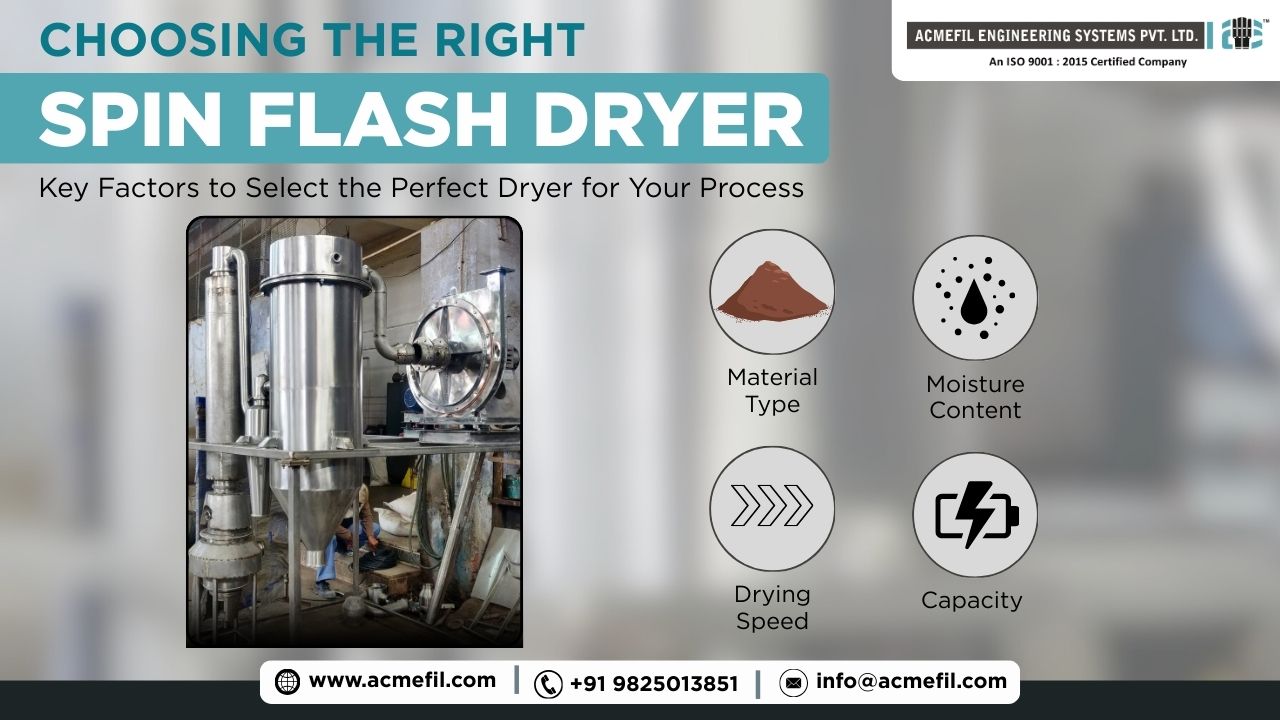
The most fundamental consideration when selecting a spin flash dryer is understanding your material’s specific properties. Different materials respond uniquely to the drying process, and your selection must accommodate these characteristics.
Moisture Content and Distribution
Determining your material’s starting moisture content is crucial for sizing your dryer properly. Consider:
- Initial moisture percentage: Higher moisture content requires more energy input
- Moisture distribution: Is water surface moisture or bound within the material structure?
- Target final moisture: What is your required final moisture specification?
Spin flash dryers typically handle materials with initial moisture contents between 10-60%, though specialized units can accommodate higher moisture levels.
Particle Size Distribution
Your material’s particle size significantly impacts drying efficiency:
- Average particle size: Most spin flash dryers work optimally with particles between 50-500 microns
- Size distribution range: Wider distributions may require special considerations
- Agglomeration tendency: Does your material tend to clump together when wet?
Dr. Raymond Johnson, process engineering specialist at the University of Michigan, notes: “Material particle size is often the most overlooked factor in dryer selection, yet it can make the difference between efficient operation and constant processing problems.”
Thermal Sensitivity
Not all materials can withstand high temperatures without degradation:
- Maximum temperature tolerance: What’s the highest temperature your product can withstand?
- Degradation mechanisms: Does your material discolor, denature, or lose efficacy when overheated?
- Time-temperature relationship: Some materials can withstand higher temperatures for very short exposures
For heat-sensitive materials like pharmaceuticals or certain food ingredients, the short residence time of spin flash dryers (typically 1-5 seconds) offers a significant advantage over other drying technologies.
2. Process Requirements and Integration
Your spin flash dryer must integrate seamlessly with your existing production line and meet your processing goals.
Production Capacity Needs
Accurately determining your required throughput is essential:
- Average throughput requirements: in kg/hr or tons/day
- Peak capacity needs: Can the system handle production surges?
- Future expansion plans: Should you size for current needs or anticipated growth?
Most spin flash dryer manufacturers offer spin flash dryers in capacities ranging from pilot-scale (5-50 kg/hr) to production-scale (up to several tons per hour).
Continuous vs. Batch Processing
Consider how the dryer will fit into your broader process:
- Process continuity: Does your operation run continuously or in batches?
- Feed system compatibility: How will material be delivered to the dryer?
- Discharge handling: Where will dried product go next in your process?
Spin flash dryers excel in continuous processing arrangements but can be adapted for batch operations with appropriate feed and collection systems.
Space and Installation Constraints
Physical installation requirements merit careful consideration:
- Available footprint: Spin flash dryers generally have a smaller footprint than other dryers of similar capacity
- Height requirements: Most units require significant vertical clearance
- Access for maintenance: Ensure adequate space for routine service and cleaning
Remember that ancillary equipment like feed systems, dust collection, and control panels will require additional space beyond the dryer itself.
3. Energy Efficiency and Operational Costs
In today’s manufacturing environment, energy efficiency isn’t just environmentally responsible—it’s economically essential.
Heat Source Options
Spin flash dryers can utilize various heat sources:
- Direct gas firing: Often most economical but introduces combustion gases into the drying medium
- Indirect heat exchange: Cleaner drying air but typically less energy efficient
- Steam heating: Common in facilities with existing steam infrastructure
- Electric heating: Precise control but usually higher operating costs
Your choice should balance energy costs, product requirements, and facility infrastructure.
Heat Recovery Potential
Modern spin flash dryer systems often incorporate heat recovery to improve efficiency:
- Exhaust air heat exchangers: Can preheat incoming air
- Product cooling heat recovery: Captures heat from cooling discharged product
- Condensate recovery: Applicable with steam-heated systems
Dr. Elena Martinez of the European Energy Institute found that “properly implemented heat recovery systems can reduce the energy consumption of industrial dryers by 15-30% with payback periods often under two years.”
Operating Cost Calculations
Before finalizing your selection, perform comprehensive operating cost projections:
- Energy consumption per kg of water removed
- Labor requirements for operation and maintenance
- Replacement parts and consumables
- Downtime for cleaning and maintenance
Request detailed energy consumption data from manufacturers based on your specific application parameters.
4. Material Contact Considerations
The surfaces that contact your product can significantly impact both product quality and equipment longevity.
Material of Construction Options
Common options include:
- Stainless steel: Standard for food and pharmaceutical applications (304 or 316L grades)
- Special alloys: For corrosive materials or extreme conditions
- Coated surfaces: Can provide non-stick properties or additional corrosion resistance
Your material’s corrosivity, abrasiveness, and end-use will determine the optimal choice.
Cleanability and Sanitation
For regulated industries, cleaning capabilities are paramount:
- Clean-in-place (CIP) compatibility: Does the design allow effective cleaning without disassembly?
- Surface finish options: Polished surfaces improve cleanability and reduce product adhesion
- Access for inspection: Can all product-contact surfaces be visually inspected?
Food, pharmaceutical, and some chemical applications may require full validation of cleaning procedures, which is easier with well-designed equipment.
Cross-Contamination Prevention
If your facility processes multiple products, consider:
- Ease of complete emptying: No dead spots where material can accumulate
- Quick-change components: For parts that might need product-specific dedication
- Cleaning verification methods: How will you confirm cleanliness between products?
The best designs minimize crevices, horizontal surfaces, and other areas where material can accumulate.
5. Control System and Automation Features
Modern spin flash dryers offer varying levels of control sophistication to match your operational needs.
Basic vs. Advanced Control Options
Consider what level of control meets your requirements:
- Basic control: Simple temperature and motor speed control with minimal automation
- Intermediate systems: PLC-based control with recipe management and data logging
- Advanced automation: Fully integrated systems with adaptive control and predictive capabilities
More sophisticated systems typically offer better product consistency and reduced operator dependence but come at a higher initial cost.
Data Collection and Analysis Capabilities
In today’s data-driven manufacturing environment, consider:
- Process parameter monitoring: What variables will be measured and recorded?
- Historical data storage: How long will operating data be retained?
- Analysis tools: Does the system offer trending, statistical analysis, or report generation?
These capabilities support continuous improvement initiatives and can help identify optimization opportunities.
Remote Monitoring and Operation
Increasingly important in modern facilities:
- Remote access options: Can the system be monitored or controlled remotely?
- Alert and notification features: How will the system notify operators of problems?
- Integration with facility management systems: Can the dryer communicate with other plant systems?
Manufacturing engineer Sarah Chen observes, “The facilities gaining the most from their drying operations are those leveraging real-time data for continuous monitoring and adjustment, often enabled by remote access capabilities.”
6. Safety and Compliance Requirements
Safety considerations are non-negotiable in dryer selection, particularly given the potential hazards involved.
Dust Explosion Mitigation
Dry powders can create explosion hazards:
- Explosion venting: Does the design incorporate appropriate pressure relief?
- Oxygen monitoring: For operations using inert gas to reduce explosion risk
- Grounding and bonding: To prevent static discharge ignition
The National Fire Protection Association (NFPA) provides standards for dust explosion prevention that may apply to your installation.
Emissions Control
Environmental compliance requires attention to:
- Particulate emissions: What filtration will capture product dust?
- VOC handling: If your material releases volatile organic compounds during drying
- Noise levels: Both for worker comfort and community relations
Regulatory requirements vary by location and industry, so investigate applicable standards early in your selection process.
Industry-Specific Compliance
Different industries face different regulatory landscapes:
- Food processing: FDA, FSMA, and potentially USDA requirements
- Pharmaceuticals: cGMP, FDA, or EMA regulations
- Chemicals: EPA, REACH, or other chemical manufacturing standards
Your vendor should demonstrate experience with applicable regulations for your industry.
How to Evaluate and Compare Spin Flash Dryer Options
Pilot Testing and Scale-Up Considerations
For most applications, pilot testing provides invaluable data before committing to full-scale equipment.
Laboratory and Pilot Scale Testing
Consider these testing approaches:
- Small-scale lab tests: Initial feasibility assessment with minimal material
- Pilot plant trials: Run representative material in a scaled-down version of the proposed system
- Test centers: Many manufacturers maintain testing facilities for customer materials
Dr. James Wilson, chemical engineering professor at MIT, advises: “No amount of theoretical modeling can replace actual testing with your specific material. The investment in thorough pilot testing almost always pays for itself in avoided problems during scale-up.”
Scale-Up Methodology
Understanding how test results translate to production scale is critical:
- Scale-up factors: What calculations convert pilot results to production expectations?
- Known limitations: Are there aspects that don’t scale linearly?
- Conservative design margins: How much safety factor should be incorporated?
Request detailed information on the manufacturer’s scale-up methodology and track record of successful installations.
Vendor Evaluation Criteria
The manufacturer you select will be a long-term partner in your operation’s success.
Experience and References
Assess each potential supplier’s credentials:
- Years in business: Look for established companies with proven staying power
- Industry-specific experience: Have they supplied similar applications to yours?
- Reference installations: Can they provide contacts at facilities running similar equipment?
Don’t hesitate to request detailed references and, if possible, site visits to see similar systems in operation.
Service and Support Infrastructure
After installation, ongoing support becomes crucial:
- Spare parts availability: Are critical components kept in stock?
- Technical support access: What hours and methods of support are offered?
- Service technician locations: How quickly can on-site help arrive if needed?
Global operations should consider the manufacturer’s international support capabilities.
Warranty and Performance Guarantees
Understand what protections you’ll have:
- Standard warranty coverage: What parts and labor are included, and for how long?
- Performance guarantees: Will the manufacturer stand behind specific performance metrics?
- Remedy procedures: How are warranty claims or performance shortfalls addressed?
The strongest manufacturers will offer meaningful performance guarantees based on your tested material.
Common Pitfalls in Spin Flash Dryer Selection
Underestimating Material Variability
One of the most frequent problems occurs when selection is based on “average” material properties:
- Seasonal variations: Natural materials often show property changes throughout the year
- Supplier changes: Different sources may provide materials with different drying characteristics
- Process upstream changes: Modifications elsewhere in your process can affect material entering the dryer
Design your system with sufficient flexibility to handle the complete range of expected variations.
Overlooking Total Cost of Ownership
Initial purchase price represents only a fraction of lifetime costs:
- Energy consumption: Often the largest operating expense
- Maintenance requirements: Both routine and major overhaul needs
- Downtime costs: Both scheduled and unscheduled
- Consumable items: Filters, gaskets, and other regularly replaced components
Request comprehensive ownership cost projections over a 5-10 year horizon.
Insufficient Focus on Operator Training
Even the best equipment performs poorly without properly trained operators:
- Initial training needs: What training does the manufacturer provide at startup?
- Ongoing training resources: How will new operators be trained in the future?
- Documentation quality: Are operating manuals clear, comprehensive, and accessible?
The most successful installations include robust training programs that create knowledgeable operators.
Case Studies: Successful Spin Flash Dryer Applications
Pharmaceutical Industry Application
A major pharmaceutical manufacturer needed to dry a heat-sensitive active ingredient with strict residual moisture specifications.
Challenge: The material degraded quickly at temperatures above 80°C but needed to reach less than 0.5% residual moisture.
Solution: A custom spin flash dryer with precise temperature control and exceptionally short residence time (less than 1 second).
Results:
- Product quality improved with more consistent moisture content
- Yield increased by 3.7% due to reduced thermal degradation
- Energy consumption decreased 22% compared to their previous vacuum dryer
Food Processing Implementation
A specialty food ingredients company required high-capacity drying of a hygroscopic flavor enhancer.
Challenge: The material quickly absorbed atmospheric moisture, making conventional drying difficult.
Solution: An integrated spin flash drying and packaging system that prevented moisture reabsorption.
Results:
- Product shelf life extended from 6 months to 18 months
- Processing capacity increased 300% within the same facility footprint
- Labor requirements reduced by 65% through automation
Chemical Processing Success Story
A specialty chemical producer needed to dry an abrasive material that had damaged several previous dryers.
Challenge: Extreme wear on metal surfaces led to frequent equipment failure and product contamination.
Solution: A spin flash dryer with specially hardened components and strategic wear-resistant coatings.
Results:
- Maintenance intervals extended from monthly to quarterly
- Metal contamination in the final product eliminated
- Overall equipment effectiveness (OEE) improved from 72% to 91%
Emerging Trends in Spin Flash Dryer Technology
Energy Optimization Innovations
The latest developments focus on reducing energy consumption:
- Advanced heat recovery systems: Multi-stage recovery capturing previously wasted heat
- Variable frequency drives: For precise control of rotating components to match demand
- Adaptive control algorithms: Self-optimizing systems that adjust parameters in real-time
These innovations can reduce energy consumption by 15-40% compared to older designs.
Smart Manufacturing Integration
Industry 4.0 capabilities are increasingly standard:
- Predictive maintenance: Monitoring component wear to schedule service before failure
- Digital twins: Virtual models that simulate and predict dryer performance
- Cloud connectivity: Remote monitoring and fleet-wide performance benchmarking
Manufacturing consultant Robert Chen notes, “The most significant improvements in drying efficiency now come not from mechanical innovations but from intelligent control systems that continuously optimize operation.”
Sustainability Improvements
Environmental considerations are driving new developments:
- Closed-loop water systems: Recovering and reusing process water
- Carbon footprint reduction: Through both energy efficiency and alternative heating methods
- Noise reduction technologies: Creating quieter work environments
Many manufacturers now provide sustainability metrics alongside traditional performance specifications.
Making Your Final Selection Decision
Creating a Comprehensive Specifications Document
Document your requirements thoroughly:
- Material properties: Complete characterization of your feed material
- Performance requirements: Throughput, moisture targets, and product quality metrics
- Facility constraints: Available utilities, space limitations, and integration points
- Future flexibility needs: Anticipated changes in products or capacities
This document becomes the foundation for vendor proposals and future performance verification.
Conducting Meaningful Vendor Comparisons
Look beyond the equipment itself:
- Total installed cost: Including ancillary equipment and installation
- Operating cost projections: Based on your specific conditions
- Implementation timeline: From order to full production
- Support infrastructure: Training, service, and parts availability
The lowest purchase price rarely represents the best long-term value.
Implementation and Commissioning Planning
Begin planning for installation early:
- Site preparation requirements: Foundations, utilities, and access
- Installation sequence: Critical path activities and dependencies
- Commissioning procedures: Verification testing and acceptance criteria
- Operator training schedule: Ensuring staff readiness at startup
A well-planned implementation minimizes disruption to existing operations and accelerates time to full productivity.
Conclusion
Selecting the right spin flash dryer involves careful consideration of multiple factors, from material characteristics to energy efficiency to long-term support. By methodically evaluating each selection criterion covered in this guide, you can confidently choose equipment that will deliver reliable performance, optimal product quality, and economical operation for years to come.
Remember that the best selection process involves collaboration between your technical team, experienced vendors, and potentially outside consultants with specific drying expertise. Take the time to thoroughly test your material, document your requirements precisely, and evaluate vendors comprehensively.
The right spin flash dryer will not only meet your immediate processing needs but will provide the flexibility and reliability to support your operation’s evolution and growth well into the future.