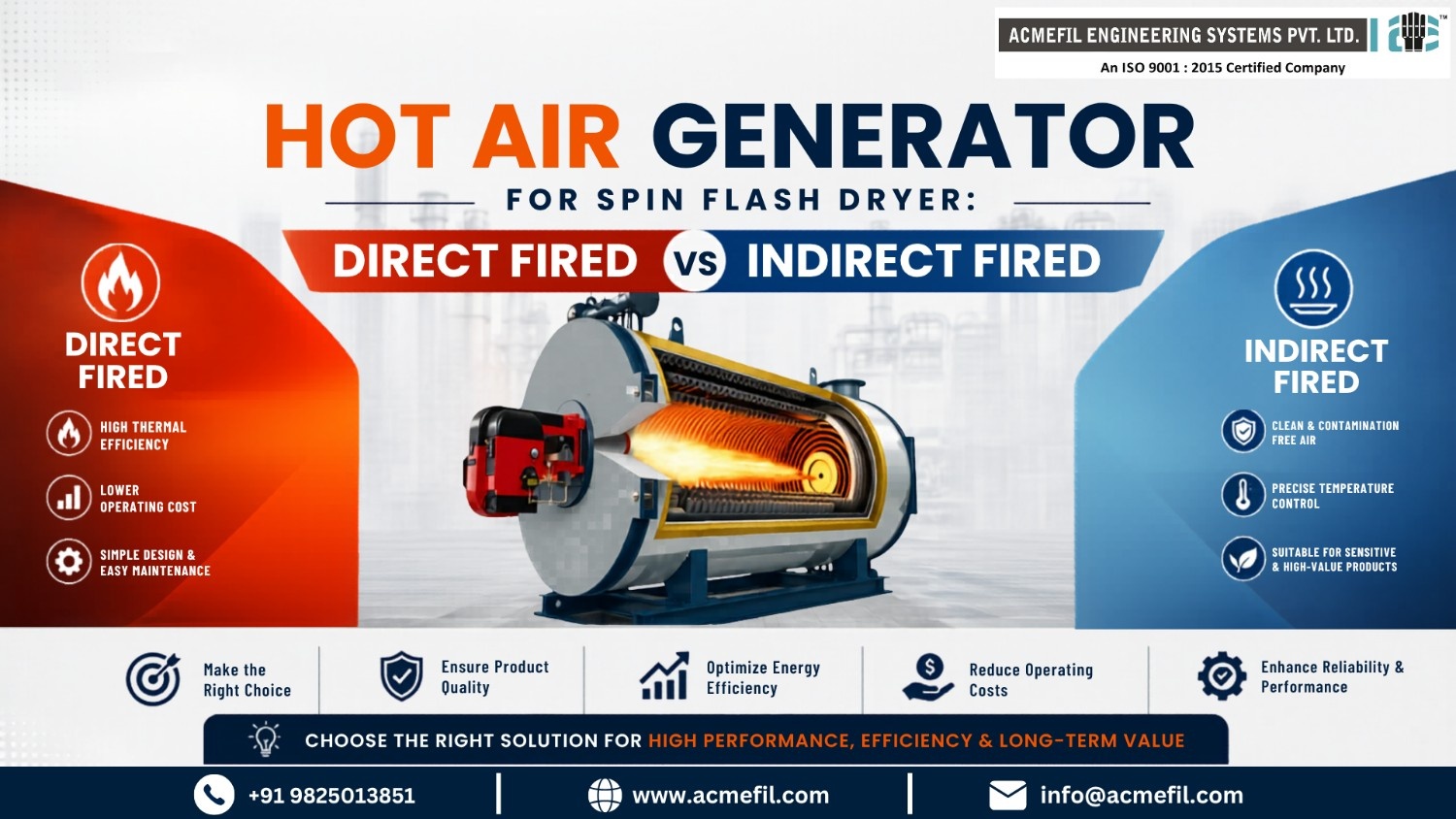
A hot air generator for spin flash dryer systems is not just a heating accessory. It decides how stable your drying temperature will be, how clean the process air will remain, how much fuel the plant will consume, and whether the final powder meets the required moisture and quality specification. For most spin flash dryer projects, the key choice is between a direct fired spin flash dryer arrangement and an indirect fired spin flash dryer arrangement.
In my experience, this decision should not be made only on fuel price. It should be made on feed sensitivity, contamination risk, inlet and outlet temperature requirement, moisture load, dust collection design, emission control, and the product quality expected by the buyer.
A spin flash dryer is already a highly application-specific dryer. The hot air system must be selected with the same level of care.
What is a hot air generator in a spin flash dryer?
A hot air generator is the thermal source that supplies heated air to the spin flash dryer. In the dryer, this hot air contacts wet cake, filter cake, paste, or sludge after the feed has been mechanically broken by the disintegrator near the feed zone.
The hot air performs three jobs at the same time:
- It transfers heat to evaporate moisture from the wet material.
- It carries dried particles upward through the drying chamber.
- It helps move the dried product toward the cyclone and bag filter system.
In a spin flash dryer, heat transfer is very fast because the material is broken into smaller particles before drying. That is why the hot air generator must deliver stable temperature, adequate airflow, and clean enough air for the product being dried.
If the hot air temperature fluctuates too much, the dryer may produce inconsistent final moisture. If the airflow is wrong, material may settle, choke, or carry excessive fines. If the air quality is unsuitable, the powder may fail on colour, odour, ash, purity, or customer acceptance.
For the full dryer mechanism, read this guide on the spin flash dryer working principle.
Direct fired spin flash dryer: what it means
A direct fired spin flash dryer uses a direct fired hot air generator to supply heated air to the dryer. In this arrangement, the fuel is burned and the combustion gases mix with the process air before entering the dryer.
This is usually considered when the product can tolerate direct contact with combustion gases and when the process needs a compact, practical heating arrangement.
A direct fired hot air generator can use fuels such as coal, lignite, wood, LDO, or gas, depending on the plant design and fuel availability. For chemical, dyestuff, pigment, agrochemical, and sludge applications, direct firing may be technically acceptable if product quality and emission requirements allow it.
The advantage is simplicity. There is no heat exchanger separating flue gas from process air. Heat transfer is direct, the layout is generally more compact, and the initial system cost can be lower than an indirect fired arrangement.
But the trade-off is important. The process air can carry combustion by-products. If the material is colour-sensitive, odour-sensitive, food-grade, pharmaceutical-grade, or purity-sensitive, direct firing may create a quality risk.
For a dedicated equipment reference, see Acmefil’s direct fired hot air generator page.
Indirect fired spin flash dryer: what it means
An indirect fired spin flash dryer uses an indirect fired hot air generator. Here, combustion gases do not mix with process air. The burner heats a heat exchanger, and clean process air passes over or through the heat exchanger surface before entering the dryer.
This design is preferred when the product must not come into contact with flue gas, ash, soot, unburnt fuel particles, or combustion smell.
For example, an indirect fired arrangement may be considered for:
- Food ingredients
- Pharmaceutical intermediates
- High-purity chemicals
- White or light-coloured pigments
- Products with strict odour limits
- Products where customer specifications do not allow combustion contact
The trade-off is cost and design complexity. The heat exchanger adds capital cost, pressure drop, maintenance responsibility, and heat transfer limits. The material of construction, expansion allowance, cleaning access, and flue gas path must be engineered properly.
An indirect fired system is not automatically better for every application. It is better only when the product or process demands separation between combustion and drying air.
For equipment-level reference, see Acmefil’s indirect fired hot air generator page.
Direct fired vs indirect fired hot air generator for spin flash dryer
| Selection Point | Direct Fired Hot Air Generator | Indirect Fired Hot Air Generator |
|---|---|---|
| Basic design | Combustion gases mix with process air | Combustion gases are separated from process air by heat exchanger |
| Best suited for | Rugged industrial materials that can tolerate combustion contact | Contamination-sensitive, colour-sensitive, odour-sensitive, or purity-sensitive products |
| Typical product fit | Dyestuff cakes, some pigments, inorganic chemicals, agrochemical intermediates, sludge, if product specs allow | Food, pharma, high-purity chemicals, white pigments, sensitive specialty chemicals |
| Fuel options | Coal, lignite, wood, LDO, gas, subject to design | Coal, lignite, wood, LDO, gas, subject to heat exchanger and combustion design |
| Main advantage | Simpler heat transfer path and compact arrangement | Cleaner process air because flue gas does not contact product |
| Main risk | Product contamination, odour, ash, soot, or colour impact if fuel combustion is not suitable | Higher system complexity, heat exchanger maintenance, pressure drop, and capital cost |
| RFQ question to ask | Can my product tolerate direct combustion gas contact? | What heat exchanger material, temperature limit, and cleaning access are required? |
| Selection mistake | Choosing direct firing only because it is cheaper | Choosing indirect firing without product-quality need or heat-load calculation |
The correct choice depends on the product. I would not advise selecting a direct fired spin flash dryer only because fuel economics look attractive. I also would not advise selecting an indirect fired spin flash dryer only because it sounds cleaner. The feed material, final powder specification, fuel type, and site conditions must decide the heating system.
Why the hot air system matters more in sticky feed drying
A spin flash dryer is commonly selected when a standard flash dryer cannot handle the feed. The feed may be wet cake, slimy paste, gelatinous material, high-viscosity sludge, or filter press discharge.
This material does not naturally disperse like a free-flowing powder. It needs mechanical action at the feed point. In a properly designed spin flash dryer, a feed screw, lump breaker, and disintegrator help break the material before it enters the drying air stream.
The hot air generator must support this action. If the air temperature is too low, the sticky mass may remain wet for too long and build up inside the dryer. If the temperature is too aggressive, heat-sensitive material may degrade, darken, or form hard particles. If the airflow is unstable, dried powder separation becomes inconsistent.
This is why heating design, feed handling, disintegrator action, and dust collection must be treated as one system. For more detail, read design and operation inside spin flash dryers.
When should you choose a direct fired hot air generator?
Choose a direct fired hot air generator for a spin flash dryer when the product can safely tolerate direct contact with combustion gases and the process does not have strict purity, odour, or colour limitations.
A direct fired system may be suitable when:
- The product is an industrial chemical or dye intermediate where combustion contact is acceptable.
- The final powder specification does not restrict flue gas contact.
- Fuel availability strongly favours coal, lignite, wood, LDO, or gas.
- The plant wants a simpler thermal arrangement.
- The application is validated through trial or prior process data.
- Emission control and dust collection are correctly engineered.
Direct firing should still be handled carefully. Burner control, fuel quality, combustion efficiency, air mixing, temperature control, refractory lining, duct design, and safety interlocks all matter.
A direct fired hot air generator should not be selected without confirming whether the final product can accept combustion contact.
When should you choose an indirect fired hot air generator?
Choose an indirect fired hot air generator when the product quality requirement does not allow direct contact between combustion gases and drying air.
An indirect fired system may be the safer choice when:
- The product is food-grade, pharma-related, or high-purity.
- The material is sensitive to odour contamination.
- The final powder must remain light-coloured.
- The buyer specification restricts ash, soot, flue gas, or combustion contact.
- The plant wants cleaner process air entering the spin flash dryer.
- The fuel contains ash or combustion by-products that cannot be allowed near the product.
- Export customer requirements demand cleaner thermal separation.
In this arrangement, the heat exchanger becomes a critical part of the design. It must be sized for heat duty, temperature, air volume, fuel type, flue gas path, pressure drop, and maintenance access.
If the heat exchanger is undersized, the dryer may not reach the required inlet temperature. If the pressure drop is too high, airflow may suffer. If cleaning access is poor, long-term performance will decline.
Fuel selection for spin flash dryer hot air generator
Fuel selection is not only a commercial question. It changes the design of the hot air generator, the combustion chamber, the flue gas path, the emission control system, and sometimes the product-quality risk.
Common fuel options include:
| Fuel | Practical Consideration in Spin Flash Dryer Heating |
|---|---|
| Coal | Requires strong combustion control, ash handling, and emission consideration. Product contact risk must be checked carefully in direct fired systems. |
| Lignite | Similar to coal, but moisture and fuel variability must be considered during combustion design. |
| Wood | Can be economical where available, but ash, fuel sizing, moisture, and combustion stability matter. |
| LDO | Cleaner and easier to control than many solid fuels, but fuel cost must be calculated. |
| Gas | Clean combustion and good control, where gas supply is available and commercially viable. |
| FBC type solid fuel system | Can be considered for solid fuels where fluidized bed combustion is technically suitable. |
For spin flash dryer applications, I prefer to look at fuel selection together with product quality. A cheap fuel is not cheap if it creates product rejection, bag filter problems, unstable temperature, or frequent shutdowns.
Hot air temperature in spin flash dryer systems
The inlet and outlet temperature for a spin flash dryer should not be copied blindly from another plant. It depends on:
- Initial moisture
- Final moisture target
- Feed rate
- Feed texture
- Heat sensitivity
- Bulk density
- Particle behaviour after disintegration
- Required powder quality
- Dryer residence time
- Airflow and separation system
- Fuel and hot air generator design
A higher inlet temperature does not automatically mean better drying. In spin flash drying, the material has short residence time and intense air contact. Many heat-sensitive materials can be dried safely when the process is correctly designed, but the actual limit must be proven by trials or reliable process data.
The outlet temperature is equally important. It gives a practical indication of drying completion, remaining moisture, and the thermal condition of the exhaust stream before cyclone and bag filter.
For operation-related guidance, read spin flash drying best practices for operation.
Sizing logic: what data is needed before selecting the hot air generator?
A hot air generator should be sized from the evaporation load, not by guessing dryer size.
The basic water evaporation load is calculated from the feed rate and moisture reduction requirement.
Simple basis:
Water to be evaporated = wet feed rate × difference between initial and final moisture, adjusted to dry solids basis
In practical RFQ evaluation, the supplier needs:
| RFQ Data | Why It Matters |
|---|---|
| Wet feed rate | Determines material load entering dryer |
| Initial moisture | Determines evaporation load |
| Required final moisture | Defines drying target |
| Feed form | Wet cake, paste, sludge, filter cake, or gelatinous mass |
| Heat sensitivity | Decides safe temperature window |
| Product purity requirement | Helps choose direct or indirect firing |
| Colour and odour limits | Critical for direct fired vs indirect fired decision |
| Bulk density | Affects conveying, separation, and discharge |
| Fuel available at site | Influences hot air generator design |
| Preferred fuel | Affects burner, combustion chamber, flue gas path, and emissions |
| Required metallurgy | Important for corrosive or high-purity products |
| Dust load | Affects cyclone and bag filter sizing |
| Plant layout | Affects ducting, pressure drop, and maintenance access |
If you are comparing dryer options, this guide on how to choose a spin flash dryer will help you structure the discussion before sending an RFQ.
Role of cyclone and bag filter after hot air drying
The hot air generator does not work alone. After drying, the air carries dried powder toward the separation system. A typical spin flash dryer line uses a cyclone separator and bag filter to recover product and control dust.
This is especially important in chemical, pigment, dye, and agrochemical drying. Fine powder carryover can affect yield, housekeeping, emission control, and bag filter life.
If hot air temperature, air volume, or feed rate is unstable, the cyclone and bag filter also become unstable. You may see high dust loading, filter choking, product loss, or poor discharge.
For support equipment reference, Acmefil’s bag filter page is useful when planning the full system around a spin flash dryer.
Application examples: which hot air system fits which material?
| Material or Industry | Likely Heating Direction | Reason |
|---|---|---|
| Reactive dye filter cake | Direct or indirect, based on product specification | Many dye intermediates are industrial products, but colour and contamination tolerance must be checked |
| Pigment cake | Direct or indirect, based on colour sensitivity | White or light-coloured pigments may require cleaner air |
| Agrochemical intermediate | Case-specific | Depends on purity, solvent history, odour, and customer specification |
| Inorganic chemical wet cake | Often direct fired may be considered | If combustion contact does not affect product quality |
| High-viscosity sludge | Often direct fired may be considered | Product purity is usually not the same as food or pharma, but emissions and safety still matter |
| Food ingredient | Usually indirect fired | Process air quality is important |
| Pharmaceutical intermediate | Usually indirect fired | Product purity and contamination control are critical |
| Heat-sensitive specialty chemical | Case-specific | Temperature profile and residence time must be proven |
This table is a starting point, not a final design rule. Feed trials and process data are still required for reliable selection.
Common mistakes in hot air generator selection
Selecting direct firing only because it is cheaper
This is the most common commercial mistake. Direct firing can be practical, but only if the product accepts combustion contact. A rejected powder batch can cost more than the equipment difference.
Selecting indirect firing without calculating heat duty
Indirect firing adds a heat exchanger. If the heat exchanger is not sized correctly, the dryer may struggle to reach the required inlet temperature or airflow.
Ignoring feed behaviour
A wet cake, sticky paste, and high-viscosity sludge do not behave the same way. The feed screw, lump breaker, disintegrator, and hot air flow must work together.
Treating the bag filter as an afterthought
Dust collection is part of the drying system. If the powder is fine, abrasive, sticky, or heat-sensitive, bag filter design must be discussed early.
Copying inlet temperature from another product
A spin flash dryer temperature profile is product-specific. Even two dye intermediates can behave differently if moisture, particle structure, or heat sensitivity changes.
Sending an incomplete RFQ
A quotation without moisture data, feed rate, fuel choice, product sensitivity, and final moisture target is not a reliable quotation. It is only a rough commercial response.
Practical RFQ checklist for hot air generator with spin flash dryer
Before asking for a quotation, prepare this data:
| Data Point | Required Input |
|---|---|
| Product name | Chemical, dye, pigment, sludge, food ingredient, pharma intermediate, etc. |
| Feed source | Filter press cake, centrifuge cake, paste, sludge, or other |
| Wet feed rate | kg/hr |
| Initial moisture | % wet basis or dry basis, clearly mentioned |
| Final moisture required | % |
| Product heat sensitivity | Yes, no, or unknown |
| Product contamination sensitivity | Can it contact combustion gas or not? |
| Colour and odour restriction | Yes or no |
| Fuel available | Coal, lignite, wood, LDO, gas, or multiple options |
| Preferred hot air generator | Direct fired, indirect fired, or open for selection |
| Site utilities | Power, fuel pressure, air, space, chimney provision |
| Dust collection expectation | Cyclone, bag filter, scrubber if required |
| Trial requirement | Lab or pilot validation before final sizing |
For high-risk feed materials, pilot testing is the most practical way to avoid wrong sizing. Acmefil has pilot plant capability for spin flash dryer trials with 10 kg/hr water evaporation capacity. If the feed is sticky, slimy, gelatinous, or heat-sensitive, trial data is more useful than assumptions.
Direct fired or indirect fired: my practical selection rule
My practical rule is simple.
Choose a direct fired hot air generator when the product can tolerate combustion contact and the plant wants a simpler, rugged, industrial drying arrangement.
Choose an indirect fired hot air generator when the product must be protected from flue gas, ash, odour, soot, or combustion-related contamination.
In both cases, do not finalize the system only from a catalogue. A spin flash dryer handles difficult feeds, and difficult feeds rarely behave exactly as expected on paper.
The correct approach is to evaluate feed behaviour, calculate evaporation load, select the disintegrator and feed system, size the hot air generator, check cyclone and bag filter duty, and validate the process where uncertainty is high.
FAQs
What is the role of a hot air generator in a spin flash dryer?
A hot air generator supplies heated air to the spin flash dryer. This hot air evaporates moisture, keeps particles suspended, and conveys dried powder toward the cyclone and bag filter system.
What is a direct fired spin flash dryer?
A direct fired spin flash dryer is a spin flash dryer heated by a direct fired hot air generator. Combustion gases mix with process air before entering the dryer. It is suitable only when the product can tolerate combustion gas contact.
What is an indirect fired spin flash dryer?
An indirect fired spin flash dryer is heated by an indirect fired hot air generator. A heat exchanger separates combustion gases from process air. This is preferred for contamination-sensitive, odour-sensitive, colour-sensitive, food, pharma, or high-purity materials.
Which fuel is used in a hot air generator for spin flash dryer?
Common fuel options include coal, lignite, wood, LDO, and gas. The best fuel depends on availability, product sensitivity, emission requirements, combustion control, and whether the system is direct fired or indirect fired.
How do I choose between direct fired and indirect fired hot air generator?
Choose direct fired if combustion contact is acceptable for the product. Choose indirect fired if the product must be protected from flue gas, ash, soot, odour, or contamination. For difficult feeds, validate the choice through process data or pilot trials.
Conclusion
The hot air generator for a spin flash dryer should be selected from the product outward, not from the burner inward. The right question is not only, “Which fuel is cheaper?” The better question is, “What air quality, temperature stability, evaporation load, and contamination control does this product need?”
A direct fired spin flash dryer arrangement can be practical for many rugged chemical, dye, pigment, agrochemical, and sludge applications. An indirect fired spin flash dryer arrangement is better when product purity, colour, odour, or contamination control is critical.
If your material is a wet cake, sticky paste, gelatinous mass, or high-viscosity sludge, share your feed data before finalizing the heating system. You can contact the Spin Flash Drying team to review your feed, fuel option, moisture target, and direct fired vs indirect fired hot air generator selection.

Siddharth Nair is the Technical Director at Acmefil Engineering Systems Pvt. Ltd., an ISO 9001:2015 certified manufacturer of industrial drying and evaporation systems headquartered in Ahmedabad, Gujarat, he has led technical evaluation, application engineering and customer solution design for spray dryers, multi-effect evaporators, agitated thin film dryers, spin flash dryers and zero liquid discharge systems.