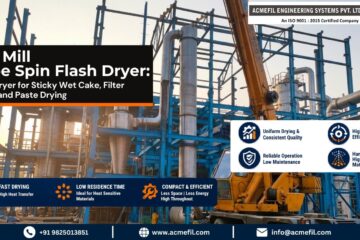
A chemical paste dryer is used when the feed is not a free-flowing powder but a wet cake, filter cake, sticky paste, gelatinous material or high-viscosity sludge. For many inorganic chemical dryer applications, the first selection question is not only capacity. It is feed behaviour. If the material forms lumps, smears at the feed point or refuses to disperse in hot air, a normal flash dryer may not work. In those cases, a spin flash dryer is often the first technology to evaluate.
In chemical plants, I do not like selecting dryers only from a moisture percentage. Two materials can both have 45% moisture, but one may disperse easily while another may behave like rubbery paste. The dryer must be selected around that real behaviour.
What Is a Chemical Paste Dryer?
A chemical paste dryer is industrial chemical drying equipment designed to convert pasty, sticky, wet or semi-solid chemical feed into a dry powder or lower-moisture solid.
Typical feed forms include:
- Filter press cake
- Centrifuge cake
- Wet chemical paste
- Pigment cake
- Inorganic chemical wet cake
- Dye intermediate cake
- Catalyst paste
- High-viscosity chemical sludge
- Gelatinous or slimy chemical material
For these materials, drying is not just a heat transfer problem. It is also a material handling problem. The feed must enter the dryer continuously, break into smaller particles, contact hot air properly and discharge without choking the system.
Why Inorganic Chemical Drying Is Difficult
Inorganic chemical drying becomes difficult when the feed has one or more of these behaviours:
- High initial moisture
- Sticky or thixotropic paste structure
- Lumps from filter press discharge
- Abrasive particle nature
- Heat sensitivity
- Fine powder dusting after drying
- Hygroscopic behaviour
- Batch-to-batch variation
- Need for clean powder collection
Inorganic chemical dryer applications may include materials such as aluminum chloride, barium sulphate, calcium chloride, manganese sulphate, silica, sodium silicate, catalysts, pigments and other inorganic salts or chemical intermediates. The exact dryer selection depends on the feed form and final powder requirement.
This is where many buying mistakes happen. A plant may ask for “chemical drying equipment” without first defining whether the feed is a liquid, slurry, paste, wet cake or free-flowing powder. Each form points to a different dryer.
Best Dryer Options for Chemical Paste and Inorganic Chemical Drying
| Feed condition | Dryer to evaluate first | Why it fits | When to avoid |
|---|---|---|---|
| Sticky wet cake or chemical paste | Spin flash dryer | Breaks and dries material in the same chamber | When product cannot tolerate mechanical disintegration |
| Free-flowing powder with surface moisture | Flash dryer | Fast pneumatic drying for dispersible feed | When material is sticky, lumpy or gelatinous |
| Liquid solution or pumpable slurry | Spray dryer | Atomizes liquid feed into droplets and dries into powder | When feed is already a wet cake or paste |
| Fluidizable powder or granules | Fluid bed dryer | Uniform hot air drying with controlled product movement | When feed is wet cake or does not fluidize |
| Thick concentrate after evaporation | ATFD or suitable contact dryer | Handles viscous concentrated streams | When rapid pneumatic powder formation is required |
| Sludge-like chemical waste | Sludge dryer or spin flash dryer, based on target output | Depends on whether the target is volume reduction or dry powder | Wrong fit if feed behaviour is not tested |
For a chemical paste dryer, the spin flash dryer is usually the strongest candidate when the material needs mechanical breaking before drying.
Why Spin Flash Drying Fits Chemical Paste Dryer Applications
A spin flash dryer combines mechanical disintegration and hot air drying in one continuous system.
The wet chemical paste or filter cake is fed into the drying chamber through a controlled feed arrangement. At the feed zone, a rotating disintegrator breaks the incoming wet material into smaller fragments. These fragments immediately contact hot air. Moisture evaporates quickly because the exposed surface area increases. The dried particles move with the air stream toward a cyclone separator, bag filter or suitable collection system.
This matters because many chemical pastes cannot disperse on their own. If the material enters a normal flash dryer as lumps, hot air may dry only the outer layer while the inside stays wet. That leads to uneven moisture, blockages, product build-up and cleaning problems.
A spin flash dryer is especially useful for:
- Wet cake drying
- Filter cake drying
- Chemical paste drying
- Pigment cake drying
- Dye intermediate drying
- Agrochemical wet cake drying
- High-viscosity sludge drying
- Gelatinous chemical feed drying
- Inorganic chemical powder production from wet feed
For broader selection logic, you can also read this guide on how to choose a spin flash dryer.
Chemical Paste Dryer Working Principle
A chemical paste dryer based on spin flash drying works in the following sequence:
- Wet cake or paste is fed through a screw feeder or controlled feeding system.
- The feed enters the bottom zone of the drying chamber.
- A disintegrator breaks lumps and opens the wet material.
- Hot air contacts the smaller particles immediately.
- Moisture evaporates during short residence time.
- Dry powder moves upward with the air stream.
- Product is separated through cyclone, bag filter or a combined dust collection system.
- Air lock rotary valve or discharge arrangement controls powder removal.
The critical area is the feed point. If the feed point fails, the whole dryer becomes unstable. That is why lump breaking, feed screw control, disintegrator design and air flow balance are not accessories. They are part of the core process design.
For the basic mechanism, refer to the spin flash dryer working principle guide.
Inorganic Chemical Dryer Selection Criteria
Before selecting an inorganic chemical dryer, collect the following process data.
| Selection input | Why it matters |
|---|---|
| Material name | Confirms chemical nature, corrosion risk and drying objective |
| Feed form | Liquid, slurry, paste, filter cake and powder need different dryers |
| Initial moisture | Drives evaporation load and hot air requirement |
| Final moisture target | Determines drying duty and possible need for secondary drying |
| Stickiness | Decides whether disintegration and special feeding are required |
| Lump size | Affects feed screw, lump breaker and disintegrator design |
| Heat sensitivity | Defines safe inlet and outlet temperature approach |
| Bulk density | Affects powder collection and downstream handling |
| Particle size requirement | Influences classifier, disintegrator and collection system |
| Abrasion or corrosiveness | Affects material of construction |
| Dusting behaviour | Affects cyclone, bag filter and clean operating environment |
| Upstream equipment | Filter press, centrifuge or evaporator output changes dryer choice |
I would not finalize a chemical drying equipment quote without this information. A price without feed behaviour is only a rough commercial number, not a reliable process selection.
Chemical Paste Dryer vs Standard Flash Dryer
A standard flash dryer is useful when the feed can disperse easily in a high-velocity hot air stream. It works well for free-flowing powders, granules or centrifuged cakes with surface moisture.
A chemical paste dryer needs a different approach when the material is sticky or lumpy. The problem is not only evaporation. The material must be opened first.
| Factor | Chemical paste dryer using spin flash drying | Standard flash dryer |
|---|---|---|
| Best feed form | Wet cake, sticky paste, filter cake, gelatinous feed | Free-flowing powder or dispersible centrifuged cake |
| Main action | Disintegration plus hot air drying | Pneumatic hot air drying |
| Feed handling | Designed for difficult wet feed | Depends on natural dispersion |
| Choking risk | Lower when feed and disintegrator are correctly designed | Higher if used for sticky paste |
| Typical chemical use | Pigments, dye intermediates, inorganic wet cakes, agrochemical pastes | Powders, granules, surface-moist chemicals |
| Trial importance | High | Moderate to high depending on material |
A flash dryer is not a bad machine. It is the wrong machine when the feed cannot open properly inside the air stream.
When Spray Drying Is Better for Inorganic Chemicals
Not every inorganic chemical dryer requirement should go to a spin flash dryer. If the feed is a liquid solution, suspension or pumpable slurry, spray drying may be more suitable.
Spray dryers convert liquid feed into powder by atomizing the liquid into droplets and contacting them with hot air. For inorganic chemicals where the feed is pumpable and powder properties depend on droplet formation, spray drying may be the correct route.
Use this simple decision:
- Liquid feed requiring atomization, evaluate spray dryer.
- Wet cake or paste from filter press, evaluate spin flash dryer.
- Free-flowing powder with surface moisture, evaluate flash dryer.
- Fluidizable particles needing uniform drying, evaluate fluid bed dryer.
- Viscous concentrate after evaporation, evaluate ATFD or similar technology.
Important Components in Chemical Drying Equipment
A chemical drying system is not only the dryer body. The supporting equipment decides whether the plant runs cleanly and consistently.
Feed System
The feed system controls wet cake or paste movement into the dryer. For difficult chemical paste, a variable speed feed screw and lump breaker help reduce choking at the inlet.
Disintegrator
The disintegrator breaks wet material into smaller fragments. Cage mill and pin mill type disintegrators are commonly evaluated based on material stickiness, lump strength and final powder requirement.
Hot Air Generator
The hot air system supplies drying energy. Direct or indirect heating must be selected based on contamination risk, product sensitivity and fuel availability. For contamination-sensitive chemicals, indirect hot air generation may need evaluation.
Drying Chamber
The drying chamber must provide enough contact between the disintegrated material and hot air. The design must avoid dead zones, build-up and uneven drying.
Cyclone Separator
The cyclone separates heavier dried particles from the air stream. It is often used before bag filtration depending on product fineness and recovery needs.
Bag Filter
A bag filter improves powder recovery and dust control. For fine inorganic chemical powder, dust collection should be treated as a process and safety requirement, not only an environmental add-on.
Air Lock Rotary Valve
An air lock rotary valve helps discharge powder while reducing uncontrolled air leakage at the outlet.
For related system design, see spin flash dryer components.
Common Mistakes in Buying Chemical Drying Equipment
Selecting by Dryer Name Instead of Feed Behaviour
“Chemical dryer” is too broad. A wet paste, solution, powder and sludge can all belong to the chemical industry, but each needs different drying logic.
Ignoring Stickiness
Stickiness causes feed build-up, unstable drying and higher cleaning frequency. It must be tested or at least honestly evaluated before selection.
Comparing Only Price
A lower-priced dryer that chokes, overdrys, underdries or needs frequent cleaning becomes expensive after installation.
Not Checking Heat Sensitivity
Some inorganic chemicals, pigments and intermediates may change colour, degrade or form hard lumps under unsuitable temperature conditions.
Treating Dust Collection as Secondary
Fine chemical powders need proper collection. Cyclone and bag filter design affects product recovery, housekeeping and operating cleanliness.
Skipping Pilot Trials for Difficult Feed
If the material is sticky, gelatinous, abrasive, heat-sensitive or inconsistent, pilot testing can prevent a wrong full-scale equipment decision.
Pilot Testing for Chemical Paste and Inorganic Chemical Dryer Selection
Pilot testing is valuable when the feed behaviour is uncertain. At Acmefil, pilot facilities are available for process development, including spin flash dryer, flash dryer and vibratory fluid bed dryer trials at 10 kg/hr water evaporation capacity, and spray dryer trials at 3 kg/hr water evaporation capacity.
A pilot trial can help confirm:
- Whether the feed enters smoothly
- Whether lumps break properly
- Whether material sticks near the feed zone
- Whether the product reaches the target moisture
- Whether the powder is too fine or too coarse
- Whether product colour or quality changes during drying
- Whether cyclone and bag filter collection is suitable
- Whether a full-scale design is technically reasonable
For difficult chemical paste dryer applications, I prefer a tested answer over a theoretical assumption.
What to Share Before Asking for a Chemical Paste Dryer Quote
When you contact a manufacturer, share this data:
- Product name and chemical category
- Feed source, such as filter press, centrifuge or reactor discharge
- Feed form, such as wet cake, paste, slurry, sludge or powder
- Initial moisture and required final moisture
- Feed rate or expected evaporation load
- Stickiness and lump formation tendency
- Heat sensitivity or maximum safe product temperature
- Bulk density before and after drying
- Particle size requirement
- Material of construction preference, if known
- Dusting, corrosion, toxicity or contamination concerns
- Available utilities and fuel type
- Space constraints and installation location
This information allows the engineering team to compare spin flash drying, flash drying, spray drying, fluid bed drying or ATFD more accurately.
Where ACMEFIL Fits in Chemical Drying Equipment Selection
ACMEFIL Engineering Systems Pvt. Ltd. manufactures industrial drying and concentrating equipment from Ahmedabad, Gujarat. For chemical drying applications, the relevant product range includes spin flash dryers, flash dryers, spray dryers, fluid bed dryers, evaporators, hot air generators, bag filters and related ancillary equipment.
The practical advantage is that a chemical buyer does not need to force every feed into one dryer type. The feed can be evaluated first. Then the right drying route can be selected.
If your feed is wet cake, paste, gelatinous material or high-viscosity chemical sludge, start with spin flash dryer evaluation. If your feed is liquid, look at spray drying. If your feed is already powdery, compare flash dryer and fluid bed dryer options.
FAQs
Which dryer is best for chemical paste drying?
For sticky chemical paste, wet cake, filter cake and gelatinous material, a spin flash dryer is usually the first dryer to evaluate because it breaks the feed and dries it in the same chamber. Final selection should depend on feed moisture, stickiness, heat sensitivity, lump behaviour and target powder quality.
What is an inorganic chemical dryer?
An inorganic chemical dryer is industrial drying equipment used to remove moisture from inorganic chemical products such as salts, catalysts, pigments, silica-based materials and other mineral or chemical compounds. The dryer type may be spin flash, flash, spray, fluid bed or ATFD depending on feed form.
Can a flash dryer dry chemical paste?
A standard flash dryer can dry suitable powders, granules or dispersible centrifuged cakes. It may fail with sticky chemical paste because the material can form lumps or clog before proper drying. For paste-like feed, spin flash drying is usually more suitable.
Is spray dryer suitable for inorganic chemicals?
Yes, spray drying can be suitable when the inorganic chemical feed is a liquid solution, suspension or pumpable slurry that can be atomized. It is not the first choice when the feed is already a wet cake or sticky paste from a filter press.
Why is pilot testing important for chemical drying equipment?
Pilot testing helps confirm actual feed behaviour. Moisture percentage alone cannot show whether a chemical paste will smear, lump, clog, degrade or dry evenly. A pilot trial gives better confidence before scaling to a full industrial dryer.
Conclusion
A chemical paste dryer should be selected from the behaviour of the feed, not from the equipment name alone. If the feed is wet cake, filter cake, sticky paste or gelatinous inorganic chemical material, spin flash drying is often the right starting point because it combines disintegration and hot air drying. If the feed is liquid, spray drying may be better. If it is free-flowing powder, flash drying or fluid bed drying may be enough.
For difficult chemical paste dryer and inorganic chemical dryer applications, share your feed data before asking for price. Feed behaviour, moisture target, heat sensitivity, stickiness and powder collection requirements decide whether the plant will run smoothly after installation.
To evaluate your chemical drying requirement, contact ACMEFIL with your feed details, moisture data and target output so the right chemical drying equipment can be selected before full-scale procurement.

Siddharth Nair is the Technical Director at Acmefil Engineering Systems Pvt. Ltd., an ISO 9001:2015 certified manufacturer of industrial drying and evaporation systems headquartered in Ahmedabad, Gujarat, he has led technical evaluation, application engineering and customer solution design for spray dryers, multi-effect evaporators, agitated thin film dryers, spin flash dryers and zero liquid discharge systems.