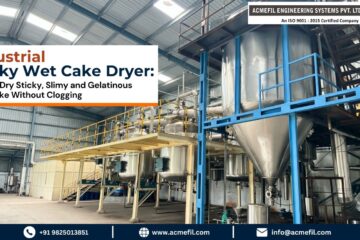
A spin flash dryer process flow diagram shows how wet cake, paste, sludge or gelatinous material enters the dryer, gets broken by a disintegrator, contacts hot air, dries in suspension, separates in a cyclone and bag filter, and exits as dry powder. The diagram is useful because spin flash drying is not only a heating process. It is a controlled combination of feeding, mechanical disintegration, hot air contact, pneumatic conveying and powder recovery.
In my experience, a good spin flash dryer diagram should not only show the machine body. It should show the complete process path, because the feeder, air system, cyclone, bag filter and discharge arrangement all affect final moisture, product loss and plant reliability.
Simple Spin Flash Dryer Process Flow Diagram
Use this basic flow layout to understand how material and air move through a spin flash dryer system.
Wet Cake / Paste / Filter Press Discharge
↓
Feed Hopper or Feed Bin
↓
Variable Speed Feed Screw / Controlled Feeding System
↓
Lump Breaker or Disintegrator Zone
↓
Hot Air Entry from Hot Air Generator
↓
Spin Flash Drying Chamber
↓
Moisture Evaporation and Pneumatic Conveying
↓
Cyclone Separator for Main Powder Collection
↓
Rotary Airlock Valve for Product Discharge
↓
Bag Filter for Fine Dust Collection
↓
Exhaust Fan and Clean Air Outlet
This is the basic spin flash dryer flow diagram. In an actual plant, the layout may also include ducting, dampers, temperature sensors, pressure monitoring, instrumentation, explosion protection if required, product cooling, pneumatic conveying after collection, or a packing system.
What a Spin Flash Dryer Diagram Actually Shows
A spin flash dryer diagram shows four important things:
- How wet feed enters the system
- Where the wet lumps are mechanically broken
- How hot air contacts and dries the dispersed particles
- How dried powder is separated from exhaust air
This matters because a spin flash dryer is usually selected for difficult feeds. These include wet cakes, slimy pastes, gelatinous materials, filter press discharge, high-viscosity sludge, pigments, dye intermediates and certain agrochemical materials.
A standard flash dryer mainly depends on hot air velocity to disperse material. A spin flash dryer adds mechanical action at the feed point. That is the major difference. The disintegrator breaks the wet cake before or during hot air contact, so the material does not enter the drying path as large lumps.
For a deeper explanation of this mechanism, you can also refer to the spin flash dryer working principle guide.
Main Components in a Spin Flash Dryer Process Flow Diagram
| Component | What It Does | What the Buyer Should Check |
|---|---|---|
| Feed hopper | Receives wet cake, paste or sludge before feeding | Bridging tendency, lump size, feed consistency |
| Variable speed screw feeder | Controls feed rate into the dryer | Uniform feed rate, screw design, clogging risk |
| Lump breaker / disintegrator | Breaks wet cake into smaller particles | Cage mill or pin mill type, material hardness, stickiness |
| Hot air generator | Supplies hot drying air | Direct or indirect heating, fuel, product sensitivity |
| Drying chamber | Where disintegrated feed contacts hot air | Residence time, air distribution, chamber geometry |
| Air stream / pneumatic conveying path | Carries particles while drying | Velocity, pressure drop, dust loading |
| Cyclone separator | Collects the main dried powder fraction | Particle size, collection efficiency, product loss |
| Rotary airlock valve | Discharges powder while controlling air leakage | Sealing, wear resistance, material compatibility |
| Bag filter | Captures fine powder from exhaust air | Dust load, filter media, pulse cleaning, emissions control |
| Exhaust fan | Maintains system suction and airflow | Total pressure drop, capacity, dust handling requirement |
| Control panel and instruments | Controls temperature, feed, airflow and operation | Temperature sensors, interlocks, automation level |
A weak diagram only shows the dryer chamber and cyclone. A useful engineering diagram shows the full flow from wet feed to dry powder discharge.
Step-by-Step Spin Flash Dryer Process Flow
Wet Feed Enters Through a Controlled Feeding System
The process starts with wet cake, paste or sludge entering the feed hopper. In many plants, this feed may come from a filter press, centrifuge, reaction vessel or upstream dewatering system.
The feed system must be controlled. If the wet cake enters too fast, the disintegrator can overload. If feeding is irregular, the dryer may alternate between over-drying and under-drying. This is why a variable speed screw feeder is commonly used in spin flash dryer layouts.
The feed screw is not just a conveyor. It is part of the drying control system.
The Disintegrator Breaks Lumps at the Feed Zone
The disintegrator is the most important difference between a standard flash dryer and a spin flash dryer.
When the wet material enters the dryer, the disintegrator breaks the cake, paste or lumped mass into smaller fragments. These fragments expose more surface area to the hot air. Better surface exposure improves moisture evaporation and reduces the risk of wet lumps passing through the system.
Common disintegrator options include:
- Cage mill type disintegrator
- Pin mill type disintegrator
The right choice depends on the feed structure, lump hardness, abrasiveness, stickiness and final powder requirement. This is why material testing matters before finalizing a full-scale layout.
For component-level understanding, this guide on spin flash dryer components is a useful internal reference.
Hot Air Enters the Drying Chamber
Hot air enters the drying chamber from a hot air generator or heating system. The air performs two jobs at the same time:
- It provides heat for moisture evaporation
- It carries the disintegrated particles through the dryer
The temperature is not selected randomly. It depends on initial moisture, target moisture, heat sensitivity, feed rate, air volume and final powder requirement.
For heat-sensitive products, the key advantage is short exposure time. The material may see high-temperature air, but it remains in the hot zone for a short duration after being dispersed. Suitability still needs validation with product trials, especially when product degradation, colour change or active ingredient loss is a concern.
Moisture Evaporates While Material Moves in Suspension
Once the wet material is broken and suspended in the hot air stream, moisture starts evaporating rapidly.
This is where the actual spin flash drying happens. The material is not lying on a tray. It is not slowly tumbling in a drum. It is drying while being dispersed and transported by hot air.
Good drying depends on four controls working together:
- Feed rate
- Disintegrator action
- Hot air temperature and volume
- Product separation after drying
If any one of these is wrong, the dryer may still run, but the powder may show uneven moisture, lumps, high dust carryover or product loss.
Cyclone Separator Collects the Main Powder Fraction
After drying, the air stream carries the dried powder to the separation system. The cyclone separator collects the heavier powder fraction from the air.
The cyclone is not a minor accessory. It affects product recovery, powder loss, dust load on the bag filter and overall plant cleanliness.
A poorly selected cyclone can create:
- High product loss
- Excess dust load on the bag filter
- Unstable pressure balance
- Frequent filter cleaning
- Poor powder recovery
In a spin flash dryer process flow diagram, always check whether the cyclone is shown clearly and whether the product discharge path is separated from the exhaust air path.
Rotary Airlock Discharges the Dried Powder
The collected powder usually discharges through a rotary airlock valve. This valve allows powder discharge while reducing unwanted air leakage.
Air leakage matters because spin flash drying depends on controlled airflow. If the discharge valve leaks excessively, it can disturb suction, reduce collection efficiency and affect system balance.
The rotary airlock should be selected based on powder flowability, abrasiveness, temperature and material of construction requirement.
Bag Filter Captures Fine Dust
After the cyclone, the remaining air still carries fine particles. A bag filter captures this fine dust before air exits the system.
For dusty materials like dyes, pigments, chemical intermediates and fine powders, the bag filter is critical for product recovery and housekeeping. Pulse jet cleaning is often used to keep filter bags clean during operation.
A spin flash dryer diagram should show the bag filter after the cyclone. If the diagram ends at the cyclone, the dust collection plan is incomplete.
For supporting equipment context, ACMEFIL’s bag filter page can be used as a reference when planning the dust collection side of the drying system.
Exhaust Fan Maintains Airflow Through the System
The exhaust fan pulls air through the dryer, cyclone, bag filter and ducting. It must handle the total system pressure drop.
A fan selected only on airflow can fail in operation if pressure drop is underestimated. The pressure drop includes the dryer chamber, duct bends, cyclone, bag filter, dampers and discharge arrangement.
This is why the process flow diagram should show the fan location clearly. In most layouts, the fan is placed after the dust collection system to maintain suction through the dryer.
Material Flow vs Air Flow in a Spin Flash Dryer Diagram
A practical diagram should show two separate flows.
| Flow Type | Path | Purpose |
|---|---|---|
| Material flow | Wet cake → feeder → disintegrator → drying chamber → cyclone → rotary airlock → dry powder collection | Converts wet feed into dry powder |
| Air flow | Hot air generator → drying chamber → cyclone → bag filter → exhaust fan → stack or outlet | Provides heat, conveys particles and removes evaporated moisture |
| Fine dust flow | Cyclone outlet air → bag filter → dust discharge | Recovers fines and reduces dust emission |
| Control flow | Sensors → control panel → feeder, temperature, fan and safety interlocks | Keeps process stable |
When reviewing a vendor’s spin flash dryer diagram, do not only trace the product line. Trace the air line also. Many drying problems start from airflow imbalance, not from the drying chamber itself.
Where the Diagram Changes Based on Feed Material
The core process flow remains similar, but the layout changes depending on material behaviour.
| Feed Condition | Diagram Area That Needs Attention | Why It Matters |
|---|---|---|
| Sticky wet cake | Feed screw and disintegrator | Prevents choking and lump carryover |
| Gelatinous paste | Feed entry and breaking zone | Material must open up before drying |
| High-viscosity sludge | Feeder torque, chamber entry, hot air contact | Poor feeding can destabilize the process |
| Fine pigment cake | Cyclone and bag filter | Fine particles increase dust load |
| Heat-sensitive material | Hot air temperature and residence time | Reduces risk of overheating |
| Abrasive chemical cake | Material of construction and wear parts | Reduces maintenance failures |
This is why a spin flash dryer cannot be finalized from a generic diagram alone. The diagram is the starting point. The feed behaviour decides the final design.
Spin Flash Dryer Diagram vs Flash Dryer Diagram
| Point | Flash Dryer Diagram | Spin Flash Dryer Diagram |
|---|---|---|
| Feed suitability | Free-flowing powder, granules, easy-to-disperse cake | Wet cake, paste, sludge, gelatinous or sticky material |
| Mechanical breaking | Usually limited or absent | Disintegrator at feed zone |
| Main drying principle | Hot air conveys and dries particles | Disintegration plus hot air drying |
| Choking risk with sticky feed | Higher | Lower when correctly designed |
| Typical applications | Centrifuged cakes, powders, granular material | Filter cakes, pigments, dyes, agrochemicals, high-viscosity sludge |
| Diagram focus | Air heater, drying duct, cyclone, bag filter | Feeder, disintegrator, drying chamber, cyclone, bag filter |
A standard flash dryer can be effective for the right feed. But when the feed enters as sticky wet cake or paste, the spin flash dryer layout becomes more relevant because it includes mechanical breaking before drying.
You can compare both options in more detail in this guide on spin flash dryers vs other drying technologies.
Process Data Required Before Finalizing the Diagram
Before asking any manufacturer for a final spin flash dryer process flow diagram, prepare this data.
| Data Required | Why It Is Needed |
|---|---|
| Product name | Determines application and material compatibility |
| Industry | Helps define hygiene, safety and material standards |
| Feed form | Wet cake, paste, sludge, lumps or filter press discharge |
| Initial moisture | Determines evaporation load |
| Target final moisture | Decides drying duty and residence requirement |
| Feed rate | Used for capacity and equipment sizing |
| Lump size | Affects disintegrator selection |
| Stickiness | Affects feeder, inlet and chamber design |
| Heat sensitivity | Affects hot air temperature and exposure time |
| Bulk density | Affects conveying and discharge design |
| Particle size requirement | Affects cyclone and collection design |
| Abrasion or corrosion | Affects material of construction |
| Available fuel | Affects hot air generator selection |
| Plant layout space | Affects ducting, access and equipment arrangement |
| Dust handling requirement | Affects bag filter and exhaust system design |
The most common mistake is sharing only feed rate and final moisture. That is not enough. For spin flash drying, the physical behaviour of the feed is just as important as the moisture percentage.
Common Mistakes in Spin Flash Dryer Diagrams
Showing Only the Dryer Body
A spin flash dryer is a system. The diagram must include feeder, disintegrator, hot air source, cyclone, bag filter, fan, discharge valves and control points. If these are missing, the drawing is not complete for engineering discussion.
Ignoring the Feed Screw
The feeder controls the load entering the disintegrator. If it is not shown properly, the diagram hides one of the most important control points in the system.
Not Marking Hot Air Direction
Hot air direction affects drying contact, pneumatic conveying and pressure balance. A good diagram should show airflow arrows clearly.
Showing Cyclone but Not Bag Filter
The cyclone collects the main powder fraction, but fine particles need filtration. For pigments, dyes and chemical powders, a bag filter is usually essential for dust control and product recovery.
Not Showing Rotary Airlocks
Rotary airlocks are important for powder discharge and air sealing. If the diagram does not show them, the product discharge logic is incomplete.
Not Showing Access for Cleaning
Industrial dryers need cleaning and maintenance access. A layout that looks neat on paper but ignores service access can create plant-floor problems later.
For operational reliability, this related post on spin flash drying best practices can support the process engineering discussion.
Where Pilot Trials Fit in the Process Flow
A process flow diagram becomes stronger after pilot testing. Pilot trials help confirm whether the feed breaks properly, dries uniformly, separates cleanly and meets the target moisture.
At ACMEFIL, spin flash dryer pilot testing is available at 10 kg/hr water evaporation capacity. For uncertain wet cake, pigment cake, dye intermediate cake, paste or sludge, this trial can reduce the risk of wrong dryer selection before committing to a full-scale system.
A pilot trial can help answer:
- Does the material feed consistently?
- Does the cake break properly in the disintegrator?
- Does the powder meet final moisture requirement?
- Is product colour, quality or activity affected?
- How much dust load reaches the bag filter?
- Is the cyclone separation acceptable?
- Does the material show wall buildup or sticking?
For difficult feeds, a trial is often more useful than a long assumption-based discussion.
Recommended Labels for a Spin Flash Dryer Diagram Image
For SEO and buyer understanding, use these labels directly on the diagram image:
- Wet cake feed
- Feed hopper
- Variable speed screw feeder
- Lump breaker / disintegrator
- Hot air generator
- Hot air inlet
- Spin flash drying chamber
- Moisture evaporation zone
- Dried powder with exhaust air
- Cyclone separator
- Rotary airlock valve
- Main powder collection
- Bag filter
- Exhaust fan
- Clean air outlet
- Fine powder recovery
These labels help engineers, procurement teams and plant managers understand the complete process without reading the full article.
Buyer Checklist for Reviewing a Spin Flash Dryer Diagram
Before approving a spin flash dryer diagram, ask these questions:
| Question | Why It Matters |
|---|---|
| Is the wet feed entry point clearly shown? | Feed entry controls choking risk |
| Is the feed screw included? | Feed stability affects drying stability |
| Is the disintegrator shown? | This is the key spin flash dryer feature |
| Is hot air direction marked? | Airflow controls drying and conveying |
| Is the cyclone shown after the dryer? | Product recovery depends on separation |
| Is the bag filter included? | Fine dust recovery and emissions depend on it |
| Is the exhaust fan shown after filtration? | Fan position affects suction balance |
| Are rotary airlocks shown? | Air leakage can disturb operation |
| Are temperature and pressure points included? | Controls help maintain stable operation |
| Is maintenance access considered? | Poor access increases downtime |
A diagram is useful only when it reflects real process behaviour. It should not be treated as a decorative drawing.
When to Use a Spin Flash Dryer Process Flow Diagram in RFQ
Include a spin flash dryer process flow diagram when sending an RFQ for:
- Wet cake dryer selection
- Filter cake drying system
- Pigment cake dryer
- Dyestuff drying equipment
- Agrochemical cake drying
- Sludge drying system
- Paste to powder drying
- Gelatinous material drying
- Chemical intermediate drying
A clear diagram helps both sides. The buyer can understand the process path, and the manufacturer can identify missing technical data before sizing the equipment.
For early-stage selection, start with this guide on how to choose a spin flash dryer. For direct project discussion, use the contact page.
FAQs
What is a spin flash dryer process flow diagram?
A spin flash dryer process flow diagram is a layout that shows how wet cake or paste enters the dryer, gets mechanically disintegrated, dries in hot air, separates in a cyclone, passes through a bag filter and discharges as dry powder.
What are the main parts shown in a spin flash dryer diagram?
The main parts are the feed hopper, variable speed screw feeder, disintegrator, hot air generator, drying chamber, cyclone separator, rotary airlock valve, bag filter, exhaust fan and powder collection system.
Why is the disintegrator important in a spin flash dryer?
The disintegrator breaks wet cake, paste or lumped feed into smaller particles before or during hot air drying. Without proper disintegration, sticky or gelatinous material may choke, dry unevenly or pass through as wet lumps.
What is the difference between a flash dryer diagram and a spin flash dryer diagram?
A flash dryer diagram mainly shows hot air drying and pneumatic conveying. A spin flash dryer diagram also includes the mechanical disintegrator at the feed zone, which makes it more suitable for wet cakes, pastes, gelatinous materials and high-viscosity sludge.
Why are cyclone and bag filter shown in the spin flash dryer flow diagram?
The cyclone collects the main dried powder fraction, while the bag filter captures fine particles from the exhaust air. Both are important for product recovery, dust control and clean plant operation.
Conclusion
A spin flash dryer process flow diagram should show the complete drying system, not only the dryer chamber. The correct flow starts from wet cake feeding, moves through controlled screw feeding and mechanical disintegration, then continues through hot air drying, cyclone separation, bag filtration, exhaust handling and powder discharge.
For buyers, the diagram is useful only when it is connected to real feed data. Moisture percentage, stickiness, lump size, feed rate, heat sensitivity, dust load and final powder requirement all affect the final layout.
If your material is a wet cake, paste, gelatinous feed, pigment cake, dye intermediate cake or high-viscosity sludge, do not approve a dryer only from a generic drawing. Share your feed behaviour and process requirement first. A pilot trial can confirm whether spin flash drying is suitable before full-scale plant design.

Siddharth Nair is the Technical Director at Acmefil Engineering Systems Pvt. Ltd., an ISO 9001:2015 certified manufacturer of industrial drying and evaporation systems headquartered in Ahmedabad, Gujarat, he has led technical evaluation, application engineering and customer solution design for spray dryers, multi-effect evaporators, agitated thin film dryers, spin flash dryers and zero liquid discharge systems.