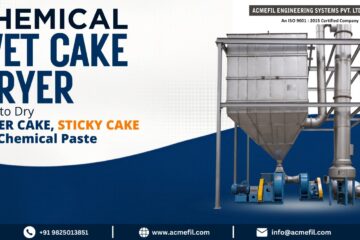
A spin flash dryer is usually the right choice when the feed is wet cake, filter cake, slimy paste, gelatinous material, pigment cake, dye intermediate or high-viscosity sludge that must be broken before it can dry properly. It is not the best dryer for every material. Spray dryers are better for atomizable liquids. Standard flash dryers are better for free-flowing powders. Fluid bed dryers are better for granular materials that can fluidize.
In drying equipment selection, I normally start with one question before looking at capacity, fuel or price:
How does the feed behave at the inlet?
That one answer often decides whether a spin flash dryer is technically suitable or whether another drying technology should be evaluated first.
Quick Answer: When Should You Choose a Spin Flash Dryer?
Choose a spin flash dryer when the material enters the dryer as a wet solid, not as a pumpable liquid or free-flowing powder.
Typical suitable feeds include:
- Wet cake from filter press
- Filter cake from dye and chemical processes
- Slimy paste
- Gelatinous material
- Pigment cake
- Agrochemical cake
- High-viscosity sludge
- Sticky chemical intermediates
- Materials that form lumps before drying
The reason is simple. A spin flash dryer combines mechanical disintegration with direct hot air drying. The disintegrator breaks the wet cake into smaller fragments as it enters the drying zone. Hot air then contacts a much larger surface area, which improves drying compared with sending a wet lump directly into a standard flash dryer.
For the basic operating mechanism, read the detailed guide on the spin flash dryer working principle.
Dryer Selection Table: Which Dryer Fits Which Feed?
| Feed condition | Better starting technology | Selection logic |
|---|---|---|
| Wet cake from filter press | Spin flash dryer | Needs lump breaking and hot air contact |
| Slimy paste or gelatinous material | Spin flash dryer | Standard flash dryer may clog or dry unevenly |
| High-viscosity sludge | Spin flash dryer, after trial | Feed system and disintegrator design are critical |
| Free-flowing powder | Flash dryer | Material already disperses in high-velocity air |
| Centrifuged cake with surface moisture | Flash dryer or spin flash dryer | Depends on lump formation and stickiness |
| Pumpable liquid or solution | Spray dryer | Feed must be atomized into droplets |
| Granular material | Fluid bed dryer | Material can fluidize in an air stream |
| Viscous concentrate from evaporator | ATFD | Indirect heat and scraper action suit thick concentrate |
| Robust bulk solid | Rotary dryer | Longer residence time may be acceptable |
| High-value oxygen-sensitive product | Vacuum dryer or closed-loop system | Lower oxygen exposure or solvent handling may be required |
This is why dryer comparison should not start with “Which dryer is best?” It should start with feed behavior, moisture target, heat sensitivity, product form and plant integration.
What Is a Spin Flash Dryer?
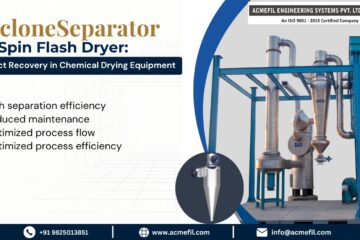
A spin flash dryer is a continuous industrial dryer used for drying wet cake, filter cake, paste and sludge-type materials. It combines a controlled feed system, lump breaker, disintegrator, hot air stream, drying chamber, cyclone separator, bag filter and discharge arrangement.
The feed is pushed into the drying zone through a feed screw. At the feed point, the disintegrator breaks the wet mass into smaller particles. Hot air immediately contacts the broken material. Moisture evaporates quickly, and the dried powder moves with the air stream toward the separation system.
The important difference is this:
A standard flash dryer depends mainly on air velocity. A spin flash dryer first solves the material dispersion problem.
That is why it is considered for difficult feeds like wet cakes, dye intermediates, pigments, agrochemical cakes and high-viscosity sludge.
Spin Flash Dryer vs Flash Dryer
A standard flash dryer is a pneumatic dryer. It works well when the feed can be carried by hot air as separate particles. It is suitable for free-flowing powder, granular material or some centrifuged cakes with surface moisture.
A spin flash dryer is selected when the feed is too sticky, lumpy or pasty for a standard flash dryer.
| Point of comparison | Spin flash dryer | Standard flash dryer |
|---|---|---|
| Best feed type | Wet cake, paste, filter cake, sludge | Powder, granular feed, free-flowing cake |
| Feed breakup | Strong disintegrator action | Limited breakup |
| Main process | Break, disperse and dry | Convey and dry |
| Clogging risk | Lower when feed system is correctly designed | Higher with sticky or lumpy feed |
| Residence behavior | Short hot air exposure after disintegration | Short pneumatic drying |
| Separation system | Cyclone and/or bag filter | Cyclone and/or bag filter |
| Better for sticky filter cake | Usually yes | Usually no |
| Better for free-flowing powder | Often unnecessary | Usually yes |
In actual plant discussions, this comparison comes up frequently. A buyer may say, “We already have a flash dryer quotation.” My next question is whether the material enters as powder or wet cake. If it enters as sticky cake, a standard flash dryer may look cheaper initially but may create inlet choking, uneven moisture and product recovery problems later.
For equipment design details, read design and operation inside spin flash dryers.
Spin Flash Dryer vs Spray Dryer
A spray dryer is not a direct substitute for a spin flash dryer. It solves a different problem.
Spray drying is used when the feed is a liquid, solution, emulsion, suspension or pumpable slurry that can be atomized into droplets. The liquid feed is sprayed into hot air, and the droplets dry into powder.
A spin flash dryer is used when the feed is already dewatered into cake, paste or sludge and cannot be atomized properly.
| Point of comparison | Spin flash dryer | Spray dryer |
|---|---|---|
| Feed form | Wet cake, paste, sludge | Liquid, solution, slurry, emulsion |
| Particle formation | Mechanical disintegration | Atomization into droplets |
| Typical inlet challenge | Lump breaking and feed consistency | Pumpability and atomization |
| Best fit | Filter cake to powder | Liquid to powder |
| Common industries | Dyes, pigments, chemicals, agrochemicals, sludge drying | Food, dairy, pharmaceuticals, chemicals, dyes |
| Trial focus | Feedability, clogging, moisture, powder separation | Droplet size, final moisture, bulk density, heat sensitivity |
If the material is still liquid and can be atomized, evaluate a spray dryer system. If the material is coming from a filter press as cake, evaluate a spin flash dryer system.
Spin Flash Dryer vs Fluid Bed Dryer
A fluid bed dryer works when air can pass through a bed of particles and fluidize them. It is effective for granular or powdery products that lift, mix and dry uniformly in the air stream.
A spin flash dryer is different. It is used before the material reaches a clean granular state. It is selected when the feed is wet, sticky, lumpy or pasty.
| Point of comparison | Spin flash dryer | Fluid bed dryer |
|---|---|---|
| Feed condition | Wet cake, paste, sludge | Granules or powder |
| Air-material contact | After mechanical breakup | Through fluidized particle bed |
| Mechanical action | Disintegrator at feed zone | Bed movement and air fluidization |
| Best use | Convert wet cake to dry powder | Final drying, cooling or controlled bed drying |
| Weak point | Not ideal for every free-flowing granular product | Not suitable if feed cannot fluidize |
| Buyer risk | Wrong disintegrator/feed design | Poor fluidization, channeling or uneven bed movement |
If the material can fluidize, a fluid bed dryer may be the better choice. If the material is still a wet cake or sticky paste, a fluid bed dryer will usually struggle at the starting condition.
Spin Flash Dryer vs ATFD
An Agitated Thin Film Dryer, or ATFD, is usually selected for viscous concentrates, slurries and thick materials where indirect heating is required. The feed is spread as a thin film on a heated surface, and scrapers continuously renew the film.
A spin flash dryer uses direct hot air after mechanical disintegration.
| Point of comparison | Spin flash dryer | ATFD |
|---|---|---|
| Heat transfer | Direct hot air contact | Indirect heated surface |
| Feed type | Wet cake, paste, sludge | Viscous concentrate or slurry |
| Mechanical action | Disintegrator breaks feed | Scraper spreads thin film |
| Common integration | After filtration or dewatering | After evaporator or MEE stage |
| Output expectation | Dry powder, depending on product behavior | Dried or semi-dried solids, depending on duty |
| Best decision factor | Feed breakup and air drying | Viscosity, heat transfer and film formation |
If the material is an evaporator concentrate, an agitated thin film dryer may be more logical. If it is a filter cake, spin flash drying may be more suitable.
Spin Flash Dryer vs Rotary Dryer
A rotary dryer is a rotating drum used for drying bulk solids. It can suit robust materials that tolerate longer residence time and mechanical tumbling.
A spin flash dryer is more relevant when the material needs fast drying after disintegration and the final product is expected as powder.
| Point of comparison | Spin flash dryer | Rotary dryer |
|---|---|---|
| Dryer layout | More compact, vertical system | Larger horizontal drum |
| Residence time | Short hot air contact | Longer drum residence |
| Feed type | Wet cake, paste, sludge | Bulk solids, minerals, granular material |
| Product sensitivity | Better where short heat exposure is useful | Better for robust materials |
| Mechanical action | High-intensity disintegration | Tumbling action |
| Common buyer mistake | Choosing it only because it is fast | Choosing it for sticky cake without feed testing |
A rotary dryer can be a strong technology for the right material. But for sticky filter cake or gelatinous feed, drum drying can create buildup and cleaning problems if the material behavior is not checked properly.
Spin Flash Dryer vs Vacuum Dryer
A vacuum dryer removes moisture under reduced pressure. It is often considered for heat-sensitive, oxygen-sensitive or high-value batch products.
A spin flash dryer is generally selected for continuous hot air drying where feed handling, evaporation load and powder discharge are the main priorities.
| Point of comparison | Spin flash dryer | Vacuum dryer |
|---|---|---|
| Operation type | Usually continuous | Usually batch |
| Pressure condition | Atmospheric hot air system | Reduced pressure |
| Oxygen exposure | Normal unless specially engineered | Lower oxygen exposure |
| Throughput logic | Continuous production | Batch control |
| Better for | Wet cake, paste, sludge where disintegration is needed | Sensitive products needing low-temperature drying |
| Key limitation | Not ideal for all oxygen-sensitive or solvent-rich products | Slower batch cycle and higher complexity |
If the product is highly sensitive to oxygen, solvent handling or temperature exposure, drying should be reviewed through safety and process trials before selecting any equipment.
Why Wet Cake Drying Needs Special Attention
Wet cake drying looks simple from outside. The plant sees a filter press discharge and assumes the dryer only has to remove moisture. But from an equipment design point of view, wet cake can behave in very different ways.
It may be:
- Crumbly
- Sticky
- Slimy
- Gelatinous
- Hard-lumped
- Thixotropic
- Abrasive
- Corrosive
- Heat-sensitive
- Dusty after partial drying
Each behavior changes the dryer design. A good spin flash dryer discussion should include the feed screw, lump breaker, disintegrator type, air temperature, air volume, cyclone, bag filter, rotary valve, cleaning access and control philosophy.
For application-level examples, read applications of spin flash dryers in key industries and the guide on spin flash dryer for sludge drying.
Cage Mill vs Pin Mill Disintegrator: Why It Matters
Spin flash dryers are not all the same. The disintegrator design has to match the material.
A cage mill type disintegrator may suit one wet cake. A pin mill type disintegrator may suit another. The decision depends on lump strength, stickiness, target particle behavior, abrasiveness and how the material reacts to mechanical impact.
| Feed behavior | Design concern |
|---|---|
| Soft wet cake | Needs controlled breakup without excessive fines |
| Sticky paste | Needs feed consistency and anti-clogging design |
| Hard lumps | Needs stronger disintegration energy |
| Abrasive pigment cake | Needs wear-resistant material selection |
| Heat-sensitive chemical cake | Needs careful air temperature and residence control |
| High-viscosity sludge | Needs trial-based feed and disintegration validation |
I would not finalize cage mill or pin mill selection from a material name alone. Two plants may call the material “pigment cake,” but one may behave like crumbly cake and another may behave like sticky paste.
When Spin Flash Drying Performs Best
Spin flash drying performs best when these conditions are present:
- The feed is a wet solid, not a liquid.
- The material forms lumps or sticky mass before drying.
- Hot air alone cannot disperse the feed properly.
- The material can tolerate mechanical disintegration.
- The dried product can be separated through cyclone and/or bag filter.
- The plant needs continuous operation instead of batch drying.
- The final product target is dry powder or dry particulate material.
Typical suitable applications include:
- Reactive dyes
- Dye intermediates
- J-Acid
- N-Methyl J-Acid
- Acetanilide
- Sulfotobias Acid
- Pigments
- Agrochemical wet cakes
- Chemical filter cakes
- High-viscosity sludge
- Wet cake from filter press discharge
When I Would Not Recommend Spin Flash Dryer First
Spin flash drying is not a universal solution.
I would not put it as the first option when:
- The feed is a liquid that can be atomized properly.
- The material is already granular and fluidizes well.
- The product needs long residence time for internal moisture movement.
- The material melts or smears during hot air contact.
- The product is highly oxygen-sensitive.
- Solvent recovery is the main requirement.
- The feed is extremely abrasive and wear risk is not acceptable.
- The final product needs a very specific particle morphology that requires atomization.
This is where honest selection matters. A wrong dryer does not only affect moisture. It affects plant uptime, product recovery, cleaning time, operator workload and long-term operating cost.
Data Required Before Selecting a Spin Flash Dryer
Before asking for a final dryer recommendation, collect the following process data.
| Required data | Why it matters |
|---|---|
| Feed source | Filter press, centrifuge, reactor discharge or sludge line changes feed handling |
| Feed form | Confirms whether it is cake, paste, sludge, slurry or powder |
| Initial moisture | Defines evaporation load |
| Target final moisture | Defines product specification |
| Bulk density | Affects feeding and separation |
| Lump size | Affects lump breaker and disintegrator design |
| Stickiness | Determines clogging risk |
| Heat sensitivity | Affects inlet and outlet temperature strategy |
| Abrasiveness | Affects material of construction and wear part design |
| Corrosiveness | Affects contact part material selection |
| Final product form | Powder, granule or dry solid changes design expectation |
| Dusting behavior | Affects cyclone and bag filter selection |
| Available fuel or heat source | Affects hot air generator selection |
| Required capacity | Defines commercial dryer sizing |
| Cleaning requirement | Affects access, shutdown and operator handling |
A properly filled process data sheet is more useful than a long equipment comparison brochure.
Why Pilot Testing Is Important
For difficult wet cake and paste drying, pilot testing can prevent expensive mistakes.
At Acmefil, the pilot facility includes spin flash dryer trial capability for evaluating whether a material can be fed, disintegrated, dried and separated properly before full-scale design. This is especially important for sticky dye intermediates, pigment cakes, agrochemical cakes and sludge.
A useful pilot trial should answer:
- Does the feed enter the screw consistently?
- Does the material bridge or choke?
- Does it break under disintegrator action?
- Does it smear, melt or deposit?
- What outlet moisture is achievable?
- Does the powder separate properly?
- Does the product degrade under heat?
- How much dust load reaches the bag filter?
- What cleaning issues appear after the run?
For many difficult feeds, the trial does not only confirm capacity. It confirms whether spin flash drying is the right route at all.
Practical RFQ Checklist for Buyers
Before sending an RFQ for a spin flash dryer, include these details:
- Product name and industry
- Feed source
- Feed form and photos, if available
- Initial moisture percentage
- Target final moisture percentage
- Feed rate
- Required evaporation load
- Bulk density
- Particle size expectation
- Material stickiness
- Heat sensitivity
- Abrasive or corrosive nature
- Solvent, odour or emission concerns
- Available utility and fuel
- Required material of construction
- Upstream equipment details
- Downstream packing or conveying requirement
- Site space limitations
- Cleaning and maintenance expectations
- Whether pilot trial is required
For a broader selection framework, read how to choose a spin flash dryer.
Operation and Maintenance Factors to Compare
A dryer should not be selected only from capital cost. Maintenance and operation matter just as much.
Compare each dryer on:
| Factor | Why it affects plant performance |
|---|---|
| Feed system reliability | Poor feeding causes unstable drying |
| Cleaning access | Sticky material can increase downtime |
| Wear parts | Disintegrators, screws and valves need inspection |
| Bag filter load | Fine powder can increase filtration load |
| Temperature control | Heat-sensitive products need stable operation |
| Operator skill | Poor operation can create moisture variation |
| Safety requirements | Dust, solvent and hot air risks need review |
| Spares availability | Downtime increases if critical spares are not planned |
| Product changeover | Multi-product plants need practical cleaning design |
For deeper plant-level guidance, refer to spin flash drying best practices for operation and spin flash dryer maintenance cost analysis.
Spin Flash Dryer vs Other Dryers: Final Comparison
| Dryer type | Best for | Not ideal for |
|---|---|---|
| Spin flash dryer | Wet cake, filter cake, paste, sludge, gelatinous feed | Atomizable liquids, already fluidizable granules |
| Flash dryer | Free-flowing powder and surface moisture removal | Sticky wet cake and paste |
| Spray dryer | Liquid feed to powder | Filter cake, paste, high-viscosity sludge |
| Fluid bed dryer | Granular materials and fluidizable powders | Wet cake that cannot fluidize |
| ATFD | Viscous concentrate and slurry after evaporation | Dry powder handling applications |
| Rotary dryer | Robust bulk solids and long residence duties | Sticky, heat-sensitive or fine chemical cakes without testing |
| Vacuum dryer | Sensitive batch materials | High-throughput continuous wet cake drying |
The best dryer is not the one with the most attractive claim. It is the one that matches the material behavior, drying duty and plant reality.
Conclusion
A spin flash dryer vs other dryers comparison should always begin with feed behavior. If the material is wet cake, filter cake, slimy paste, gelatinous feed, pigment cake, agrochemical cake or high-viscosity sludge, spin flash drying is often the correct technology to evaluate first because it combines disintegration and hot air drying in one continuous system.
If the material is a liquid, start with spray drying. If it is a free-flowing powder, start with flash drying. If it is granular and fluidizable, start with fluid bed drying. If it is a viscous concentrate from evaporation, start with ATFD. If it is oxygen-sensitive or solvent-rich, evaluate vacuum or closed-loop options carefully.
For difficult drying applications, the safest route is not assumption. It is process data, technical review and pilot validation.
To discuss a wet cake, paste, pigment, dye intermediate, agrochemical or sludge drying application, share your feed details through the Spin Flash Drying contact page or review ACMEFIL’s spin flash dryer system for equipment-level details.
FAQs
Which dryer is best for wet cake drying?
A spin flash dryer is usually the better option for wet cake drying when the material is sticky, lumpy, slimy or gelatinous. The disintegrator breaks the wet cake before hot air drying. If the cake is already free-flowing and only surface moisture has to be removed, a standard flash dryer may also be evaluated.
What is the main difference between a spin flash dryer and a flash dryer?
A standard flash dryer mainly dries and conveys free-flowing material in a hot air stream. A spin flash dryer adds a disintegrator at the feed point, which helps break wet cake, paste and high-viscosity sludge before drying.
Is a spin flash dryer better than a spray dryer?
A spin flash dryer is better for wet cake, paste, filter cake and sludge-type feeds. A spray dryer is better for liquids, solutions, emulsions and slurries that can be atomized into droplets. They are not direct substitutes.
When should I choose a fluid bed dryer instead of a spin flash dryer?
Choose a fluid bed dryer when the material is granular or powdery and can fluidize properly. Choose a spin flash dryer when the material starts as wet cake, sticky paste or lumpy sludge that must be broken before drying.
Why is pilot testing important before selecting a spin flash dryer?
Pilot testing is important because sticky, gelatinous and high-viscosity feeds behave differently under heat, air velocity and mechanical disintegration. A trial helps verify feedability, clogging risk, final moisture, powder quality, separation behavior and heat sensitivity before full-scale design.

Siddharth Nair is the Technical Director at Acmefil Engineering Systems Pvt. Ltd., an ISO 9001:2015 certified manufacturer of industrial drying and evaporation systems headquartered in Ahmedabad, Gujarat, he has led technical evaluation, application engineering and customer solution design for spray dryers, multi-effect evaporators, agitated thin film dryers, spin flash dryers and zero liquid discharge systems.