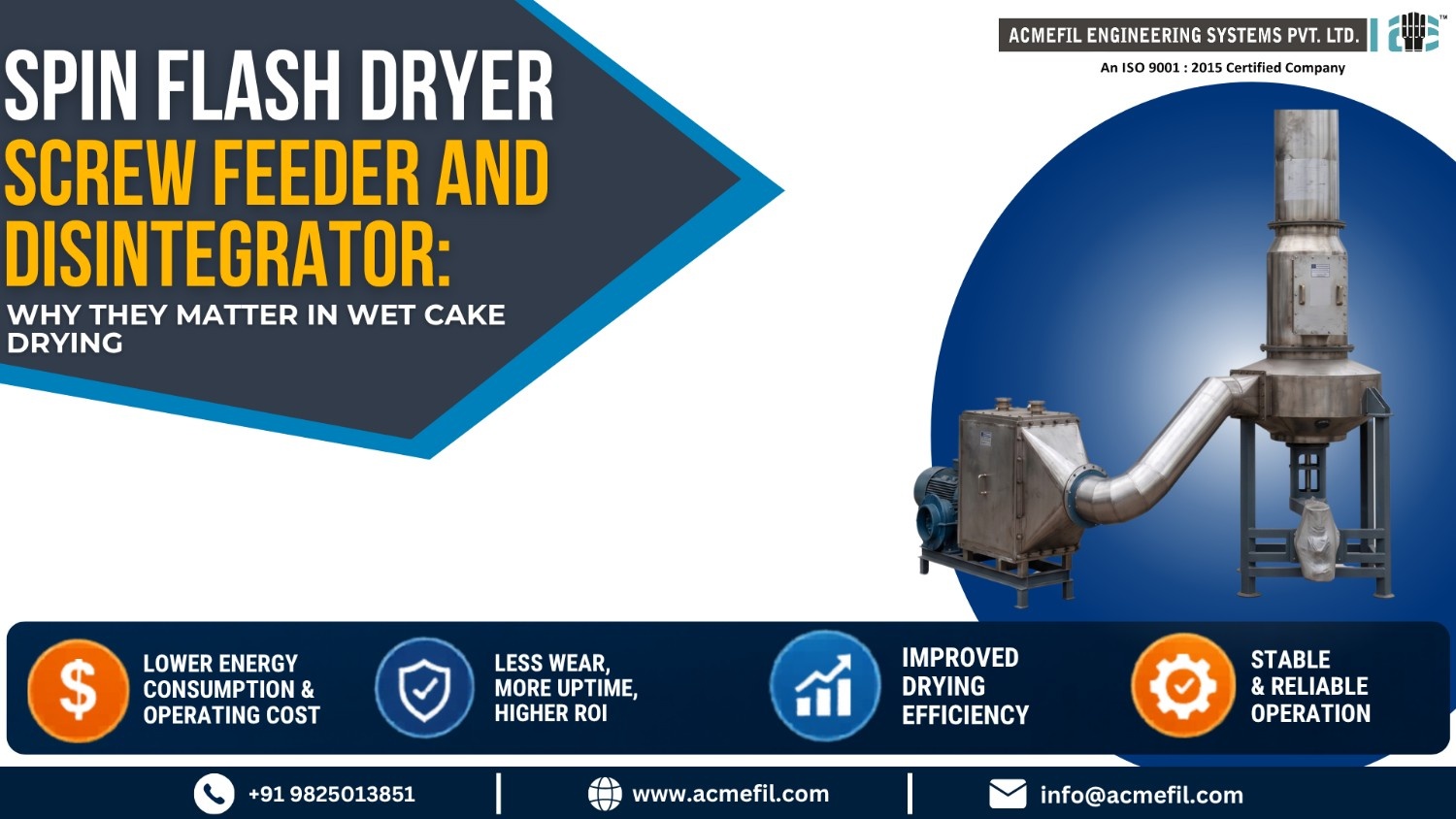
A spin flash dryer screw feeder and disintegrator decide whether wet cake drying runs smoothly or becomes a blockage problem. The screw feeder meters sticky wet cake into the dryer at a controlled rate. The disintegrator breaks the incoming lumps at the feed point so the material can contact hot air quickly. For filter cake, gelatinous paste, pigment cake, dye intermediate cake, agrochemical cake, and high-viscosity sludge, these two components are not accessories. They are central to stable drying.
In my experience, many drying problems blamed on temperature are actually feed handling problems. If the feed enters the dryer in irregular lumps, the hot air cannot dry it uniformly. One part of the material may remain wet, another part may overheat, and the plant operator keeps adjusting inlet temperature without solving the root cause.
For readers new to the system, first understand the basic spin flash dryer working principle and then look closely at the feed zone. That is where most difficult wet cake applications either succeed or fail.
Why standard flash dryers struggle with wet cake
A standard flash dryer works well when the feed is already free-flowing, granular, powdery, or easily dispersible. The material is carried by high-velocity hot air and dried during pneumatic conveying.
Wet cake behaves differently.
Filter press discharge, slimy paste, gelatinous material, and high-viscosity sludge do not naturally disperse in air. They bridge inside the feed hopper, fall into the dryer as large lumps, stick to surfaces, and create choking near the inlet. Once lumping starts, the dryer no longer sees a steady feed. It sees slugs.
That is why a spin flash dryer uses a controlled feeding arrangement and mechanical disintegration near the hot air zone. The system is designed to convert difficult wet feed into small, exposed fragments before drying takes place.
What does the screw feeder do in a spin flash dryer?
The spin flash dryer screw feeder transfers wet cake from the feed hopper into the drying chamber at a controlled and adjustable rate. Its job is not only to move material. Its real purpose is to stabilize feed delivery so the disintegrator, hot air system, and separation system receive a predictable load.
A properly selected screw feeder helps in five ways:
- It prevents sudden feed dumping into the dryer.
- It reduces feed surging from filter press cake or paste.
- It allows feed rate adjustment according to evaporation load.
- It supports consistent outlet moisture control.
- It reduces the risk of choking at the feed entry.
In sticky feed applications, I prefer to treat the screw feeder as part of the process control system, not just as a mechanical conveyor. If the screw feeder speed is wrong, the dryer will not remain stable even if the hot air generator, blower, cyclone, and bag filter are correctly sized.
Why variable speed feeding matters
A variable speed screw feeder gives the operator control over how much wet cake enters the dryer per minute. This matters because evaporation load is not only a function of wet feed quantity. It also depends on initial moisture, final moisture requirement, feed stickiness, heat sensitivity, air temperature, airflow, and residence time.
For example, two filter cakes may both look similar after filtration. One may have loose, crumbly behavior. The other may be plastic and sticky. If both are fed at the same screw speed, their drying behavior can be completely different.
Variable speed feeding helps the operator match the feed rate with real drying behavior. When outlet moisture rises, the feed rate may need correction. When the dryer runs below capacity, the feed rate may be increased carefully. When the feed starts bridging or lumping, the feed zone must be checked before assuming the dryer is undersized.
This is why feed trials are important before finalizing a full-scale system. A pilot run can show whether the wet cake flows, bridges, smears, breaks, or forms elastic lumps.
What does the disintegrator do in a spin flash dryer?
The spin flash dryer disintegrator is the rotating mechanical element that breaks wet cake, paste, or sludge lumps at the feed point. It exposes more surface area to hot air and helps convert sticky feed into smaller fragments that can dry in suspension.
Without proper disintegration, hot air only dries the outer surface of large lumps. The inside remains wet. This can lead to high final moisture, uneven product quality, product deposits, and repeated cleaning shutdowns.
A good disintegrator does three important things:
| Function | Why it matters in drying |
|---|---|
| Breaks feed lumps | Reduces large wet cake pieces before they enter the drying path |
| Increases exposed surface area | Allows hot air to remove moisture faster and more uniformly |
| Supports pneumatic movement | Helps the material travel toward the cyclone or bag filter as dried powder |
The disintegrator is the reason a spin flash dryer can handle feeds that a simple flash dryer usually cannot handle well, such as wet filter cakes, gelatinous pastes, dye intermediate cakes, pigments, agrochemical intermediates, and high-viscosity sludge.
Screw feeder vs disintegrator: different jobs, same objective
The screw feeder and disintegrator are often discussed together, but they solve different problems.
| Component | Main role | Problem it solves | What happens if it is wrong |
|---|---|---|---|
| Screw feeder | Meters wet feed into the dryer | Surging, uneven feeding, bridging, sudden overload | Outlet moisture fluctuation, choking, unstable operation |
| Lump breaker | Pre-breaks large cake pieces before final entry | Oversized filter cake lumps | High mechanical load on disintegrator, irregular feed |
| Disintegrator | Breaks wet material at high-speed contact zone | Poor dispersion, sticky agglomerates, low surface area | Wet lumps, deposits, poor drying uniformity |
| Hot air stream | Removes moisture after material is dispersed | Evaporation and pneumatic movement | Incomplete drying if feed is not properly broken |
In simple words, the screw feeder controls how much material enters. The disintegrator controls how well that material opens up for drying.
Where the lump breaker fits in the feed system
In many wet cake applications, the feed system includes a lump breaker before or near the screw feeder. Its role is to reduce large pieces coming from the filter press or centrifuge before they reach the disintegrator.
This is especially useful when the feed arrives in irregular chunks. A lump breaker reduces the load variation on the screw feeder and avoids forcing oversized cake pieces into the disintegrator. The result is more stable feeding and less chance of choking.
For a plant handling dye intermediates, pigment cake, or sludge, this small detail can make a major difference in day-to-day operation. A dryer may look well-sized on paper, but if the lump breaker and screw feeder are not matched to the actual feed behavior, the operator will fight blockages every shift.
Cage mill type vs pin mill type disintegrator
Spin flash dryers are commonly configured with cage mill type or pin mill type disintegrators. The correct selection depends on the feed’s physical behavior, not only the product name.
| Disintegrator type | Typical fit | Practical selection logic |
|---|---|---|
| Cage mill type disintegrator | Tougher wet cake, sticky lumps, heavy agglomerates | Useful when the feed needs stronger impact and repeated breaking action |
| Pin mill type disintegrator | More dispersible cakes, finer lump reduction, powder-forming materials | Useful when the feed needs rapid impact and finer dispersion |
| Trial-based selection | Uncertain, sticky, heat-sensitive, or new materials | Best when feed behavior cannot be judged reliably from a datasheet |
I would not finalize cage mill versus pin mill selection only from a material name. “Pigment cake” or “chemical wet cake” is not enough information. Moisture content, cake structure, stickiness, plasticity, abrasiveness, heat sensitivity, and desired final powder behavior all matter.
That is why pilot plant validation is useful for difficult materials. At Acmefil, spin flash dryer pilot trials are available with 10 kg/hr water evaporation capacity for process development and validation before full-scale design.
Feed behavior matters more than the keyword
Many buyers ask for a spin flash dryer for wet cake, but the dryer manufacturer needs more than the keyword “wet cake.”
Two wet cakes with the same moisture percentage can behave very differently. One may crumble easily. Another may behave like rubber. One may break into dry granules. Another may smear on the screw flights. One may dry quickly after disintegration. Another may form a sticky skin while the core remains wet.
Before selecting the screw feeder and disintegrator, these feed properties should be checked:
| Feed property | Why it matters |
|---|---|
| Initial moisture percentage | Defines water evaporation load |
| Required final moisture | Defines drying severity and outlet control |
| Stickiness and plasticity | Affects hopper flow, screw feeding, and wall deposition |
| Lump size from filter press | Affects lump breaker and disintegrator load |
| Bulk density | Affects screw feeder capacity and hopper design |
| Heat sensitivity | Affects inlet and outlet temperature strategy |
| Abrasiveness | Affects wear parts and material of construction |
| Corrosiveness and pH | Affects contact part metallurgy |
| Dusting tendency after drying | Affects cyclone, bag filter, and discharge arrangement |
For more complete design logic, read this guide on design and operation inside spin flash dryers.
How poor screw feeder selection affects dryer performance
A weak or poorly matched screw feeder can create several operational problems.
The first problem is bridging in the feed hopper. Sticky wet cake may stop flowing downward even when the screw is rotating. The operator sees feed starvation, then sudden collapse of material into the screw. This creates unstable dryer loading.
The second problem is smearing. Some pastes do not move cleanly through a standard screw. They smear, compact, or rotate with the screw instead of moving forward. This reduces feeding accuracy.
The third problem is overfeeding. If too much wet cake enters the dryer, the hot air system cannot evaporate the moisture at the required rate. Outlet moisture rises. The product may remain wet or form deposits.
The fourth problem is underfeeding. If feed is too low, the dryer may run hot, product quality may vary, and energy use per kg of dried product may become inefficient.
The screw feeder should therefore be selected with the same seriousness as the dryer body. It must match the actual feed, not only the rated capacity.
How poor disintegrator selection affects final powder quality
The disintegrator directly affects drying uniformity. If it is undersized or unsuitable, the dryer may produce powder with wet particles, hard lumps, sticky deposits, or inconsistent moisture.
Common signs of disintegrator-related problems include:
- Large wet particles in the product discharge
- Material build-up near the feed zone
- Frequent choking after wet cake feeding
- High variation in final moisture
- More load on the downstream bag filter
- Higher cleaning frequency
- Product that looks dry outside but contains wet cores
When this happens, increasing the inlet temperature is not always the correct solution. Higher temperature may dry the outer surface faster, but it will not fix poor disintegration inside large wet lumps. The mechanical feed zone must be checked first.
Why the feed zone controls residence time
Spin flash drying is a short residence time drying process. That short residence time is useful only when the material is properly dispersed. If the wet cake enters as large lumps, residence time becomes uneven. Small particles dry quickly. Large lumps remain wet.
The screw feeder and disintegrator help create a more uniform particle exposure pattern. That allows the hot air stream to contact the material more consistently and carry dried particles toward separation.
This is one reason spin flash dryers are useful for heat-sensitive materials. The product does not need to remain inside the hot air path for a long period when the feed is properly broken and dispersed.
Where cyclone and bag filter performance enters the discussion
The feed system affects dust collection too. When wet cake is properly disintegrated and dried, the product can move toward the cyclone and bag filter in a more predictable way. When lumps break irregularly, the separation load becomes unstable.
Very fine product may increase bag filter load. Poorly dried sticky particles may blind filter bags. Large particles may increase product inconsistency. So the feed zone, dryer body, cyclone, bag filter, and discharge system must be considered as one drying plant, not separate pieces.
For a deeper operational view, see spin flash drying best practices for operation.
Materials where screw feeder and disintegrator design becomes critical
The screw feeder and disintegrator become especially important in materials that are wet, sticky, gelatinous, or difficult to disperse.
Common examples include:
- Filter press cake from dye and pigment plants
- Reactive dye intermediates
- J-Acid and N-Methyl J-Acid cake
- Acetanilide cake
- Sulfotobias Acid cake
- Agrochemical wet cake
- Pigment cake
- High-viscosity sludge
- ETP sludge where spin flash drying is technically suitable
- Gelatinous chemical paste
- Sticky inorganic chemical wet cake
Not every material in this list will behave the same way. That is why the RFQ should include actual feed data, sample photographs, moisture analysis, and trial requirements where possible.
RFQ checklist for spin flash dryer screw feeder and disintegrator selection
Before asking for a quotation, prepare these details. It helps the dryer manufacturer size the feed system more realistically.
| RFQ detail | What to provide |
|---|---|
| Material name | Chemical/product name and application industry |
| Feed source | Filter press, centrifuge, reactor discharge, sludge handling system |
| Wet feed rate | kg/hr of wet material |
| Initial moisture | Percentage moisture before drying |
| Final moisture | Required moisture after drying |
| Cake behavior | Crumbly, sticky, plastic, slimy, gelatinous, abrasive, corrosive |
| Lump size | Typical and maximum lump size after filtration |
| Heat sensitivity | Any product degradation risk at high temperature |
| Bulk density | Wet and dry bulk density if available |
| Operating hours | Batch or continuous operation, hours per day |
| Contact metallurgy | MS, SS304, SS316, or special requirement if known |
| Dust control need | Cyclone, bag filter, emission control, clean operation requirement |
| Trial requirement | Whether pilot validation is required before full-scale design |
For broader procurement guidance, use this article on how to choose a spin flash dryer.
Practical design questions buyers should ask
When you discuss the screw feeder and disintegrator with a manufacturer, ask direct questions.
- How will the feed hopper prevent bridging?
- Is the screw feeder variable speed?
- Is a lump breaker included before the feed enters the dryer?
- Which disintegrator type is proposed, cage mill or pin mill?
- Why is that disintegrator suitable for this specific wet cake?
- What data is needed to confirm feed rate and evaporation load?
- Can the material be tested in a pilot spin flash dryer?
- How will cyclone and bag filter sizing handle the dried powder?
- What contact material is recommended for corrosive or abrasive feed?
- What operating checks should plant operators follow during startup?
These questions quickly separate a serious technical proposal from a generic dryer quotation.
Why pilot testing is the safest route for difficult wet cakes
Some feeds cannot be judged properly from a datasheet. Sticky behavior, lump formation, smearing, wall deposition, and drying response become clear only during a trial.
Pilot testing helps confirm:
- Whether the wet cake can be fed smoothly
- Whether the screw feeder can maintain stable feed rate
- Whether a lump breaker is required
- Whether cage mill or pin mill disintegration is more suitable
- Whether the product dries to the required final moisture
- Whether the powder separates cleanly in downstream equipment
- Whether the process is suitable for scale-up
ACMEFIL’s in-house R&D facility includes pilot equipment for spin flash drying with 10 kg/hr water evaporation capacity. For new products, this is a practical way to reduce risk before purchasing full-scale drying equipment.
Common mistakes in screw feeder and disintegrator selection
The most common mistake is asking only for dryer capacity and ignoring feed behavior. A dryer cannot be selected correctly without knowing how the wet cake moves, breaks, and dries.
The second mistake is assuming that a higher inlet temperature will solve wet lumps. It may not. If wet cake is not mechanically dispersed, temperature alone cannot create uniform drying.
The third mistake is choosing a disintegrator type without testing difficult material. Cage mill and pin mill designs have different breaking behavior. The right answer depends on the feed.
The fourth mistake is underestimating downstream dust collection. A dryer that creates too many fines or sticky particles can overload the bag filter or increase cleaning frequency.
The fifth mistake is not sharing real samples or photographs. A process engineer can learn a lot from seeing the actual cake coming out of the filter press.
Conclusion
A spin flash dryer screw feeder controls the feed rate. The spin flash dryer disintegrator controls the breakup of wet cake at the drying point. Together, they decide whether sticky filter cake, paste, dye intermediate cake, pigment cake, agrochemical cake, or high-viscosity sludge can be dried consistently.
For easy-flowing material, a standard flash dryer may be enough. For wet cake and gelatinous feed, the feed zone becomes the heart of the system. The right screw feeder, lump breaker, and disintegrator reduce choking, improve hot air contact, stabilize final moisture, and make the dryer easier to operate.
Before finalizing a spin flash dryer quotation, test the feed behavior properly. Share moisture data, lump size, stickiness, final moisture target, and operating requirement. For difficult materials, pilot trials are the safest way to confirm the screw feeder and disintegrator selection before full-scale investment.
FAQs
What is the role of a screw feeder in a spin flash dryer?
A screw feeder meters wet cake, paste, or sludge into the spin flash dryer at a controlled rate. In difficult feed applications, it helps reduce surging, supports stable evaporation load, and allows feed rate adjustment based on drying performance.
Why is a disintegrator used in a spin flash dryer?
A disintegrator breaks wet cake lumps at the feed point so the material can expose more surface area to hot air. This helps prevent wet cores, sticky deposits, uneven final moisture, and choking near the dryer inlet.
Which is better, cage mill or pin mill disintegrator?
Neither is universally better. Cage mill type disintegrators are commonly considered for tougher lumps and heavier wet cake. Pin mill type disintegrators are commonly considered where finer impact and dispersion are suitable. The correct choice depends on feed stickiness, lump size, moisture, abrasiveness, and trial results.
Can a spin flash dryer handle filter press cake directly?
A spin flash dryer can handle many types of filter press cake when the feed system is designed correctly. The screw feeder, lump breaker, and disintegrator must be matched to the cake’s moisture, stickiness, lump size, and drying target.
Why does my spin flash dryer choke near the feed inlet?
Choking near the feed inlet is often caused by uneven feeding, oversized wet cake lumps, sticky feed behavior, poor screw feeder selection, or insufficient disintegration. Temperature should not be adjusted blindly until the feed zone is inspected.

Siddharth Nair is the Technical Director at Acmefil Engineering Systems Pvt. Ltd., an ISO 9001:2015 certified manufacturer of industrial drying and evaporation systems headquartered in Ahmedabad, Gujarat, he has led technical evaluation, application engineering and customer solution design for spray dryers, multi-effect evaporators, agitated thin film dryers, spin flash dryers and zero liquid discharge systems.