A spin flash dryer is worth considering when the feed is a wet cake, filter cake, sticky paste, gelatinous material, or high-viscosity sludge that cannot disperse properly in a standard flash dryer. But the real cost is not only the purchase price. The real cost depends on feed behavior, disintegrator wear, hot air system efficiency, bag filter condition, manpower, cleaning frequency, spare parts, downtime and product rejection.
In my experience, many buyers ask, “What is the cost of a spin flash dryer?” too early. The better question is, “What will this dryer cost to operate reliably for my material?”
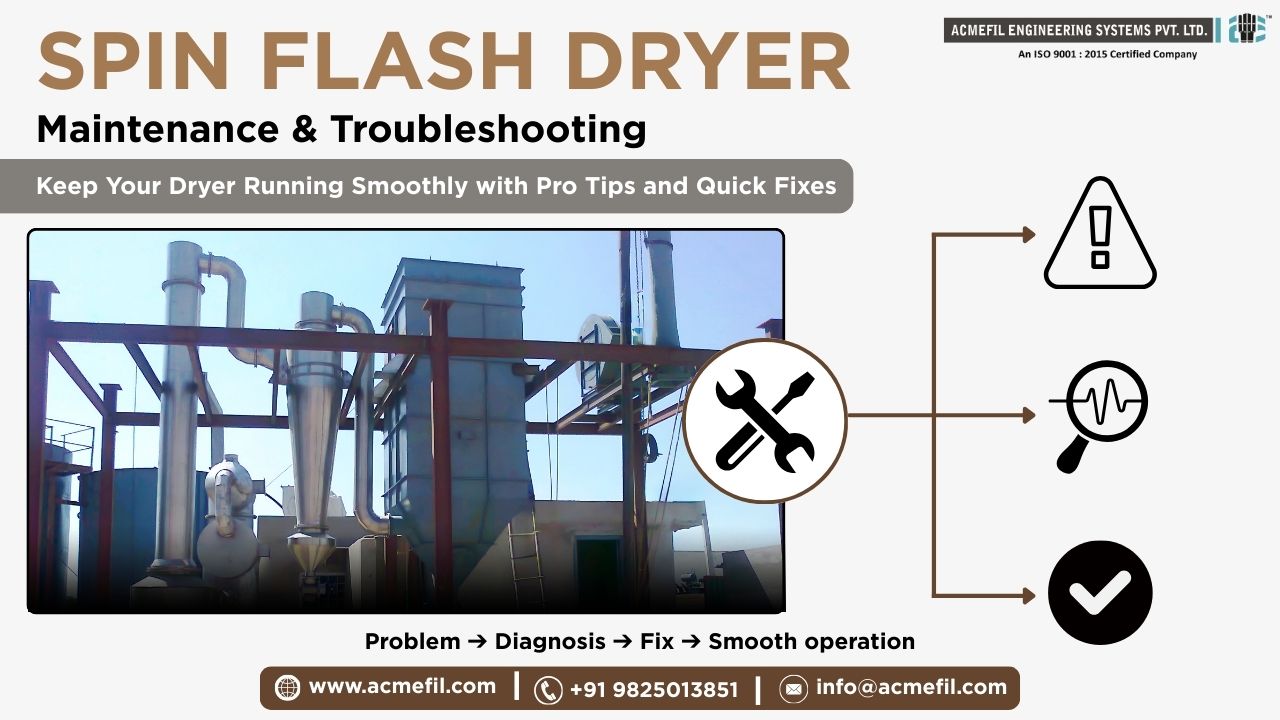
This guide explains spin flash dryer maintenance, troubleshooting and cost analysis from a practical plant-engineering point of view.
What Makes Spin Flash Dryer Maintenance Different?
A normal flash dryer works well when the material can disperse easily in high-velocity hot air. A spin flash dryer is different because it handles difficult feed forms.
Typical materials include:
- Wet cake from filter press discharge
- Slimy paste
- Gelatinous material
- High-viscosity sludge
- Dye intermediates
- Reactive dyes
- Pigments
- Agrochemical intermediates
- Filter cakes that form lumps during feeding
The most maintenance-sensitive area is the feed and disintegration zone. The feed screw, lump breaker, cage mill or pin mill disintegrator, air inlet, drying chamber bottom and product discharge system must work together. If one area is neglected, the dryer may still run, but moisture variation, choking, vibration or high power consumption will start appearing.
For the basic process mechanism, refer to this guide on spin flash dryer working principle. For design-level selection, the spin flash dryer manufacturer page by Acmefil gives additional equipment context.
Main Cost Drivers in a Spin Flash Dryer
A spin flash dryer cost analysis should include both capital cost and operating cost. Purchase price alone is not enough.
| Cost Driver | Why It Matters | What to Check Before Buying |
|---|---|---|
| Feed moisture | Higher water evaporation load increases dryer size, hot air load and fuel use | Initial moisture, final moisture target, hourly feed rate |
| Feed stickiness | Sticky feed increases choking risk and cleaning frequency | Cake texture, lump size, tackiness, temperature sensitivity |
| Disintegrator type | Cage mill and pin mill designs behave differently with different materials | Wet cake behavior, desired particle breakup, wear risk |
| Material abrasiveness | Abrasive pigments and minerals increase wear on pins, blades, ducts and bends | Particle hardness, silica/mineral content, expected run hours |
| Corrosion tendency | Acidic or chemical feeds may require better metallurgy | pH, chloride content, solvent traces, cleaning chemicals |
| Hot air system | Fuel cost is a major operating cost in thermal drying | Direct or indirect hot air generator, fuel type, inlet temperature |
| Dust collection | Poor cyclone or bag filter performance increases powder loss and maintenance | Particle size, fines load, bag material, pressure drop |
| Automation level | Better controls reduce operator error but increase instrumentation cost | Temperature, feed rate, airflow and interlock requirements |
| Maintenance access | Bad access increases downtime during cleaning and inspection | Doors, platforms, inspection ports, filter access, bearing access |
| Pilot validation | Trials reduce the risk of wrong sizing and wrong disintegrator selection | Run trial with actual feed whenever material behavior is uncertain |
The lowest quotation is not always the lowest-cost system. A dryer that chokes twice a week, consumes excess fuel, or produces off-spec moisture can become expensive even if the initial price looks attractive.
What Should Be Included in Spin Flash Dryer Cost Analysis?
A proper spin flash dryer maintenance cost analysis should include these cost buckets:
| Cost Bucket | Include These Items |
|---|---|
| Equipment cost | Dryer body, feed screw, disintegrator, hot air generator, cyclone, bag filter, rotary valve, ducting, control panel |
| Installation cost | Foundation, platform, electrical wiring, duct connection, utility connection, insulation, commissioning |
| Utility cost | Fuel, electrical load, compressed air if used, process air handling |
| Maintenance cost | Bearings, seals, belts or couplings, lubrication, disintegrator wear parts, gaskets, filter bags |
| Cleaning cost | Manpower, downtime, cleaning chemicals, production changeover time |
| Downtime cost | Lost production hours, emergency maintenance, delayed dispatches |
| Quality loss | Product rejection due to moisture variation, overheating, contamination or particle size inconsistency |
| Safety and compliance cost | Dust control, interlocks, earthing, exhaust handling, housekeeping |
| Training cost | Operator training, maintenance training, SOP development |
| Upgrade cost | Future automation, hot air generator upgrade, bag filter improvement, material-of-construction changes |
For serious procurement, create a 3-year or 5-year total cost sheet. This gives a clearer picture than comparing only two vendor quotations.
Daily Maintenance Checklist for Spin Flash Dryers
Daily maintenance is not complicated, but it must be disciplined. Most avoidable failures start with small signs that operators ignore.
Use this shift-level checklist:
| Area | Daily Check | Why It Matters |
|---|---|---|
| Feed hopper and screw feeder | Check bridging, lumps, abnormal load and feed fluctuation | Prevents choking at dryer entry |
| Lump breaker or disintegrator | Listen for abnormal noise, rubbing or vibration | Early warning of wear, imbalance or buildup |
| Inlet and outlet temperature | Record trend, not just one reading | Moisture control depends on temperature stability |
| Airflow and pressure | Check draft, airflow indication and abnormal pressure drop | Low airflow causes wet product and buildup |
| Cyclone separator | Check powder discharge and leakage | Poor discharge increases carryover and blockage |
| Bag filter | Monitor differential pressure | High pressure drop indicates bag blinding or moisture condensation |
| Rotary air lock valve | Check smooth rotation and leakage | Air leakage affects separation and system balance |
| Product moisture | Compare actual moisture with target | Detects feed or process drift early |
| Dust leakage | Inspect joints, doors and duct flanges | Dust leakage affects safety, hygiene and product recovery |
| Motor load | Track unusual current variation | Indicates overload, buildup or mechanical resistance |
A daily log is important. Without trend data, maintenance becomes guesswork.
Weekly and Monthly Maintenance Plan
Weekly and monthly checks should go deeper than daily observation.
Weekly Maintenance
- Clean feed screw, hopper and feed transition points.
- Inspect disintegrator pins, cage, blades or arms for buildup.
- Check coupling, belt, guard, motor alignment and foundation bolts.
- Inspect lubrication points and bearing temperature.
- Clean inspection windows and sight glasses if provided.
- Check bag filter pulse cleaning operation.
- Inspect ducting for powder deposits.
- Verify emergency stop and key interlocks.
- Review product moisture trend for the week.
Monthly Maintenance
- Conduct vibration check on rotating components.
- Inspect disintegrator wear more closely.
- Check screw feeder flights for wear or deformation.
- Inspect hot air generator, burner or heater section.
- Check insulation condition.
- Inspect cyclone cone, bends and product discharge area for erosion.
- Inspect bag filter bags, cages and pulse headers.
- Calibrate key temperature and pressure instruments.
- Review spare parts consumption.
- Review energy consumption per kg of water evaporated, if metering is available.
The interval should be adjusted based on duty. A dryer running abrasive pigment 20 hours per day cannot follow the same maintenance interval as a dryer running a mild organic filter cake for one shift.
Shutdown Maintenance Checklist
Planned shutdown is the right time to inspect the parts that cannot be checked properly during operation.
| Component | What to Inspect | Risk If Ignored |
|---|---|---|
| Disintegrator assembly | Pins, cage, blades, clearance, wear pattern, balance | Vibration, poor breakup, high power load |
| Feed screw | Flights, shaft, liner, seals, drive | Feed fluctuation, choking, leakage |
| Dryer bottom | Material buildup, erosion, corrosion | Choking, contamination, uneven drying |
| Hot air inlet | Deposits, refractory condition, insulation, leakage | Poor drying, hot spots, fuel waste |
| Cyclone | Cone wear, air leakage, powder discharge | Product loss, dust carryover |
| Bag filter | Bag condition, cage condition, pulse valves, hopper discharge | High pressure drop, dust emission |
| Rotary valve | Blade wear, clearance, sealing | Air leakage, product backflow |
| Bearings and seals | Temperature history, lubrication, leakage | Sudden breakdown |
| Electrical panel | Loose terminals, overload history, control health | Tripping, unsafe operation |
| Safety systems | Interlocks, earthing, emergency stop, guards | Operator and plant safety risk |
Do not use shutdown only for cleaning. Use it for root-cause inspection.
Common Spin Flash Dryer Problems and Troubleshooting
Troubleshooting should start from the material and process data, not only from the machine.
| Problem | Likely Causes | Corrective Action |
|---|---|---|
| Feed choking at inlet | Large lumps, sticky cake, incorrect feed screw speed, worn disintegrator, poor hopper design | Reduce lump size, tune screw speed, inspect disintegrator, check feed consistency |
| Product moisture too high | High feed rate, low inlet temperature, low airflow, high feed moisture, poor disintegration | Reduce feed rate, check hot air system, verify airflow, inspect disintegrator |
| Product is overheated or discolored | Outlet temperature too high, feed interruption, excessive residence time, hot spots | Stabilize feed, check temperature control, inspect air distribution |
| Dryer vibration | Buildup on rotor, bearing wear, misalignment, damaged pins or cage | Stop and inspect, clean rotor, check bearings and balancing |
| High bag filter pressure drop | Wet fines, moisture condensation, blinded bags, poor pulse cleaning | Check outlet temperature, inspect bags, verify pulse air, clean or replace bags |
| Low product recovery | Cyclone leakage, rotary valve leakage, fine particles escaping, bag filter issue | Check seals, inspect cyclone, check bag filter condition |
| High fuel consumption | Air leakage, high feed moisture, poor insulation, wrong airflow, fouled hot air generator | Seal leaks, check feed data, inspect insulation, tune combustion |
| Frequent cleaning required | Feed too sticky, wrong inlet conditions, poor disintegration, material melting or softening | Run feed trial, adjust temperature profile, review dryer design |
| Product contamination | Worn contact parts, poor cleaning, damaged filter bags, external air ingress | Inspect contact parts, improve cleaning SOP, replace filter bags |
| Motor overload | Excess feed, material buildup, mechanical restriction, bearing issue | Reduce feed, clean dryer, inspect drive and bearings |
A spin flash dryer is not a “set and forget” machine. Once the feed moisture, feed texture or upstream filter press performance changes, the dryer behavior also changes.
Cost Impact of Poor Maintenance
Poor maintenance usually increases cost in four ways.
Higher Energy Cost
If the bag filter is choked, airflow drops. If airflow drops, operators often increase temperature or reduce throughput to maintain final moisture. Both choices cost money.
If insulation is damaged, heat loss increases. If air leaks enter the system, the hot air generator must heat extra air that does not contribute to drying.
Higher Spare Parts Cost
When vibration is ignored, one worn component can damage other parts. A small disintegrator wear issue can become a shaft, bearing or motor issue.
Higher Downtime Cost
Unplanned shutdown is always more expensive than planned maintenance. It affects production planning, dispatch commitment and manpower allocation.
Higher Quality Loss
Moisture variation creates rejected batches. Overheated material may lose color, flow behavior or active performance depending on the product. For dyestuff, pigments, chemicals, food ingredients or pharmaceutical intermediates, quality loss can be more expensive than the maintenance job itself.
When Is a Spin Flash Dryer Worth the Investment?
A spin flash dryer is worth evaluating when the material has one or more of these conditions:
- It comes from a filter press as wet cake.
- It is slimy, sticky or paste-like.
- It forms lumps during feeding.
- It needs rapid drying with short heat exposure.
- It cannot be handled reliably in a simple flash dryer.
- Manual tray or batch drying creates high labour and inconsistent quality.
- The plant needs continuous drying instead of batch handling.
- The final product must become dry powder with controlled moisture.
It may not be the right first choice when:
- The product is already free-flowing and granular.
- The feed is a low-solids liquid better suited to spray drying.
- The product needs agglomeration or granulation behavior better suited to fluid bed drying.
- The batch size is too small to justify continuous drying.
- The material is highly heat sensitive and cannot tolerate the required drying temperature, even for short exposure.
For technology comparison, this page on comparing spin flash dryers vs other drying technologies can help buyers shortlist the right dryer family.
Spin Flash Dryer vs Standard Flash Dryer in Maintenance Cost
| Factor | Standard Flash Dryer | Spin Flash Dryer |
|---|---|---|
| Best feed form | Free-flowing powders, granules, centrifuged cakes that disperse easily | Wet cake, sticky paste, gelatinous material, high-viscosity sludge |
| Main maintenance focus | Airflow, ducting, cyclone, bag filter, feeder | Feed screw, disintegrator, airflow, cyclone, bag filter, rotary valve |
| Choking risk | Lower for free-flowing feed, higher if wet cake is forced into it | Lower when designed correctly for wet cake, but feed zone must be maintained |
| Wear parts | Duct bends, feeder, cyclone, filter bags | Disintegrator pins/cage/blades, feed screw, duct bends, cyclone, filter bags |
| Operator sensitivity | Moderate | Higher, because feed consistency strongly affects dryer performance |
| Cost mistake | Using it for sticky feed | Wrong disintegrator design or insufficient feed testing |
| Best buying decision | Use when feed disperses easily | Use when the feed needs mechanical breakup before drying |
This is why a standard flash dryer and a spin flash dryer should not be compared only by price. They solve different feed-handling problems.
How to Reduce Spin Flash Dryer Maintenance Cost
Match the Dryer to the Actual Feed
Do not size the dryer based only on material name. “Pigment wet cake” or “sludge” is not enough. Two materials with the same name can behave differently depending on particle size, filtration method, moisture, stickiness and temperature sensitivity.
Collect:
- Material name and process source
- Feed moisture percentage
- Required final moisture
- Wet cake texture
- Lump size
- Bulk density
- Abrasiveness
- Corrosiveness
- Heat sensitivity
- Expected operating hours per day
- Required evaporation rate
- Cleaning restrictions
- Utility availability
Use Pilot Trials for Difficult Materials
For uncertain wet cake, paste or sludge behavior, a pilot trial is better than assumption-based sizing. Acmefil has in-house pilot plant capability for spin flash dryer trials with 10 kg/hr water evaporation capacity. This is especially useful when the buyer is not sure whether the material will disperse, choke, smear, melt or dry cleanly.
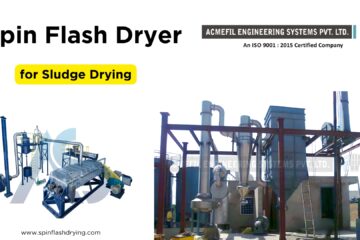
You can also use the spin flash dryer for sludge drying guide when evaluating high-viscosity sludge applications.
Keep Feed Consistent
The dryer cannot compensate for unstable upstream filtration forever. If the filter press discharge moisture changes widely, the dryer outlet moisture will also become difficult to control.
A good maintenance plan should include communication between:
- Filter press operator
- Dryer operator
- Maintenance team
- Quality control team
- Utility operator
Maintain the Bag Filter Properly
Bag filter neglect is a common hidden cost. High differential pressure affects airflow. Poor airflow affects drying. Wet exhaust can blind filter bags. Dust leakage creates housekeeping and safety issues.
Check bag filter pressure trend, pulse cleaning, hopper discharge and bag condition routinely.
Maintain the Hot Air Generator
The hot air generator affects fuel cost, drying stability and safety. Poor combustion, damaged insulation or unstable temperature control will increase cost even if the dryer body is mechanically sound.
For support equipment selection, Acmefil also offers hot air generator systems for industrial drying applications.
Build a Critical Spare Parts List
Do not wait for failure to identify spares.
Typical critical spares may include:
- Disintegrator pins, cage or blades
- Bearings
- Seals and gaskets
- Feed screw wear parts
- Coupling or belt parts
- Filter bags
- Rotary valve parts
- Temperature sensors
- Pressure switches or transmitters
- Pulse valves for bag filter
- Motor protection components
For ACMEFIL equipment owners, the genuine spare parts page is the relevant support reference.
Simple Spin Flash Dryer ROI Framework
You do not need a complicated financial model at the first stage. Start with this structure.
Step 1: Calculate Current Drying Cost
Include:
- Current labour cost
- Current fuel and electricity cost
- Current batch drying time
- Rejection cost
- Rework cost
- Manual handling cost
- Floor space used
- Dust and housekeeping cost
- Maintenance cost of existing drying method
Step 2: Estimate New Spin Flash Dryer Operating Cost
Include:
- Fuel consumption
- Electrical load
- Operator requirement
- Planned maintenance
- Spare parts
- Cleaning time
- Bag filter maintenance
- Hot air generator maintenance
- Expected uptime
- Product recovery
Step 3: Calculate Commercial Benefit
Potential benefits may come from:
- Faster drying
- More consistent final moisture
- Continuous operation
- Reduced manual handling
- Cleaner working area
- Lower rework
- Lower batch dependency
- Better fit for filter press discharge
Do not assume savings blindly. Validate them against plant data and trial results.
Step 4: Compare Total Cost, Not Only Price
The right comparison is not:
“Vendor A price vs Vendor B price.”
The right comparison is:
“Which system gives lower cost per kg of dried product at required moisture and quality, over the operating life of the plant?”
That is the number that matters.
RFQ Checklist for Spin Flash Dryer Maintenance and Cost Analysis
Before asking for quotation, send complete data. A vague RFQ leads to vague pricing and hidden scope gaps.
| RFQ Data Point | Why It Matters |
|---|---|
| Material name and process source | Helps identify material behavior and industry context |
| Feed form | Wet cake, paste, sludge, slurry or granular feed |
| Feed moisture | Determines water evaporation load |
| Final moisture target | Defines drying duty |
| Feed rate | Determines capacity |
| Operating hours | Affects sizing, duty and maintenance frequency |
| Feed temperature | Affects heat load |
| Heat sensitivity | Determines safe operating temperature window |
| Abrasion and corrosion data | Determines metallurgy and wear protection |
| Lump size | Affects feed screw and disintegrator design |
| Available fuel | Affects hot air generator design |
| Available electrical supply | Affects motor and panel planning |
| Dust control requirement | Affects cyclone and bag filter sizing |
| Space layout | Affects installation and maintenance access |
| Cleaning requirement | Affects access doors, CIP need and shutdown planning |
| Automation expectation | Affects control panel, instruments and interlocks |
| Trial requirement | Reduces risk for difficult feed |
For selection-stage reading, use this guide on how to choose a spin flash dryer.
Maintenance Mistakes That Increase Cost
Mistake 1: Ignoring Feed Variation
If feed moisture and cake texture change every shift, the dryer will need constant correction. Stabilize upstream filtration first.
Mistake 2: Running With Worn Disintegrator Parts
The disintegrator is not just a mechanical part. It controls breakup, surface area and drying behavior. Worn pins or blades can cause wet product, vibration and higher energy consumption.
Mistake 3: Treating Bag Filter Pressure Drop as a Minor Issue
A rising pressure drop changes the whole airflow balance. It affects moisture, fuel use and product recovery.
Mistake 4: Cleaning Only After Choking
Cleaning should be preventive. If the plant cleans only after choking, maintenance is already reactive.
Mistake 5: Buying Without Trial for Difficult Material
For sticky, slimy or gelatinous materials, a trial can prevent a wrong full-scale purchase. The cost of a failed dryer selection is much higher than the cost and time of process validation.
Practical Maintenance Schedule Summary
| Frequency | Maintenance Focus |
|---|---|
| Every shift | Feed behavior, temperature, pressure drop, sound, vibration, product moisture |
| Daily | Feed screw, hopper, disintegrator sound, dust leakage, rotary valve, product discharge |
| Weekly | Feed system cleaning, lubrication, belt or coupling check, pulse cleaning check |
| Monthly | Vibration check, instrument check, hot air generator inspection, cyclone and bag filter inspection |
| Quarterly | Disintegrator wear inspection, duct inspection, screw feeder inspection, safety interlock testing |
| Annual shutdown | Full mechanical inspection, balancing if required, bearing review, control calibration, structural inspection |
This table is a starting point. Final intervals should be based on material behavior, duty hours, plant environment and OEM recommendations.
FAQs
What is included in spin flash dryer maintenance cost?
Spin flash dryer maintenance cost includes planned inspection, cleaning, lubrication, disintegrator wear parts, feed screw maintenance, bearings, seals, filter bags, rotary valve parts, hot air generator maintenance, instrumentation calibration and downtime planning. For abrasive or sticky materials, disintegrator and feed-zone maintenance usually become more important.
Why does a spin flash dryer choke during operation?
A spin flash dryer may choke because the wet cake has large lumps, the feed screw speed is wrong, the material is too sticky, the disintegrator is worn, airflow is insufficient, or the bag filter pressure drop is too high. The root cause should be checked from feed condition, mechanical breakup and air balance together.
Is a spin flash dryer cheaper than a spray dryer?
It depends on the feed and process requirement. A spin flash dryer can be more suitable for filter cake, paste, sludge and wet cake applications. A spray dryer is generally used for liquid feed that must be atomized into droplets. Comparing them only by price is incorrect because the feed form and drying mechanism are different.
How often should a spin flash dryer be serviced?
Basic checks should be done every shift or daily. Deeper checks should be weekly, monthly, quarterly and during annual shutdown. The exact interval depends on operating hours, material abrasiveness, stickiness, corrosion risk, product sensitivity and plant duty cycle.
How can I reduce spin flash dryer operating cost?
Stabilize feed moisture, maintain the disintegrator, monitor bag filter pressure drop, prevent air leakage, maintain the hot air generator, train operators and use process trials for difficult material before finalizing full-scale design. The biggest cost reduction usually comes from preventing choking, reducing rejection and improving uptime.
Conclusion
Spin flash dryer maintenance and cost analysis should start with the material, not with the machine price. If your feed is a wet cake, sticky paste, gelatinous product or high-viscosity sludge, the dryer must be selected and maintained around feed breakup, hot air contact, product separation and dust control.
A good spin flash dryer can reduce drying difficulty when the application is correct. A poorly selected or poorly maintained dryer can create choking, high fuel use, moisture variation and frequent shutdowns.
Before finalizing a spin flash dryer, share your feed properties, moisture target, capacity requirement, operating hours and utility details. For uncertain materials, ask for a pilot trial before full-scale procurement.
For technical discussion, visit the Spin Flash Drying contact page or review Acmefil’s AMC services for industrial dryers and evaporators if your priority is lifecycle reliability.

Siddharth Nair is the Technical Director at Acmefil Engineering Systems Pvt. Ltd., an ISO 9001:2015 certified manufacturer of industrial drying and evaporation systems headquartered in Ahmedabad, Gujarat, he has led technical evaluation, application engineering and customer solution design for spray dryers, multi-effect evaporators, agitated thin film dryers, spin flash dryers and zero liquid discharge systems.